
The Astonishing Love Story of Isabel de Godín
Twenty years apart, a crossing of the Andes and the Amazon, and almost her entire party dead. The story of the woman who crossed half a continent to be reunited with her husband.
This whole story actually begins with Sir Isaac Newton and his Laws of Motion, which caused quite a stir worldwide and allowed the scientists of the world to become a sort of sorcerers and predict things. Among those things, Newton himself had predicted that the Earth was not a perfect sphere, but rather flattened at the poles and stretched at the equator. So the French set themselves the task of proving it.
Let us remember that Newton was English, and the reputable French Academy of Sciences could not allow an Englishman to shine across the world without first putting up a fight, so the prediction had to be corroborated and they assembled every resource needed to do it.
They sent two teams of scientists: one to the North Pole and another to the Republic of Ecuador (which did not yet bear that name). It was expected that the North Pole team would finish its mission last, since the calamities of reaching the harsh North Pole sound far more severe than those of traveling to the equator — but it turned out the opposite, and by a wide margin. Europeans of the time (and this continues to this day) do not understand how Hispanic society works or its bureaucratic procedures. We must also remember that the Spanish colonizers of the day placed every kind of obstacle in the French expedition's way, fearing the whole thing was a ruse to spy on their colonial "secrets".
The point is that it was in 1735 when the scientific expedition led by Charles-Marie de La Condamine arrived in the country to measure the terrestrial meridian and contribute to the study of the shape and dimensions of our planet. Among the members of the mission was Jean Godin, a young French officer passionate about science and adventure, who — to not stretch the story out — fell hopelessly in love with Isabel Gramesón, a beautiful Ecuadorian woman who spoke perfect French. In fact, many members of the geodesic mission ended up tangled in love affairs, duels to the death and a thousand other troubles during the survey, which lasted years — so many that, in the end, no one in Europe was waiting for them anymore, since the Newton prediction had already been corroborated with data from the North Pole team.
Jean Godin had plenty of time for his romances and, given that this was a distinguished lady of society, the proper thing was to enter into a formal courtship — and so he did. In fact, he had time to fall in love, propose marriage, marry, and get his wife Isabel pregnant. It was after that that time ran out on him.
At some point Jean Godin had to return to France to claim a family inheritance after his father's death. He decided to make a heroic journey down the Amazon, bound for the village of Cayenne in French Guiana, to reach the Atlantic and board a ship to Europe. His adventurous spirit had led him along a difficult, uncertain route, full of tribes and dangers. If he succeeded, he would also have established a new route into a French territory in America. Isabel, recently pregnant, stayed behind to look after her belly.
But the journey went too well to become an easy return. Jean reached Cayenne; what he could not manage was to come back. The war between crowns, the suspicion of Spanish and Portuguese authorities, and a colonial paperwork worthy of Kafka before Kafka, left him stranded on the other side of the continent. For years he wrote letters, requested permits, called in favors and waited for replies that crossed jungles, mountain ranges and imperial desks at the glacial speed of an empire. Meanwhile, Isabel waited in Riobamba. She gave birth. She lost children. She buried hopes. And, worse, for long stretches she did not even know whether her husband was still alive.
So much time passed that the separation stopped looking like an accident and began to look like fate. Twenty years. There are marriages that don't survive two; theirs survived twenty of absence, rumor and silence. Jean, stuck in French Guiana, finally managed to have the courts in Lisbon and Madrid authorize arrangements to bring his wife out by way of the Amazon. On paper, the plan looked reasonable. In the American reality of the 18th century, it was an invitation to disaster.
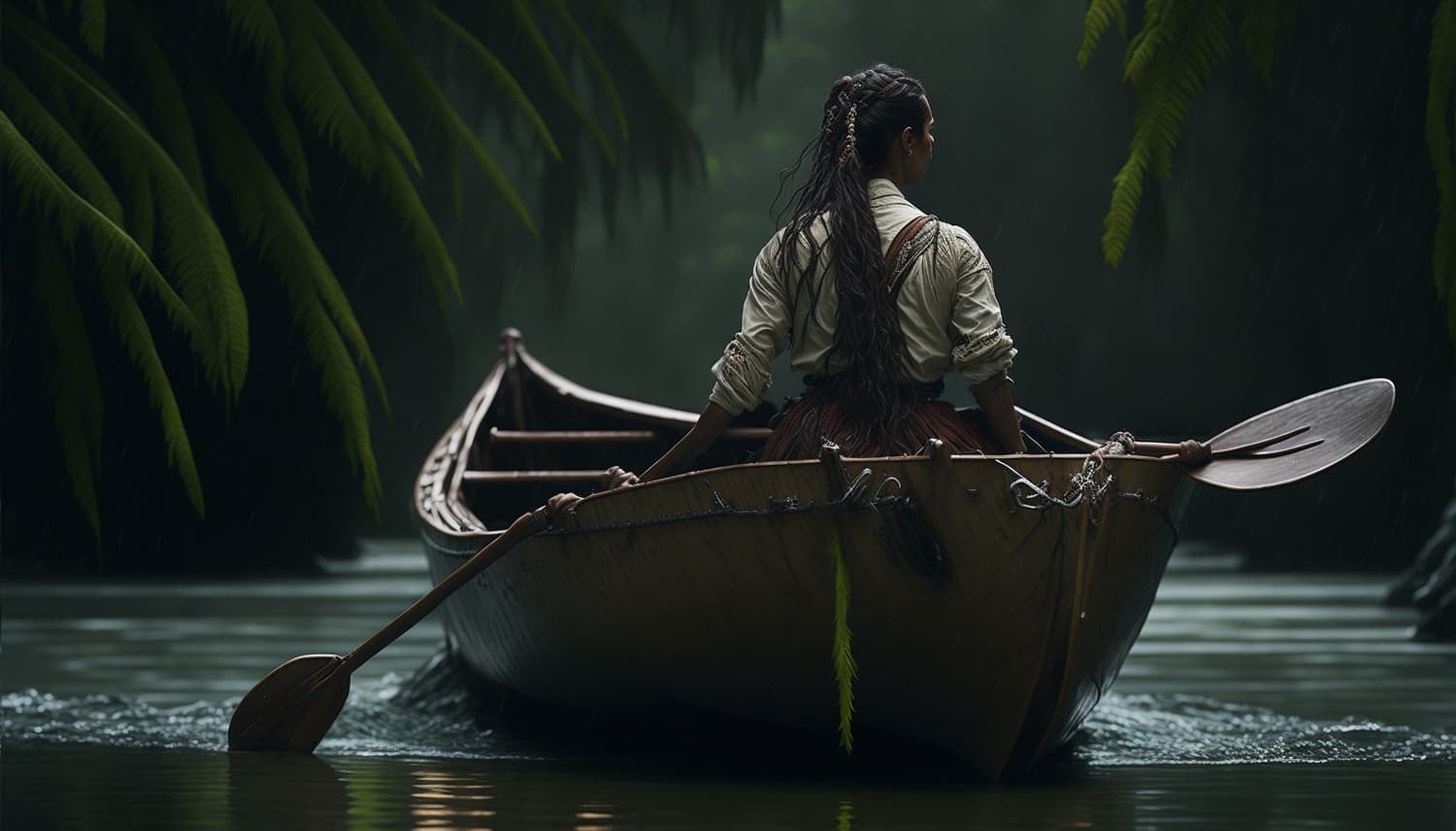
When the news finally arrived that a vessel was waiting downriver for her, Isabel was no longer the young woman of the geodesic mission days. She was over forty, her body battered by life and her heart hardened by losses that would have been enough for anyone to give up. And yet she did exactly the opposite. She sold her possessions, gathered a small retinue — relatives, servants, indigenous porters — and on October 1, 1769, she left Riobamba heading east. She was not going for a visit. She was going to risk her life for a possibility.
At first everything was grueling but still plausible: mountain, mud, porters, heat, insects, paths that were more suggestion than path. The first serious warning of what was coming appeared at Canelos. The settlement, where they were supposed to find help and a boat, was practically deserted because of a smallpox epidemic. The guides fled. The logistics fell apart. Two indigenous men promised to build a canoe and take them down the Bobonaza to Andoas. It was the only option. Isabel accepted. By that point love had stopped being romantic: it had become a cold decision.
From there the expedition entered its dark stretch. The canoe was bad, the group overloaded, and the jungle does not forgive small mistakes. One man drowned. Part of the party went ahead to look for help and took far longer than it should have. Those left behind began to fall sick. Insect bites turned infected. Damp rotted their strength. Hunger shrank everyone. One by one the companions fell: first the weakest, then the strong ones, then those who had seemed indispensable. Servants died, Europeans died, her own brothers died. In stories like this death does not arrive with trumpets; it walks in quietly, sits down beside you, and waits.
When the scene reached its cruellest moment, Isabel was left alone among corpses, in the middle of a jungle she did not know, hundreds of leagues from any shelter. And then the truly extraordinary happened. She did not collapse. Or, rather, she surely collapsed, but afterwards she stood up. She walked alone for several days, wounded, starving, almost naked, drinking what she could and pushing on without knowing precisely where. She was held together by an obstinate, almost absurd idea: keep going.
At the end of that impossible march she was found by indigenous people who took her in and led her to Andoas. Anyone would have understood that as the end of the odyssey and the start of a return home. Not her. She rested only as long as she absolutely needed to, pulled herself together as best she could, and continued downriver to Lagunas. From there she pushed on along the vast Amazonian artery, passed missions and outposts of the great river, crossed the immense expanse that separates the Andes from the Atlantic, and at last reached the area of Oyapock. On July 22, 1770, more than twenty years after the separation and after a journey that had left a trail of dead behind her, Isabel was reunited with Jean Godin.
Sometimes history tries to tame episodes like this by calling them "romantic feats," as if a ribbon were enough to understand them. But what Isabel de Godín did was far harder than a simple proof of love. She did not write verses, nor faint while staring at the horizon. She crossed mountains, descended into the Amazon basin, survived disease, abandonment, imperial bureaucracy, getting lost, and the death of almost her entire party. She did it because she had decided she would not let the world — not the jungle, not the kings, not the officials, not bad luck — dictate her ending.
That is why her story still astonishes. Because in a time when women were assigned a still, domestic and obedient role, Isabel did something very few men of her century would have dared to try. She crossed half a continent to be reunited with her husband. She looked for him when almost no one expected anything anymore. And she got there. If that is not one of the fiercest and most extraordinary love stories this land has produced, then I don't know what is.
Categories
You may also like
The Story of a Fruit That Was Rented
A few years ago, I was researching for the book Guayaquil, Historias a Color, reviewing photographs of Guayaquil from over a century ago

The Count of Monte Cristo
By: Raúl Guerrero The first book I read from cover to cover was an illustrated summary of The

The Invisible Giants and Their Shoulders of Concrete: The Story of Forgotten Brilliant Minds
A phrase I've always liked, for everything it carries behind it, is one uttered