
Could a Quantum Computer Crack All Our Passwords?
Could a quantum computer crack all our passwords? The short answer is yes, and even the NSA warns it could break today's encryption.

Cryptography is a technique used to protect information and keep it secure from potential threats. Since the times of ancient Egypt, cryptography has been used to protect confidential information, such as military messages and state secrets. However, with the advent of quantum computers, the hypothesis has been raised that this security could be compromised.
Quantum computing is a branch of computer science that uses the quantum properties of matter to process information. Unlike classical computers, which use bits to process information, quantum computers use qubits, which are the basic unit of information in a quantum computer. Qubits have the property of being in multiple states at the same time, which allows them to process information at a much greater speed than classical computers.
Could a quantum computer crack all our passwords? The short answer is yes. Quantum computers have the capacity to process information at a much greater speed than classical computers, which allows them to break the security of current cryptography.
Even important U.S. government agencies, such as the NSA, have mentioned the following:
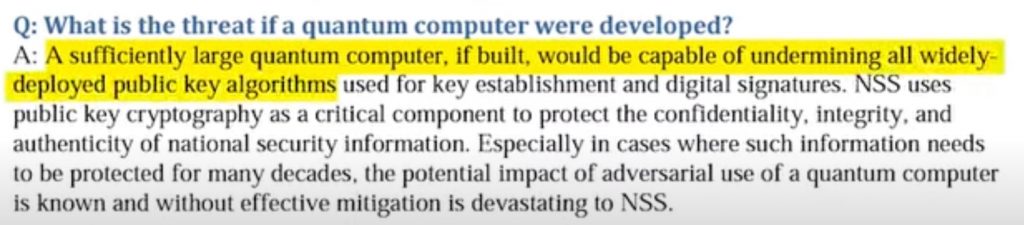
Transcription:
"A sufficiently powerful quantum computer, if built, would be capable of undermining all currently deployed public key algorithms for digital signatures and keys"
Modern cryptography is based on complex mathematical algorithms that make it virtually impossible for a classical computer to decipher protected information. For example, 128-bit encryption is commonly used in current cryptography and is considered secure. However, a quantum computer is capable of breaking the security of current cryptography in an incredibly short time compared to other types of computers.
To better understand this, let's compare how long it would take three different types of computers to break the security of 128-bit encryption:
- An average user's computer: it would take around 10^6 years to crack 128-bit encryption.
- A current supercomputer (2023): it would take around 100 years to crack 128-bit encryption. Although it is speculated that the U.S. government has already managed to decrypt some cryptocurrency accounts and recover electronic money stolen by hackers.
- A powerful quantum computer: it would take around 10 seconds to crack 128-bit encryption.
As we can see, a quantum computer is capable of breaking the security of current cryptography in an incredibly short time compared to other types of computers.
This scenario could become a reality within 10 years, which means we would have to change even the way encryption is handled in current banking. Therefore, it is important to invest in research and development to find new ways to protect information.
Hackers Are Already Getting Ahead
There are currently hackers venturing into a new practice they call HNDL or SNDL (Store Now Decrypt Later), which means something like "store now, decrypt later." The idea is to obtain ("steal") encrypted information from different vulnerable systems, such as passwords, credit card numbers, classified documents; to decrypt that information when quantum computing is within reach. Below is a brief definition from Wikipedia.
https://en.wikipedia.org/wiki/Harvest_now,_decrypt_later
It is important to note that the arrival of quantum computers does not mean that all current cryptography is insecure. Asymmetric cryptography algorithms, such as RSA and ECC, use mathematical problems that are difficult to solve even for quantum computers. However, symmetric cryptography algorithms, such as AES, are more vulnerable to quantum computer attacks.
An important documentary on the subject is the one I've included below. I recommend watching it.
In closing, the arrival of quantum computers poses a significant challenge to information security. It is necessary to invest in research and development to find new ways to protect information and prevent it from falling into the wrong hands. If measures are not taken, we could face a security crisis in the not-too-distant future. It is important that governments, companies, and users take steps to protect information and guarantee privacy in the era of quantum computing.
Categories
The books · born from this blog

Atahualpa con su abrigo de pelo de murciélago
y otras 49 historias verdaderas que parecen mentira
Available on Amazon
Tocar madera
Pequeña historia de las supersticiones que el mundo no ha podido soltar
Available on Amazon
100 futuros
Cien escenarios del mundo que viene con la inteligencia artificial
Available on AmazonYou may also like
Why Computer Files Are Called Files
The digital file inherits its name from a real office: papers strung on a thread. From the Latin filum to the file system, this is the story of the file.
The First Personal Computer Wasn't the One You Think
Almost everyone credits the 1975 Altair as the first personal computer, but several came earlier: from Olivetti in 1965 to the Kenbak-1 in 1971.
The first computer virus was called Brain
In 1986, two brothers in Lahore wrote Brain, the first PC virus. It destroyed nothing: it guarded their software and left their name, address and phone.