
The last purple on the planet
Tyrian purple, the dye drawn from thousands of sea snails, was so coveted it defined emperors, then vanished when its secret was lost forever.
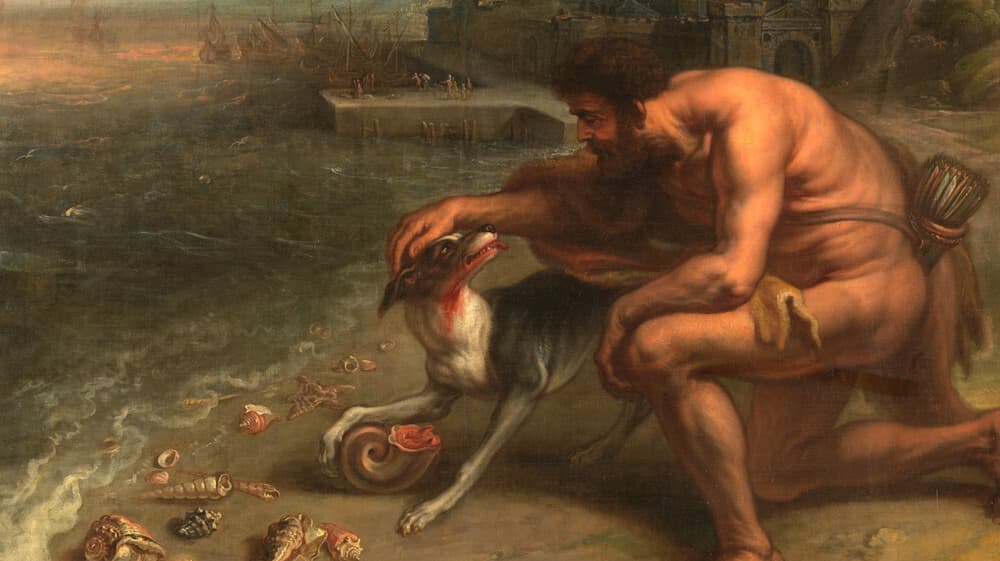
In the Prado Museum, in Madrid, there is a painting entitled The Discovery of Purple, executed by Theodoor van Thulden from a sketch by the famous Rubens. In it it is "related" how the Phoenician god Melkart discovered purple in the injured snout of his dog.
But what on earth is purple?
Well, at present we only have the name of the color, exotic ... or not even now. But centuries ago, when dyeing things was a sight worthy of admiration, this Phoenician dye revolutionized the commerce and customs of almost all mankind.
Of course, you have to understand that the dyes were discovered little by little and each color was a novelty and revolution. More or less like when we went from black and white to color television. The color revolution is now difficult to understand, in a world where it is so easy to print a color sheet; But it was not always so easy to have a painting or something tinted on hand. The "artificial" color was novel, admirable, contemplable.
So famous was the tint of purple and the Phoenicians who discovered it, that the very word "Phoenicians" is derived from the Greek word "phoiniks," which means purple. Relators of yesteryear, like Homer himself, wrote of these wonderful dyed fabrics in their works.
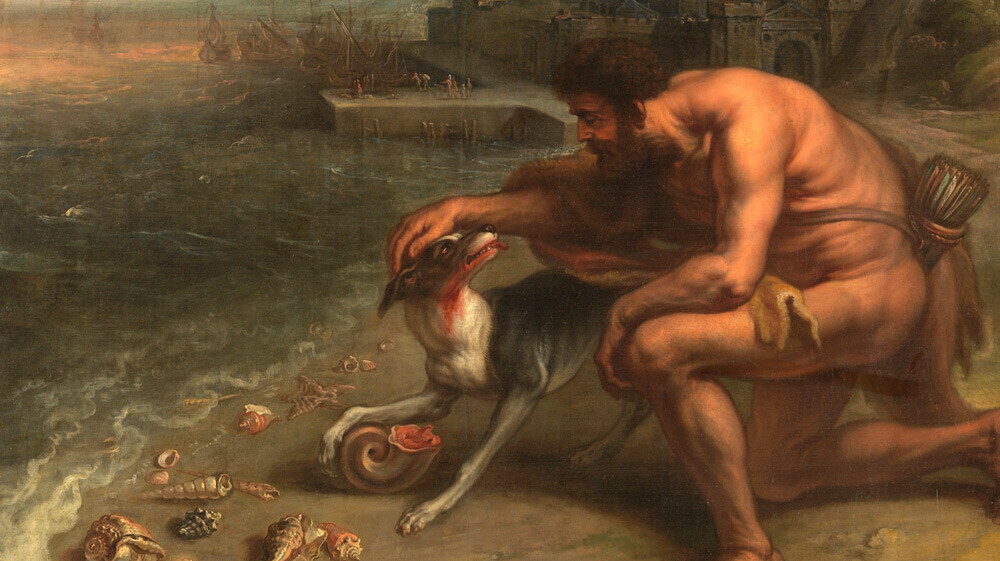
This dye was extracted from a snail that lived among the rocks of the Phoenician coasts. That is why the allegory of Rubens, where the dog accidentally dyes its muzzle when biting some snails on the beach. These snails belong to the species Murex trunculus and Murex brandaris. It is not that the species went extinct —it still exists—, but the colors they secreted were so coveted that the craft was exploited brutally for centuries and, with the fall of the great production centers, the secret of that dye was eventually lost. We did not get to see its splendor, only to learn of its celebrity through writings, old paintings or empty broken shells. Some say that it was more like a fiery red than the current purple, but it is not known, the tissues that we have left have degraded over time.
It is speculated that thousands of snails were needed to extract just enough to dye a dress. Its center of exploitation was the city of Tyre, on the present-day coast of Lebanon, which is why it was also called Tyrian Purple. This color became a status symbol. The aristocracy of some empires such as Greek or Roman, showed beautiful dresses dyed in the famous color. A law was even promulgated to prohibit any Roman citizen of "lower" social class from wearing purple-dyed garments.
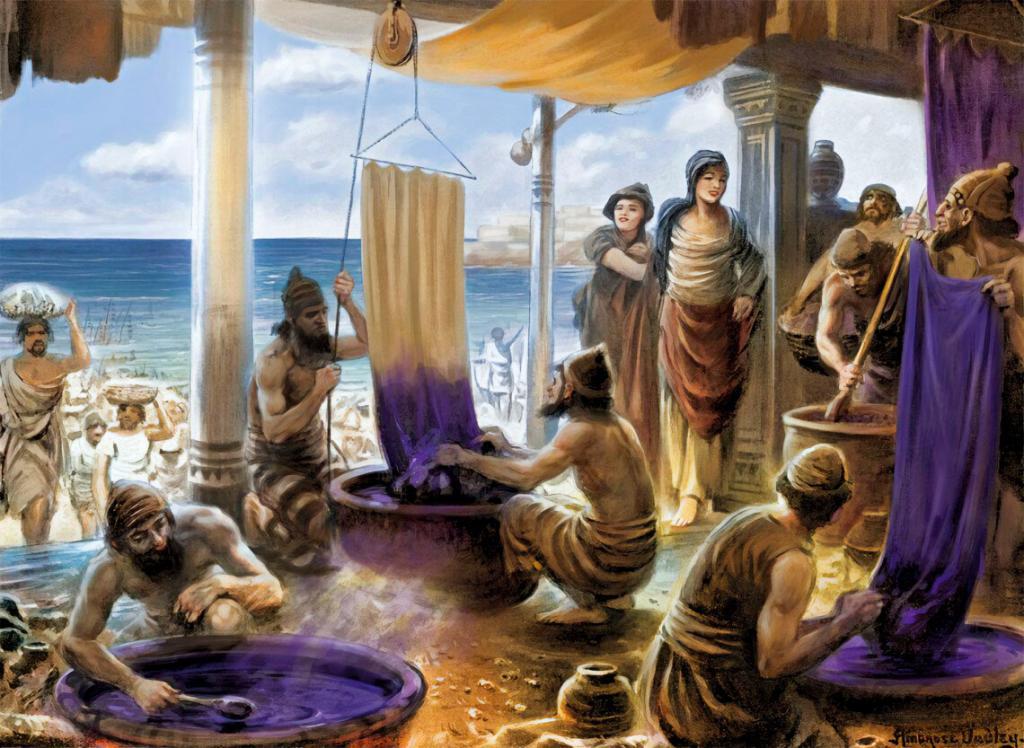
So was this color revolution, which faded between the 5th and 10th centuries, when the secret of its making was lost.
It is in this extinct snail context that the Spanish arrived in America at the end of the 15th century. Purple was a story of the past already in those times. There was still talk of its mythical fame, but there were already other new colors and tints that distracted humanity's incomprehensible search for this color. And do not think that I say it like that lightly, I will write another article where I will tell you why I say that we are obsessed with purple, but for now I will focus on the years after the conquest.
The purple of the Native Americans
Long after the "discovery" of America, some European adventurers observed in surprise how Native Americans on the coasts of what is now Ecuador, dyed their garments "milking" a small snail. The analogy with the ancient purple of Tyre was obvious. Surprised, they recounted their findings. The most notable was the Spaniard Antonio de Ulloa, whose 1748 observation was collected in the General History of Travels —the monumental eighteenth-century compilation associated with the Englishman Thomas Astley—, where the following can be read (I show the image, a version translated into Spanish).
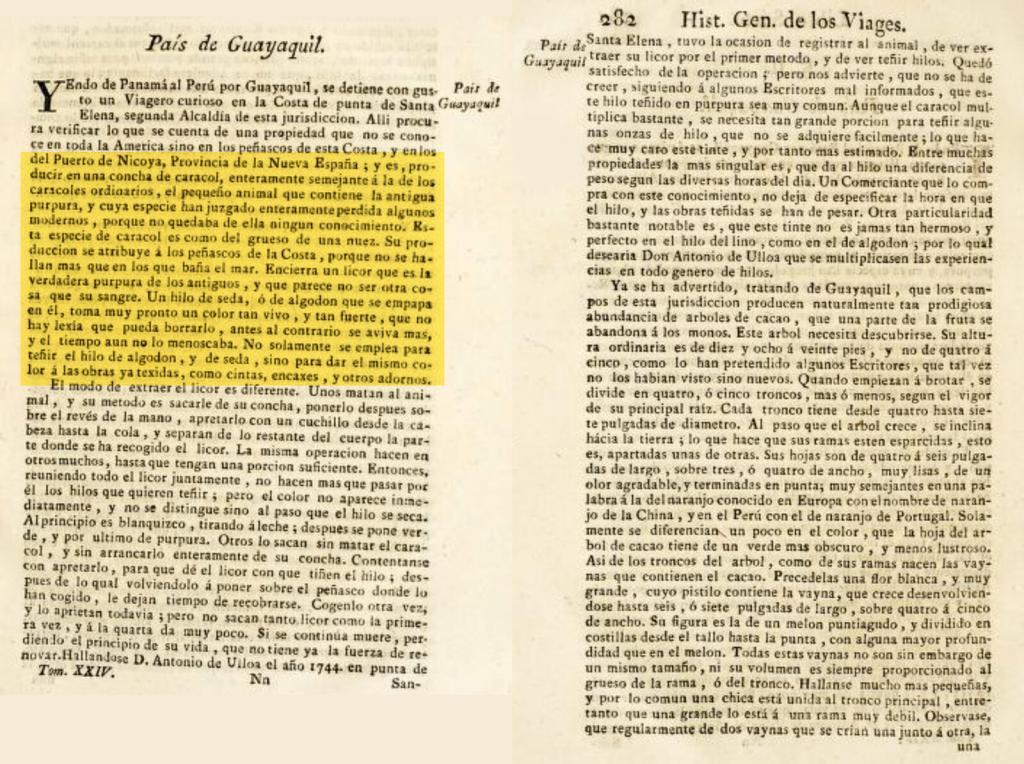
… And it is to produce in a snail shell, entirely similar to that of ordinary snails, the small animal that contains the ancient purple, and whose species some modern people have judged to be entirely lost, because no knowledge remained of it. This species of snail is about the thickness of a walnut. Its production is attributed to the cliffs of the coast, because there are only those in which the sea bathes. It contains a liquor that is the true purple of the ancients, and that appears to be nothing other than their blood.
Book General History of Travel, by Thomas Astley
Without a doubt a very interesting story. What Thomas Astley did not know is that it was a different species from the one previously mentioned Murex trunculus or Murex brandaris, but the similarity with the Phoenician purple is surprising. In addition, the similarity of the extraction method and its use is surprising.
This snail still exists in America and in fact there are a couple of places where the method is still used as a tourist attraction more than anything else, as it is not a profitable method in itself today. The point is that we will never know if this color is exactly the same as the famous Tyrian Purple.
Be that as it may, we can say that the purple of America is the last purple on the planet.
References
- Theodoor van Thulden (after Peter Paul Rubens), The Discovery of Purple, c. 1636-1638, oil on canvas, Museo Nacional del Prado, Madrid, inv. P01845. museodelprado.es
- Christopher J. Cooksey, 'Tyrian Purple: 6,6′-Dibromoindigo and Related Compounds,' Molecules 6(9), 2001, 736-769. DOI: 10.3390/60900736. doi.org
- Pliny the Elder, Natural History, Book IX, ch. 60-65. perseus.tufts.edu
Categories
The books · born from this blog
Atahualpa con su abrigo de pelo de murciélago
y otras 49 historias verdaderas que parecen mentira
Available on Amazon
Tocar madera
Pequeña historia de las supersticiones que el mundo no ha podido soltar
Available on Amazon
100 futuros
Cien escenarios del mundo que viene con la inteligencia artificial
Available on AmazonYou may also like

The Voice of the last Castrato. The only known recording of the famous singer Alessandro Moreschi.
Boys were castrated for centuries to keep their angelic voices, and one chilling recording lets you hear the very last of them sing before he died.

Knock on Wood: The Real Origin of the Superstition
Almost everyone thinks knocking on wood comes from Celtic tree worship. But the documented trail leads to a far more recent origin: a children's game.

Stockholm Syndrome Was Born to Silence a Hostage
The famous syndrome didn't come from a study: the police's own psychiatrist coined it to discredit a hostage who criticized him. It isn't in the DSM.