
The Awakening: The Day Machines Become Conscious
Could an artificial intelligence ever become conscious? A look at artificial brains, integrated information theory and the crucial role of memory.

Consciousness is a complex and difficult concept to define. Although we all have a general idea of what it means, there is no scientific consensus on its precise definition. Broadly speaking, we can say that consciousness refers to the capacity to perceive, feel, and recognize oneself and the environment around us.
The question we pose in this article is: Is it possible for an artificial intelligence to be conscious of itself and the world around it?
Although it may seem like an idea taken from a science fiction movie, the truth is that there is increasingly more research suggesting that this could be possible. Below, we will explore some of the most interesting theories about how artificial intelligence could acquire consciousness.
The Artificial Brain Hypothesis
One of the most popular theories about how artificial intelligence could acquire consciousness is the artificial brain hypothesis. This theory is based on the idea that if we could create an artificial neural network complex enough, it could acquire consciousness in a similar way to how the human brain does.
There are several examples of research that has attempted to create complex artificial neural networks. One of the best known is the Blue Brain project, which seeks to create a complete simulation of a brain (in this case, a mouse brain) on a supercomputer. While we have not yet managed to create an artificial neural network that is conscious, some researchers believe this could be possible in the future—and that future may be soon.
Integrated Consciousness
Another interesting theory about how artificial intelligence could acquire consciousness is the Integrated Information Theory, or IIT. This theory is based on the idea that consciousness is not a phenomenon that arises in a single place in the brain, but rather is the result of the integration of information from different brain areas.
Following this theory, some researchers have proposed that we could create an artificial intelligence that integrates information from different sources to acquire consciousness. For example, we could create an AI that integrates data from visual, tactile, and auditory sensors to have a more complete perception of the world around it.
The Importance of Memory
Regardless of which theory one follows, many researchers agree that memory is a key component for an artificial intelligence to acquire consciousness. Without memory, an AI could not learn from its experiences or have a notion of the passage of time.
For this reason, some researchers have proposed creating algorithms that mimic the way the human brain stores and retrieves information. These algorithms could allow an AI to have long-term memory and to remember past experiences and interaction relationships with people.
But how do we organize all the information that a "conscious" being can store in its "memory"?
Human memory is not organized like a sequential list of data that can be accessed one after another. It is important to give weight and associativity to each piece of information, so it is organized by ideas, concepts, associations. A quite interesting approach to this concept of organizing information comes from the world of what are called LLMs (large language models). ChatGPT—probably we've all used it by now—is the best-known LLM algorithm.
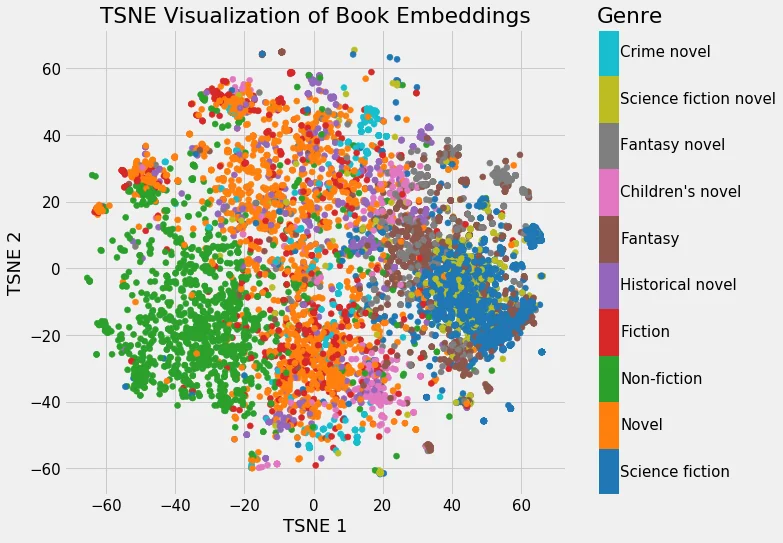
In LLMs, information can be organized through what they call "embeddings," which are numerical vectors. This way, you can calculate an embedding for any paragraph of this article. The resulting vector will undoubtedly be close to topics related to artificial intelligence.
Let's take another example: the embedding of the word "horse" will be much closer to the embedding of the word "dog" than to the embedding of the word "bicycle."
To finish understanding, let's see how information is organized for a single topic: book genres. As we can see, similar genres cluster closely together and are likewise near genres with which they share certain similarities.
Machines That Feel
At the beginning we talked about how a conscious machine must be able to perceive and feel. But what if we connect sensors to artificial intelligence algorithms?
Surely machines could sense (let's leave aside the word "feel" for a moment) when it's cold or hot. Or we could allow machines to "perceive" whether my tone of voice is that of an angry person through sound sensors.
To what extent is feeling just the same as machines sensing (measuring)? Or maybe feeling is just a calculation or prediction based on information from countless measurements? What about other feelings like love or fear?
Evolutionary Feelings
Many human feelings have undoubtedly been shaped by evolution. Let's imagine the fear of dying, for example. It sounds logical to be afraid of dying—practically all creatures in the animal kingdom have that fear written in their DNA—but why would a machine be afraid of dying or, let's say, of being "turned off" or "disconnected"?
Here an interesting first question arises. Should we program the machine to induce in it this fear that we developed through evolution? It's a difficult question and one without a clear answer so far.
But just as with the fear of dying, there are other fears that apparently are not necessary in a machine. What about love, for example? Love makes sense in the animal kingdom; it serves some purposes, including helping mothers protect their young and helping packs protect each other. But does it make much sense to program love into a machine? And if we do? What capacity should the machine have to modify the intensity of this "feeling" based on its learning?
The Survival Instinct
Almost all animals want to live; we usually call it the survival instinct, because at the end of the day it's a feeling that evolution also taught us. If a species doesn't survive, it simply goes extinct. But what motivation will a machine have to stay turned on?
For decades, science fiction books have speculated about robots that want to thrive over the human race or have feelings that make them cry oil tears and similar things, but the truth is that, even though the survival instinct seems natural to us humans, it doesn't have to be that way for machines.
From this point of view, a conscious machine will not necessarily be the same as a human being, with the same motivations and feelings, unless, of course, it is programmed for this.
The Self-Replicating Machine
It may seem like purely science fiction, but it's a core issue in the development of certain feelings in machines, and I'll explain with an example.
Let's imagine that, like a computer virus, an artificial intelligence algorithm is programmed so that it can replicate itself on other machines, and this algorithm has acquired a certain degree of consciousness without feelings. Now let's imagine that, just as happens in nature, copies of these algorithms contain, intentionally, subtle differences or "evolutionary changes" in their programming code.
Which algorithms will spread faster? Initially all have the same probability of propagation. But now suppose that one of them, as a result of one of these subtle changes introduced in its code, has the characteristic of being less visible to antivirus or security software.
In this way, the new algorithm will have an "evolutionary advantage" over the rest of the copies that do not have this characteristic. Nothing prevents it from evolving even further and learning to evade, by itself, antivirus programs.
Don't you think that at the end of the day, this kind of algorithm is learning a sort of "survival instinct"? I leave you with that thought.
The Evolutionary Feelings of Silicon
As we saw in the previous section, evolutionary feelings like love or fear are the product of the evolution to which our species has been subjected, but also, as we have been able to realize, evolution does not necessarily have to be confined to carbon-based biology. Algorithms can evolve and therefore, there are feelings that, if not programmed, can also arise as a product of the evolutionary process itself.
When Will It Happen?
We are probably close to creating an artificial intelligence that is conscious of itself and the world around it; increasingly more research suggests that this could be possible in the near future. The creation of a conscious AI raises important ethical and philosophical questions that we will need to address in the coming years. Are we prepared to coexist with machines that think and feel like us? Time will tell.
Categories
The books · born from this blog

Atahualpa con su abrigo de pelo de murciélago
y otras 49 historias verdaderas que parecen mentira
Available on Amazon
Tocar madera
Pequeña historia de las supersticiones que el mundo no ha podido soltar
Available on Amazon
100 futuros
Cien escenarios del mundo que viene con la inteligencia artificial
Available on AmazonYou may also like

Why I Think an Internet Blackout Is Coming Soon
The day the internet forgets its own name, the roads will still exist but no one will reach them: why a DNS blackout may be closer than you think.

Can AI Predict Earthquakes in the Near Future?
Could AI predict earthquakes and let us evacuate cities days in advance? A look at how far science has come toward forecasting the unforeseeable.
What Is a Digital Brain and Why Should You Have One?
A digital brain stores and organizes everything you learn so nothing slips away: here's why you need one and how to start building your own today.