
The Giant Stones of Yap and What Money Really Is
On a tiny Pacific island, money was made of giant stones — some so heavy they never moved, and one of them sat at the bottom of the sea.
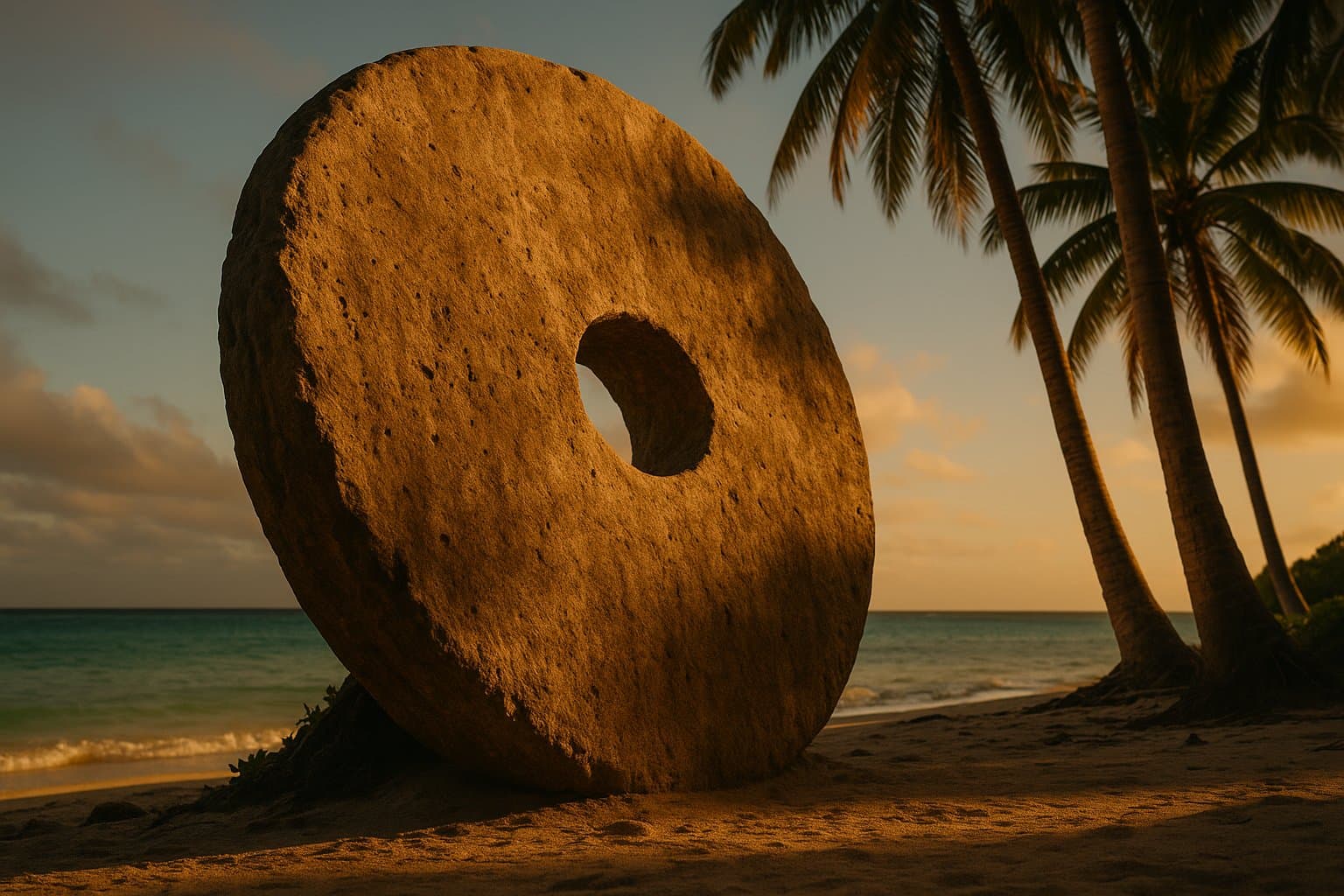
On the island of Yap, at the western edge of the Caroline Islands, money doesn't fit in a pocket. The traditional currency of this small Micronesian archipelago is the rai — also called fei — enormous limestone discs with a hole in the center: the size of a cartwheel when modest, and over three meters across and four metric tons when large. For centuries, they paid for land, marriages, ransoms, compensations, and alliances between clans; everything that truly mattered in Yap was settled in stone. And the story of these rocks is, at the same time, the best answer ever given to a question we rarely ask ourselves: what is money, really, at its core?
Full-moon stones
There are no deposits of that stone in Yap. The Yapese tell that some five or six hundred years ago, a man named Anagumang, instructed by the divinity Le-gerem, sailed with seven companions to the Palau islands, more than four hundred kilometers to the southwest, and there discovered a glittering rock: crystalline calcite, deposited drop by drop by rainwater on the walls of caves. According to legend, the first pieces were shaped like fish, lizards, turtles, or crescent moons, until the definitive shape turned out to be that of the full moon, with a hole in the center through which a log could be passed to carry it on the shoulders of several men.
The discs were carved in the quarries of Palau with adzes of stone and giant clam shell, and the central hole was bored, according to tradition, with a bow drill and a piece of reef rock. Each expedition was an undertaking of dozens of men authorized by a chief, and it could last months or years: the stone had to be extracted, shaped, lowered to the sea, and brought home in canoes or on bamboo rafts across hundreds of kilometers of open ocean. The rafts carrying the largest pieces, slow and unsteerable, were set adrift so the current would carry them toward Yap while the canoes set out in pursuit, and it was not unusual for stones — or men — to be lost along the way. Of the spoils, the largest pieces and two-fifths of the smaller ones went to the chief who had financed the voyage; the oarsmen received baskets of taro. There, money was earned with one's life.
The money that didn't move
With such a cost of production, nobody expected a large stone to move when it changed owners. The most valuable pieces remained for years or generations in the same spot — by the side of a path, in front of a chief's house, in a village clearing — and ownership was transferred by a mechanism far less visible but perfectly effective: public announcement. If a family handed over a stone as payment, the transaction took place before witnesses and became part of the piece's oral history, that chain of previous owners everyone knew. The physical location of the disc was almost irrelevant; what carried weight was the shared record.
A stone's value, moreover, was not measured only in meters. The fineness of the carving and the veining of the calcite mattered, but what mattered most was the biography. A piece brought by a celebrated navigator was worth more than another of equal size; if men had died during its transport, its prestige rose; if it had passed through illustrious hands or had settled memorable affairs, better still. Each disc was an archive: the sum of labor, risk, and memory that the community recognized as its own.
The stone at the bottom of the sea
In 1903, the American anthropologist William Henry Furness III spent several months in Yap, and in 1910 he published The Island of Stone Money, the first detailed study of the system. He wrote down the case that would make the island famous among economists. An old friend of his, Fatumak, assured him that in a nearby village lived a family whose wealth no one questioned, even though no one — not even the family itself — had ever laid eyes on it: it consisted of an enormous fei that had been lying at the bottom of the sea for two or three generations. An ancestor had been bringing it from Palau when a storm caught the raft, and to save themselves the crew had to cut the cargo loose; the stone sank. Back home, the men testified before everyone to the extraordinary size and quality of the piece and swore that the loss had not been the owner's fault. The community accepted that the accident was a minor detail. The stone was there, properly carved, under a few hundred feet of water off the coast, and its purchasing power remained — Furness wrote — as valid as if it were leaning visibly against the side of its owner's house.
Captain O'Keefe and stone inflation
In 1871, an Irish-American trader named David Dean O'Keefe was shipwrecked near Yap, was rescued by the islanders, and decided to stay and make his fortune. He built a thriving business in copra and sea cucumber, and soon understood where the real bonanza lay: with his schooners and his iron tools he could bring stones from Palau in quantities and sizes no canoe had ever achieved, and trade them for copra. The Yapese accepted the deal, but they did not value those pieces the same way. Obtained without canoes, without months of labor, and without deaths along the way, the stones of the O'Keefe era traded at a discount to the ancient ones. The island had discovered inflation: multiplying money did not multiply wealth, and easy money was worth less. It would not be the last time abundance devalued a rarity: it happened to the pineapple when it stopped being a European rarity, and to every currency that governments printed in excess. O'Keefe, incidentally, became so legendary that Hollywood dedicated a film to him in 1954, with Burt Lancaster in his role.
The black cross and the gold drawers
From 1899, when Spain sold the Carolines to Germany, the colonial administration ran into a minor but irritating problem in Yap: it ordered the chiefs to repair the coral-block paths connecting the districts, and the chiefs simply ignored the order, because for the islanders' bare feet those paths were already fine. How do you fine people who don't use banknotes? The solution was as simple as it was effective: an emissary toured the disobedient districts painting a black cross on the most valuable fei, marking them as confiscated by the government. Without moving a single kilo of stone, Germany had seized the island's wealth. According to the account, the paths were repaired from one end to the other until they looked like park drives; the government then erased the crosses and the fine was paid.
The episode was rescued in 1991 by the economist Milton Friedman, who paired it with an unsettlingly similar one. In 1932-33, the Bank of France, doubting that the United States would stick to the gold standard at the traditional price of $20.67 an ounce, asked the Federal Reserve to convert into gold the dollars it held on deposit in New York. To avoid the shipment, it was agreed that the gold would stay in the Fed's vault, simply moved into drawers labeled as property of France. A few labels were enough — "they might as well have been crosses in black paint," Friedman joked — for the financial press to speak of a "loss of gold," for the dollar to be perceived as weaker and the franc as stronger, and for the supposed drain to end up as one of the factors that led to the banking panic of 1933. Is there any real difference — he asked — between feeling poorer because of crosses painted on stones and feeling poorer because of marks on drawers in a basement?
The real vault is trust
It is worth not looking down on Yap. Their system was a ledger distributed across the memory of the whole island: no one possessed the stone, but rather an entry in an oral record validated by witnesses. Anthropologists Scott Fitzpatrick and Stephen McKeon have described it, not without provocation, as an antecedent of bitcoin: a blockchain without electricity. And the parallel doesn't end there. The balance of a bank account is not a pile of bills with our name on it, but an entry the bank acknowledges; stocks, funds, and property deeds certify things we don't see either. The Yapese trusted the memory of their community; we trust banks, states, and servers. The technology changes, not the mechanism.
In Yap, meanwhile, the stones are still there: some six thousand large discs lined up in front of houses and along paths, so present in the island's identity that they even appear on license plates. They are no longer quarried, but they still change hands in marriages and traditional agreements, coexisting with the dollar used in the shops. Every time we use the word money we invoke, without knowing it, a Roman goddess; every time a Yapese points to a moss-covered disc, they invoke something just as invisible: the story of who brought it, who paid for it, and who agreed it was valuable. Because money has never been the object. Money is the agreement.
References
- William Henry Furness III, The Island of Stone Money: Uap of the Carolines, Philadelphia & London, J. B. Lippincott Company, 1910. gutenberg.org
- Milton Friedman, "The Island of Stone Money", Working Papers in Economics E-91-3, Hoover Institution, Stanford University, February 1991. digitalcollections.hoover.org
- Cora Lee C. Gillilland, The Stone Money of Yap: A Numismatic Survey, Smithsonian Institution Press, 1975.
- Scott M. Fitzpatrick & Stephen McKeon, "Banking on Stone Money: Ancient Antecedents to Bitcoin", Economic Anthropology 7(1), 2020, pp. 7–21. DOI: 10.1002/sea2.12154. doi.org
Categories
The books · born from this blog
Atahualpa con su abrigo de pelo de murciélago
y otras 49 historias verdaderas que parecen mentira
Available on Amazon
Tocar madera
Pequeña historia de las supersticiones que el mundo no ha podido soltar
Available on Amazon
100 futuros
Cien escenarios del mundo que viene con la inteligencia artificial
Available on AmazonYou may also like
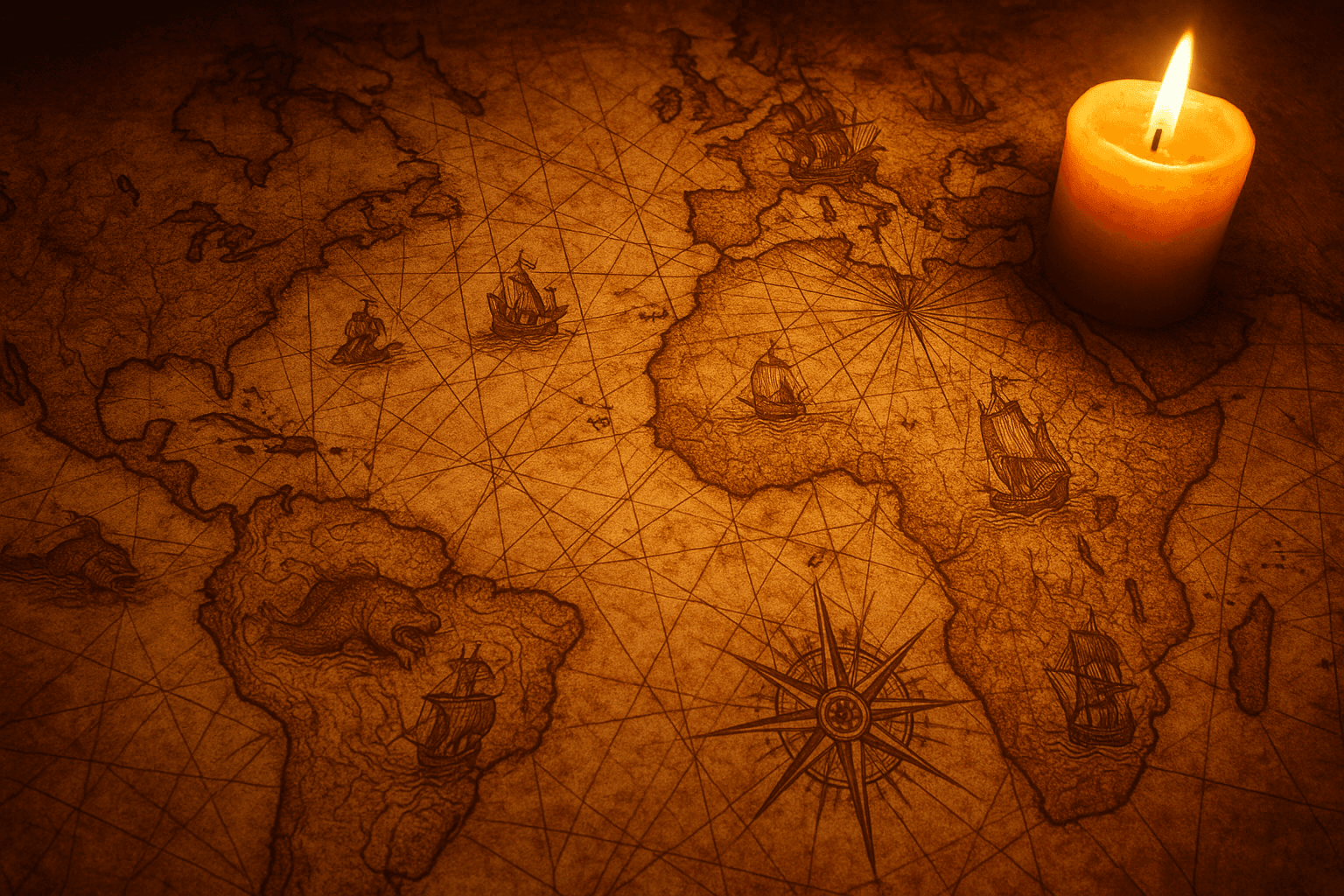
The Piri Reis Map: What It Really Shows, and What It Doesn't
The 1513 Piri Reis map is cited as proof of an ice-free Antarctica. What an Ottoman admiral actually drew is more interesting than the myth.
Rubber Before Goodyear: The Gum That Melted
Before vulcanization, rubber was a gum that melted in summer and cracked in winter. From the Maya to Goodyear, here's how it was finally tamed.
Porcelain: the Chinese secret Europe tried to steal
For centuries Europe paid fortunes for Chinese porcelain without knowing how it was made. This is the story of a hundred-year industrial espionage.