
The Priest Who Hunted Supernovas
Robert Evans, an Australian priest with a homemade cardboard telescope, spotted more supernovas than anyone, a record astronomers still can't explain.
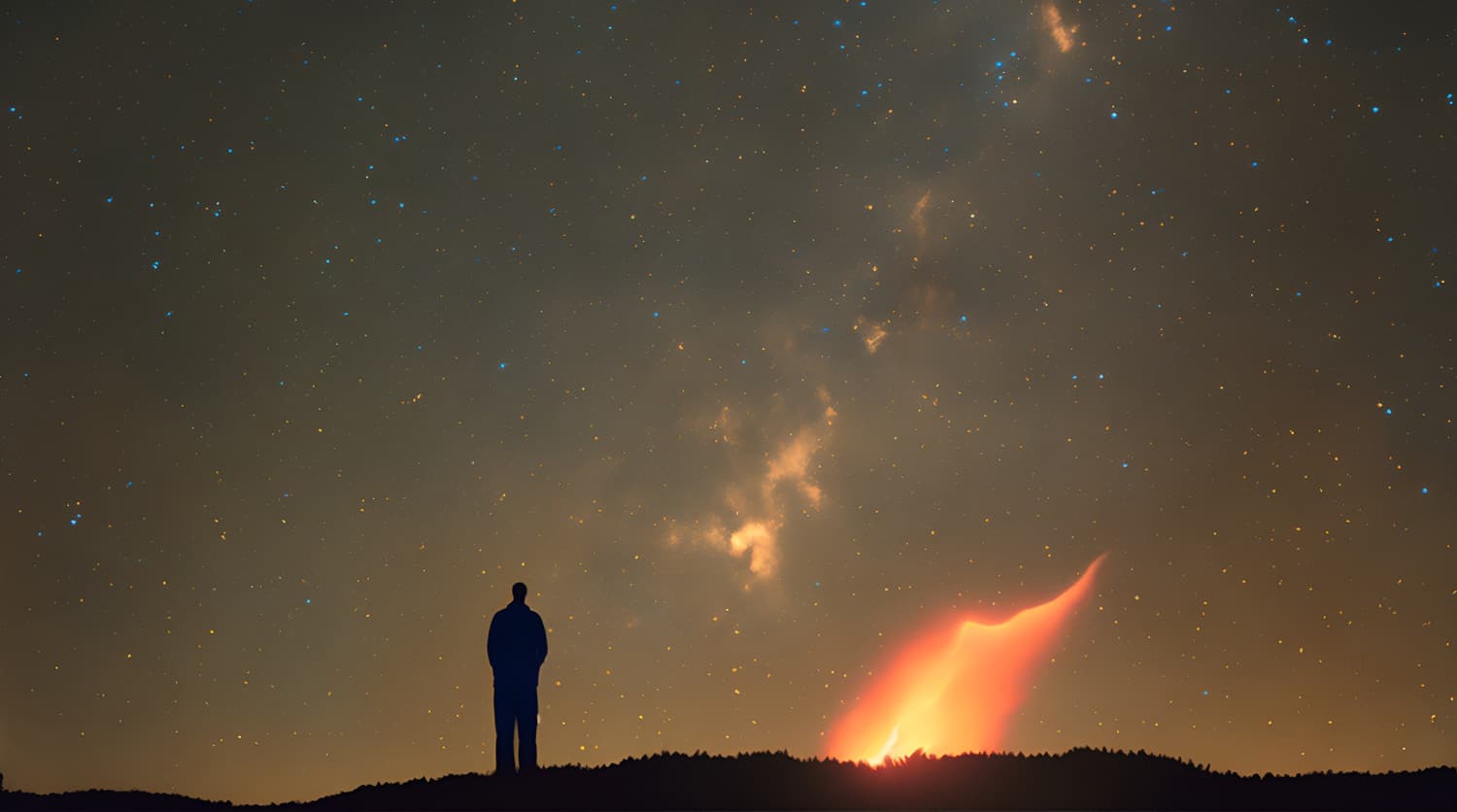
A supernova is basically a stellar explosion of massive proportions. Imagine if our sun exploded. Of course, in the sky, these events occur very far from us, at almost unimaginable distances, so what reaches us is basically a tiny—and almost always imperceptible—flash.
To be a bit more precise, a supernova is a stellar explosion that occurs when a star exhausts all its nuclear fuel and collapses under the force of gravity. During the explosion, the star emits a vast amount of energy and matter into space, making it one of the brightest sources of light in the universe.
Astronomers around the world are constantly hunting for these episodes, and to do so they use sophisticated and complex equipment. Many scientists camp out for seasons at telescopes atop high hills to detect one of these events, often without success. Today, computers are used to track these cosmic megablasts.
But the equipment and technology aren't within everyone's reach, and there's a truly astonishing case in which a single person, armed only with a homemade telescope, managed to capture an astounding number of supernovas—which still raises questions about how he achieved such a record.
Robert Evans was an Australian priest who devoted his life to observing the universe. From a young age he was drawn to the stars, probably inspired by an old star map his father shared with him. His enthusiasm was such that his brother, an optometrist by profession, built him a rudimentary telescope from the lenses of an old microscope. It wasn't exactly a good telescope—instead of tubes they used rolled-up cardboard—but even so, it managed to fuel his growing passion.
Evans began hunting supernovas in 1955. Probably, as he would say in a later interview, because observing them was so rare and that attracted him. It's also probable—this is my speculation—that his history studies at the University of Sydney led him to encounter ancient documents of stellar explosions observed with the naked eye, from very ancient times through the medieval era.
Several historical events are believed to have actually been supernovas. There are accounts of "supernovas" from thousands of years before the Christian era. Better-documented ones occurred in the years 185, 1006, 1054, 1572, and 1604. They must have been colossal events to be admired with the naked eye. The observation in the year 185 was reported by ancient Chinese astronomers and is considered the first confirmed observation of a supernova. In fact, the stellar remnants of that event can still be observed today.
In any case, when Evans found his first supernova in 1981, visual discoveries —by eye, without photographic plates— were an absolute rarity. It seems that precisely this motivated him to look at the sky every night with his modest telescope.
Many years passed before he discovered his first explosion in 1981. Most people would have given up after several months of tireless searching. But Robert Evans was different—decades passed in which he continued his routine of going out to the back of his house or church with his telescope, trying to hunt a very elusive prey.
Little by little he improved his telescopic equipment and tried several times, until he succeeded, to adapt a camera to record his observations. Over time, he refined his skills, though his equipment remained modest for capturing the type of object he sought. He learned the sky almost by heart, so much so that after his first supernova observation he found 9 more with this kind of makeshift equipment. Quite a record!
His fame grew and soon he was a topic of conversation in local astronomical circles. He was given access to the Siding Spring Observatory, thanks to which he discovered 7 more supernovas. For Evans, hunting supernovas had gone from being a pipe dream to an almost routine task. He became an expert hunter. He ended up discovering 42 supernovae visually —a world record no one has matched— plus several more on photographic plates: a genuine achievement, the product of passion, patience, and perseverance.
Fortunately in Evans's case, justice was done in his lifetime—his dedication was rewarded with various recognitions such as the Medal of the Order of Australia, the Centenary Medal of the Astronomical Society of France, and Honorary Membership of the Royal Astronomical Society of Canada, among others.
This article is a tribute to Robert Evans, tireless observer, who died in 2022. He departed to see up close that universe he contemplated his entire life from afar.
References:
- 1) Interview with Robert Evans
- 2) Remnants of the explosion in the year 185
- 3) Wikipedia: Robert Evans
- 4) Awards received by Robert Evans
References
- Royal Astronomical Society of Canada, "Honorary Member: Rev. Robert O. Evans", The Royal Astronomical Society of Canada (RASC), Toronto, n.d. rasc.ca
- NASA, "Oldest Recorded Supernova" (on the remnant RCW 86 and the AD 185 supernova recorded by Chinese astronomers), NASA, 2011 (upd. 2024) nasa.gov
- Jonathan Foye, "Vale, Bob Evans", Insights (official magazine of the Uniting Church in Australia, Synod of NSW/ACT), November 2022 insights.uca.org.au
Categories
The books · born from this blog
Atahualpa con su abrigo de pelo de murciélago
y otras 49 historias verdaderas que parecen mentira
Available on Amazon
Tocar madera
Pequeña historia de las supersticiones que el mundo no ha podido soltar
Available on Amazon
100 futuros
Cien escenarios del mundo que viene con la inteligencia artificial
Available on AmazonYou may also like

The Airship: The Elegant Future That Burned
The airship promised to cross oceans in silent luxury. From Giffard to the Hindenburg, the story of an elegant future that ended in flames.
The Bicycle: The Machine That Freed the City
In 1817 Karl Drais built a running machine with no pedals. A century later the bicycle had reshaped cities and helped set women free.
The Airplane Before the Wrights: Who Almost Won
Before the Wright brothers flew in 1903, pioneers nearly got there first: Cayley, Lilienthal, Ader and Santos-Dumont. This is their untold story.