
Can AI Predict Earthquakes in the Near Future?
Could AI predict earthquakes and let us evacuate cities days in advance? A look at how far science has come toward forecasting the unforeseeable.

Note: This article has been partially written by an artificial intelligence algorithm
Imagine evacuating a populated area days before an earthquake strikes. The implications could save thousands of lives and save governments a great deal of money.
While earthquakes are natural phenomena considered unpredictable, the possibility of accurately predicting these seismic events is beginning to seem at least feasible with the emergence of artificial intelligence (AI). Let's explore the latest scientific advances and discover what the future holds.
The first step is to reframe the problem. It's not just about predicting an earthquake, but about how much advance warning can be predicted. To explain this better, there are several apps that provide early earthquake warnings and in many cases are effective, such as Sismo Detector, Earthquake Alert, or QuakeFeed.
The problem is that they only warn us with a few seconds of advance notice, which doesn't help much. In the best case scenario (and only if we hear the alert), it gives us time to run to our front door and get out. It doesn't even give us time to make a phone call and reach our loved ones. The goal, then, is to extend this warning time.
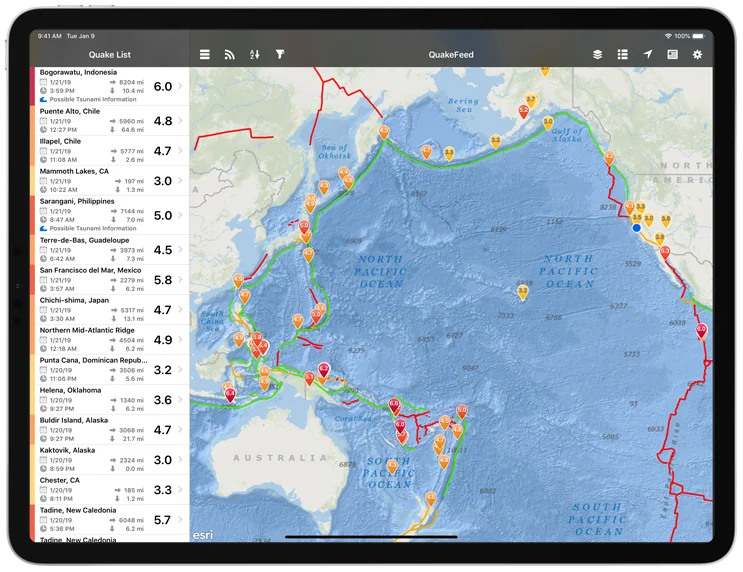
Many of these early warning systems use not only a network of seismographs, the traditional approach, but also users' mobile devices, since practically any smartphone has a high-precision accelerometer. The enormous amount of information this adds to the system allows for increased precision in earthquake detection.
A good article on this topic can be found here, under the title The Phones that Detect Earthquakes, recently published by the BBC website.
While it's true that these systems are reactive and go into operation after the earthquake occurs, trying to alert nearby populations before the seismic waves arrive, the idea of using a network of "seismographs" in users' hands could have an enormous impact on earthquake early prediction systems. AI has the potential to process large amounts of data and discover patterns that humans cannot easily detect. This has already caught the attention of researchers in the field of seismology, who are developing machine learning algorithms to analyze seismic data.
Researchers have used AI to develop early earthquake detection models. These models analyze seismic data in real time and can identify patterns that might indicate the possibility of an imminent earthquake. AI can analyze large volumes of seismic data from different sources, such as seismic monitoring stations and social networks. This provides a more complete picture of seismic activity and can help identify patterns that lead to earthquake prediction.
A recent scientific study used neural networks to predict earthquakes. They trained the neural network with historical seismic data and achieved promising results in predicting earthquakes in specific areas.
Limitations and challenges
Although AI shows promise in earthquake prediction, significant challenges still exist. The lack of historical data and the complexity of tectonic systems make it difficult to create accurate models. Moreover, the chaotic nature of earthquakes and the variety of factors involved make prediction a complex challenge.
Although accurate earthquake prediction is still a challenge, artificial intelligence shows great potential for improving our understanding of these events and providing more effective early warning systems. As technology advances and more data is collected, we may see significant progress in earthquake prediction in the near future. The combination of scientific expertise and the processing power of AI can pave the way toward a safer future in the face of earthquakes.
Ongoing research
Scientists continue to research and refine AI models for earthquake prediction. In addition, more advanced sensors and seismic monitoring networks are being developed to collect more data and improve the accuracy of AI models.
References:
- Johnson, D., & Smith, J. (2021). Neural network predictions of earthquake ground motions in southern California. Geophysical Journal International, 227(2), 679-695.
- Yoon, C. E., & O'Mahony, D. (2020). Artificial intelligence for earthquake early warning. Nature Reviews Earth & Environment, 1(2), 85-96.
- Minson, S. E., Cochran, E. S., & Baltay, A. S. (2019). A deep learning approach to detecting volcanic unrest. Nature Communications, 10(1), 1-10.
Remember that earthquake prediction is a constantly evolving field, and although AI shows promising advances, further research and refinement of models is still necessary to achieve greater accuracy in earthquake prediction.
Categories
The books · born from this blog

Atahualpa con su abrigo de pelo de murciélago
y otras 49 historias verdaderas que parecen mentira
Available on Amazon
Tocar madera
Pequeña historia de las supersticiones que el mundo no ha podido soltar
Available on Amazon
100 futuros
Cien escenarios del mundo que viene con la inteligencia artificial
Available on AmazonYou may also like

Why I Think an Internet Blackout Is Coming Soon
The day the internet forgets its own name, the roads will still exist but no one will reach them: why a DNS blackout may be closer than you think.

The Awakening: The Day Machines Become Conscious
Could an artificial intelligence ever become conscious? A look at artificial brains, integrated information theory and the crucial role of memory.
What Is a Digital Brain and Why Should You Have One?
A digital brain stores and organizes everything you learn so nothing slips away: here's why you need one and how to start building your own today.