
The Car That Runs on Firewood: Old Technology Cuba Is Reviving Out of Necessity
A Cuban mechanic runs his Fiat on charcoal, reviving the century-old gasifier that powered half a million cars in WWII, now reborn out of necessity.
The idea caught my attention after seeing a video posted on YouTube by Reuters, showing a Cuban mechanic who modified a 1980 Fiat to run on charcoal. The video went viral in minutes. And with good reason. Because the scene looks like something from another era: a vehicle driving through the streets of Cuba, with a metal contraption installed in the rear, hoses, improvised tanks, and a stainless steel pitcher stuffed with old rags serving as a filter. It seems crazy, but the car works.
The man behind the invention is Juan Carlos Pino, a 56-year-old mechanic from the town of Aguacate, east of Havana. In one of his first tests, the vehicle covered 85 kilometers and reached a speed of 70 km/h. Not on gasoline, but on charcoal.
And all of this, of course, has a context. Cuba is going through one of its most severe energy crises in recent times. Since early 2026, Venezuela—its main historical oil supplier—stopped supplying crude after Maduro's capture. On top of that, the United States, under the Trump administration, issued an executive order threatening tariffs on any country that sold oil to the island. The result: rationed gasoline, lines lasting days at service stations, supply only in dollars and with a twenty-liter cap per person. An entire island searching for how to move without fuel.
In that scenario, Cuban ingenuity appeared again. And what Pino did is not a whim or a weird experiment. It's real technology, with more than a century of history. It's called a gasifier.
When Necessity Invents the Fuel
The gasifier is, in essence, a device that converts solid fuels—like firewood, charcoal, or almost any organic waste—into a combustible gas. The magic is in the process: by burning wood or charcoal partially, with little oxygen, a mixture of gases is generated, mainly carbon monoxide and hydrogen. That gas, once filtered and cooled, can directly feed a conventional internal combustion engine, like the one in any gasoline car.
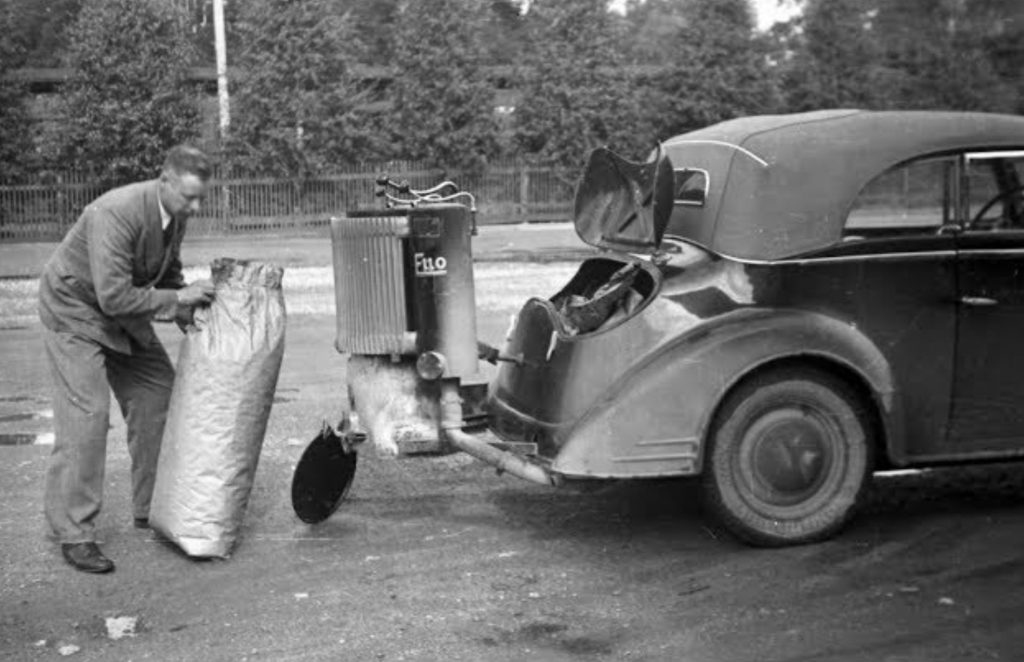
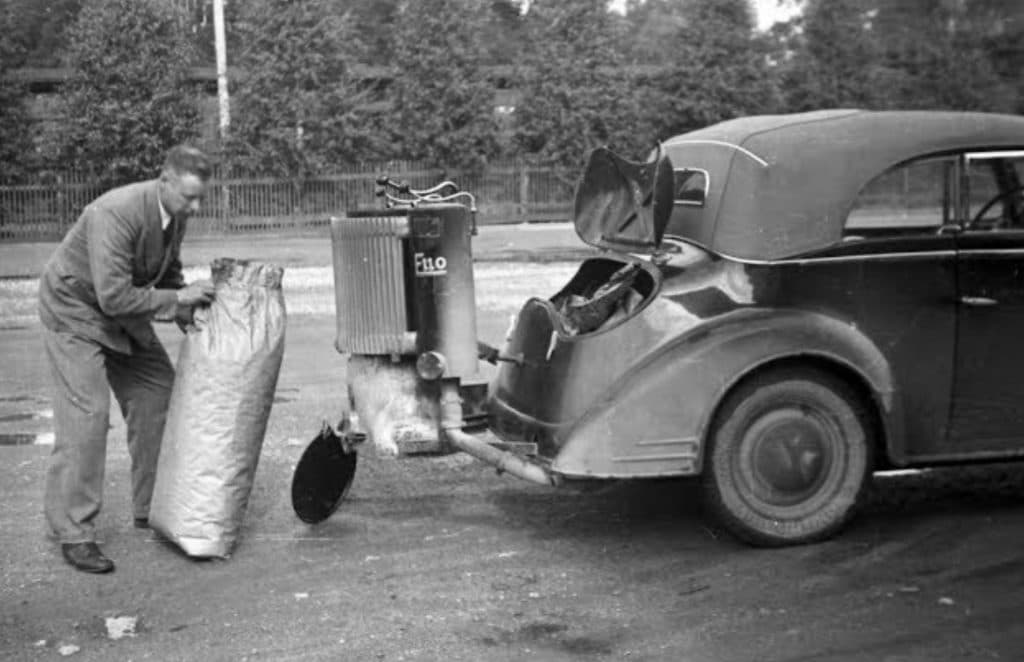
The system has a name and surname. It was the French chemical engineer Georges Christian Peter Imbert, born in 1884, who perfected it in the twenties for mobile use. His design, mass-produced since 1931, was so effective that it ended up changing the history of mobility in all of Europe.
The process, seen up close, works like this: the firewood or charcoal is introduced into a metal reactor (a kind of sealed boiler). There it burns in a controlled manner, with a limited air supply. The incomplete combustion generates that gas mixture that then passes through a system of filters and coolers before entering the engine's carburetor, exactly where the vaporized gasoline would go. The engine doesn't notice much difference. Well, yes it does notice one: it loses power. Approximately between 30% and 50% of performance goes out the window. So Formula 1 speeds, no. But the car runs. And in Cuba, that's enough.
The Moment When the Whole World Did It
The most fascinating thing about this story is that this is not a crisis invention. The world has already lived through it. And on a massive scale.
During World War II, when gasoline was a war resource and European civilians simply had no access to it, gasifiers became the universal solution. It's estimated that in Germany alone more than 500,000 gasifier vehicles were circulating by the end of the conflict. To supply them, the German government installed a network of 3,000 "wood stations" distributed throughout the country, where drivers could refuel their solid fuel before continuing their journey.
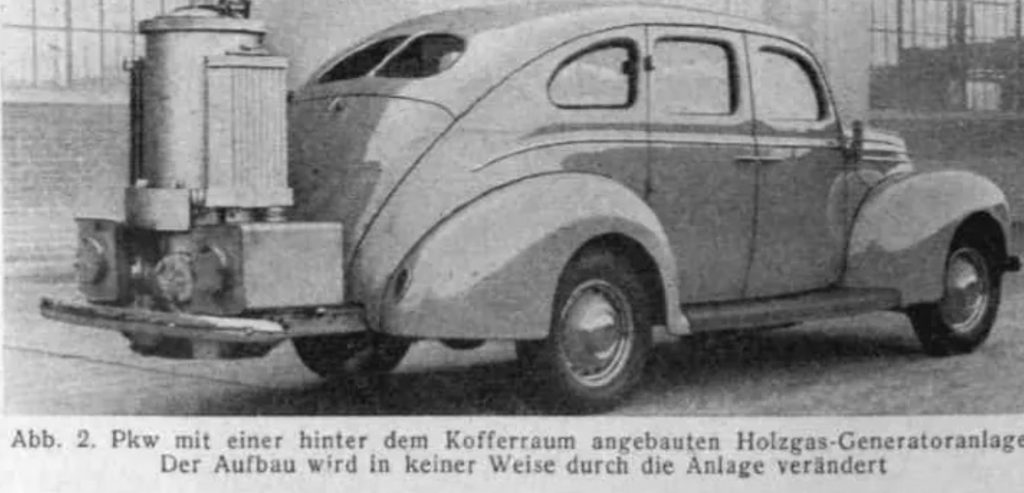
And it wasn't just Germany. In Sweden there were 73,000 adapted vehicles; in France, 65,000; in Denmark, 10,000; in Finland they reached 43,000. In total, it's estimated that more than one million vehicles throughout Europe ran on wood gas during the war. Trucks, buses, tractors, motorcycles. Even 600 boats in Finland. The German army even deployed more than 50 Tiger tanks with gasifiers in 1944.
A curiosity I can't keep to myself: Volkswagen manufactured a version of the "Beetle" that came off the assembly line with the gasifier already installed, with all the equipment hidden inside the body. The only clue was a hole in the hood for loading firewood. That's industrial design with wartime creativity.
And when the conflict ended and gasoline became available again, what happened? The same as always: the technology disappeared almost overnight. Nobody wanted to load firewood when you could simply go to the gas station.
How Do You "Feed" a Car Like This?
Here comes the practical part that I find interesting to explain, because one imagines it's extremely complicated, but in reality it's not so much.
Adapting a gasoline engine to run on a gasifier didn't require being an aeronautical engineer. A mechanic with some skill could do it in a few hours with basic materials. The basic system has three main components:
- The reactor or boiler: a sealed metal cylinder where the firewood or charcoal is introduced and controlled combustion is initiated.
- The filtration system: the gases produced contain particles and tars that would damage the engine. The filter captures them. In improvised versions—like Pino's in Cuba—a steel pitcher with old rags does that job perfectly.
- The cooler: the gas comes out hot and needs to cool before entering the engine. It's usually a series of pipes exposed to the outside air.
Once cold and filtered, the gas enters the carburetor mixed with air, just like vaporized gasoline. The engine burns it and that's it.
Of course, the starting ritual wasn't like turning a key. You had to light the firewood, wait for the combustion to stabilize, ventilate the system, and only then could the engine start. The process could take between 10 and 20 minutes before each trip. Nothing for the impatient modern person.
And consumption: about 3 kilos of wood is approximately equivalent to one liter of gasoline. War vehicles reached about 2.5 kilometers per kilogram of firewood. It's not exactly efficient, but when there's no alternative, it works.
The Dark Side of the Invention
It's not all war romanticism and popular creativity. The gasifier has its real dangers, and they're worth mentioning.
The main one is carbon monoxide: one of the gases the system produces. It's colorless, odorless, and extremely toxic. A minimal leak in the connections can be enough to poison the driver and passengers in minutes, without anyone noticing until it's too late. In well-built versions the risk is manageable. In improvised versions with scrap and secondhand hoses, the margin of error is considerably reduced.
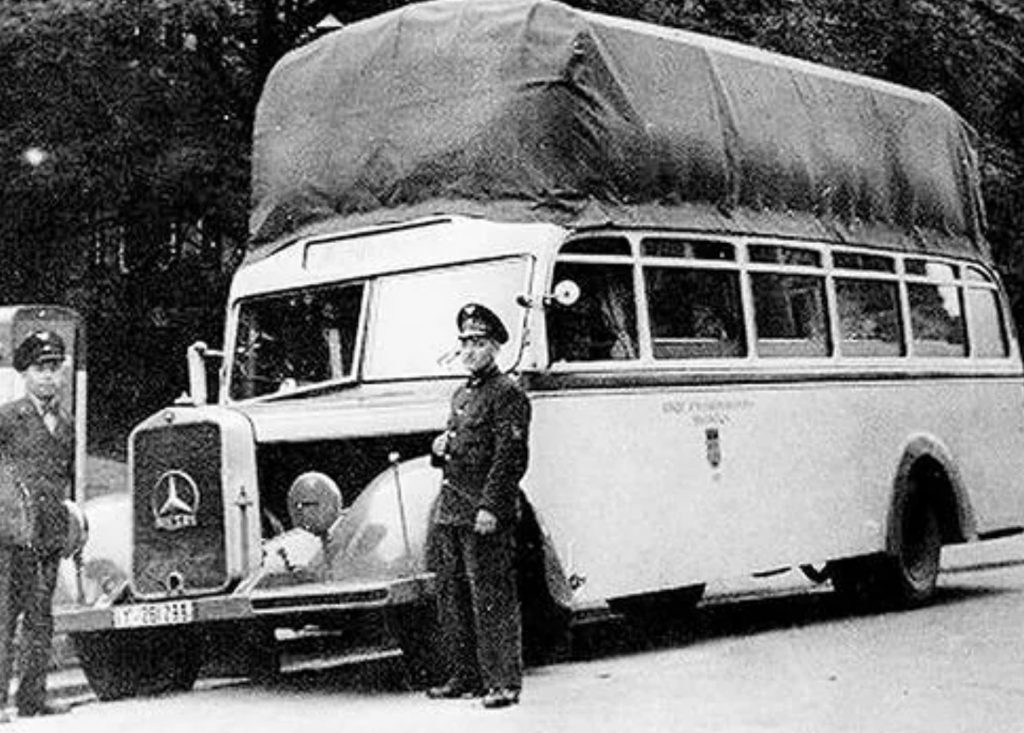
The other disadvantage is weight. The system is bulky. In some small vehicles it didn't fit in the trunk and the reactor had to be installed on a separate trailer that the car dragged. Imagine driving through the city with a slow-burning cart as an appendage.
And then there's the long-term environmental issue. During World War II, in France, the heyday of wood-powered vehicles coincided with a serious decline in the country's timber forests. A million cars consuming kilos of wood per kilometer can deforest pretty quickly if there's no forest management plan behind it.
Back to the Future, Involuntarily
What's happening in Cuba has something of a broken mirror about it. It's not just an ingenious mechanic. It's an entire country adapting bakeries to run on firewood and charcoal, installing improvised solar panels, growing their own food. Pino's Fiat fits perfectly into that logic of collective survival.
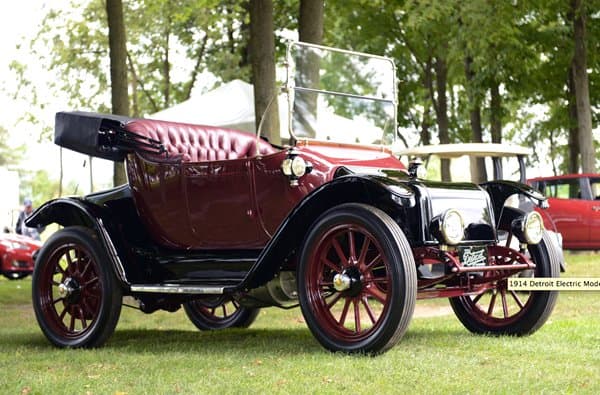
And what that image generates in me, beyond admiration for the ingenuity, is an uncomfortable question: how many technologies have we archived simply because oil made them unnecessary? The electric vehicle existed before the gasoline one—as I recounted in another blog post—and it also spent decades in oblivion until oil started to fail. The gasifier lived its splendor, was discarded, and now reappears on a Caribbean island as an emergency solution.
Technology doesn't die. It hibernates.
And it seems that every time oil fails us, we wake up to look at the past searching for the answers we already had.
Did you like this story? Subscribe to the Neomano newsletter to receive more curiosities like this directly in your inbox.
References
- FAO, Wood Gas as Engine Fuel, FAO Forestry Paper 72, Rome, Food and Agriculture Organization of the United Nations, 1986. fao.org
- Arne Kaijser, “Driving on wood: the Swedish transition to wood gas during World War Two,” History and Technology, vol. 37, no. 4, 2021, pp. 443-473. DOI: 10.1080/07341512.2022.2033387. doi.org
- FAO, Wood Gas as Engine Fuel, FAO Forestry Paper 72, Rome, FAO, 1986, introduction. fao.org
Categories
The books · born from this blog

Atahualpa con su abrigo de pelo de murciélago
y otras 49 historias verdaderas que parecen mentira
Available on Amazon
Tocar madera
Pequeña historia de las supersticiones que el mundo no ha podido soltar
Available on Amazon
100 futuros
Cien escenarios del mundo que viene con la inteligencia artificial
Available on AmazonYou may also like
Mysteriously endless experiments. Can they work indefinitely? One of them has been in operation since the 19th century.
A bell ringing nonstop since 1840 and a tar drop falling once a decade: two stubborn experiments that have outlived the scientists who began them.
Electric vehicles, an invention that we forget, because of oil, but they have existed since the 19th century.
Electric cars aren't new: a 1927 guide reveals models from the 1890s with a 100-mile range, an invention oil made the world forget for a century.
Harvesting energy from radio waves (Energy harvesting). A technology that we already used more than a century ago.
Harvesting energy from radio waves sounds like the future, yet a battery-free crystal radio was already doing it back in the 19th century.