
The miraculous malaria cure that became a gin and tonic
The malaria cure born from Andean cinchona bark became quinine, then tonic water, and finally the gin and tonic we still raise in our glasses.

Before the arrival of the Spanish, the aboriginal tribes of South America knew the miraculous property of the bark of a tree that relieved fever and pain, so when the Europeans brought paludism (or malaria) the natives decided to use that old remedy for this new disease. The thing is that the Spanish had not taken this ancestral medicine very seriously, until —so goes the legend that gave the tree its name— in 1632 the wife of the Viceroy of Peru, the Countess of Chinchón, fell ill with malaria. On the verge of death and in the middle of a delirious agony, a servant suggested that she be treated with the bark of the miraculous tree and, to everyone's surprise, she recovered.
La Cinchona or Quina, the miraculous tree
In 1653, the Jesuit Bernabé Cobo was already documenting its miraculous properties: "In the terms of the city of Loja, diocese of Quito, a certain breed of large trees is born that have the bark like cinnamon, a little thicker, and very bitter, which, ground into powder, is given to those who have fever and with only that remedy they are removed”.
From there they named the miraculous tree in honor of the woman and named it Cinchona. Its bark traveled to Europe and its popularity only grew. They took it by the ton, in ships laden with bark and precious metals. They called the bark Quina and later the first European chemists extracted its active element from it and called it quinine.
Legions of intrepid adventurers scoured the South American jungles in search of new varieties of the Cinchona tree in hopes of finding more effective barks. And they found them! They questioned the aborigines and they told them about the Quina Amarilla tree, the Quina Colorada and even the rare Quina Canela tree. There are many chronicles of these adventurous scientists who were in charge of writing in their diaries their adventures in the middle of the jungle looking for the Cinchona. They are worth reading, as I guarantee that they are up to any Indiana Jones movie.
One of these adventure stories is that of Charles Marie de La Condamine, a French scientist who came to Ecuador in the 18th century to demonstrate that the Earth is flattened at the poles and thus prove that the claims of the famed Sir Isaac Newton were true. Back then Ecuador was not even called that, and measuring was not a matter of just turning on a GPS. The blessed measurement took him almost 10 years and, as you can imagine, he had enough time to satisfy his scientific curiosity in other matters. Anything La Condamine stumbled upon caught his attention and he documented it. In his explorations he found a very effective species of Cinchona tree and communicated this information to the French scientific community, who spread this discovery in all directions and soon began to import this variety of bark from the New World.
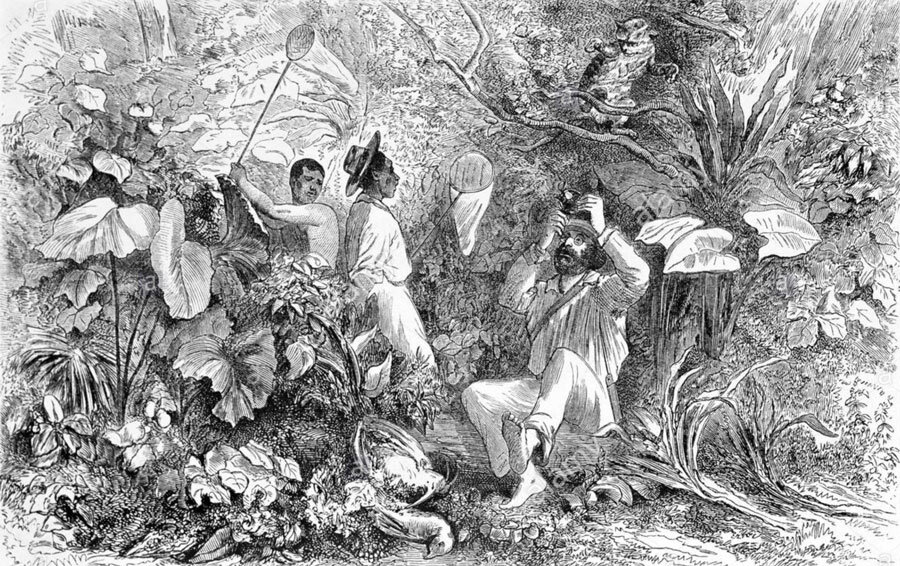
As it was a good business to export the bark to Europe, the South American countries put customs restrictions so that the seeds of Cinchona could not leave their lands and thus prevent this little tree from being planted on other continents and monopolizing its trade. But this did not last long, soon English merchants managed to convince an indigenous man named Manuel Incra to get a batch of seeds that they took to London and later sold to the Dutch at the price of gold. The story goes that the Dutch decided to take them to one of their colonies; more precisely to the island of Java, now part of Indonesia. Henceforth the Dutch supplied much of the world's demand for quinine.
Carbonated water, the invention of sensation in Europe
While quinine was causing a sensation as a medicine in Europe, a Geneva watchmaker named Johann Jacob Schweppe had managed to put carbon dioxide into the water, giving rise to the now popular carbonated waters or fizzy drinks. He founded a company and created various fruit-flavored drinks. By the second half of the 19th century, there were already several soft drink factories in England, experimenting with fruit and plant flavors. Soda drinks with healing properties could not be absent and eventually someone came up with the idea of adding quinine to carbonated water. It can be said that the invention of carbonated water and the discovery of quinine coincided in time and it was only a matter of finding a suitable head to conceive the idea.
The carbonated water with quinine was baptized with the name of tonic water, and the watchmaker Schweppe also jumped on the fashion train and brought out his own version of tonic water, which still lives on to this day under one of the best-known brands in the world: Schweppes Tonic Water.
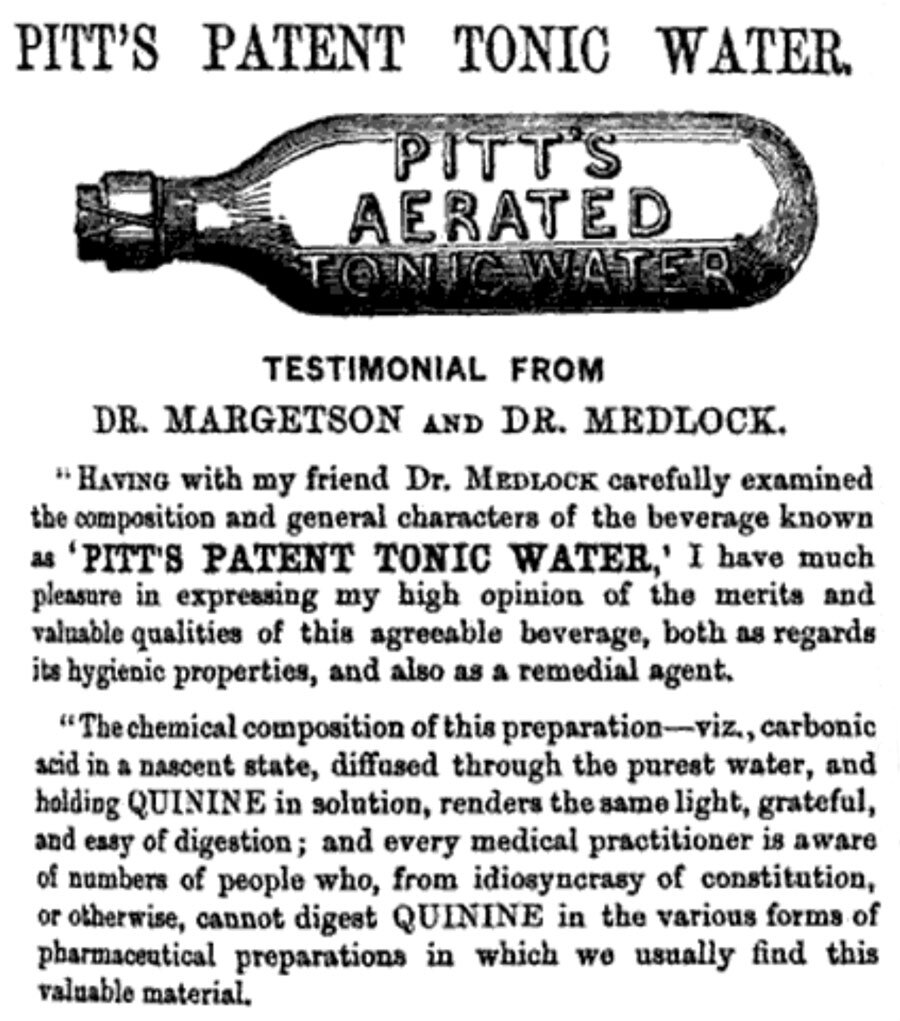
Schweppe was not the only one, several other manufacturers did the same and thus brands such as Cunnington's tonic water or Pitt's tonic water were born. They all touted the apparent health benefits of their products. The following is an advertisement that appeared in a London publication from 1861, describing the benefits of Pitt's tonic water.
Other interesting carbonated drinks also emerged, such as gingerade, which is nothing more than the well-known Ginger Ale of our times. That is, a drink based on ginger and carbonated water.
It happened one fine day that the English army that was stationed in India (then an English colony) was provided with a good dose of tonic water. The English had the wrong theory that tonic water not only relieved malaria but could also prevent it, so they decided to supply the army with this drink. What they did not calculate was that the tonic water tasted like "remedy" (in fact it was), since it was much more bitter then than it is today.
This caused the soldiers to not want to take it until someone had the fantastic idea of adding a little gin to it. You already know the rest of the story 😉
References
- Bernabé Cobo, Historia del Nuevo Mundo [1653], ed. Marcos Jiménez de la Espada, Seville: Sociedad de Bibliófilos Andaluces, 1890-1893, 4 vols. (description of the 'fever tree' of Loja). cervantesvirtual.com
- P. J. Pelletier and J. B. Caventou, "Recherches chimiques sur les quinquinas", Annales de Chimie et de Physique, 2nd ser., vol. 15, 1820, pp. 289-318 and 337-365 (isolation of quinine). archive.org
- Kim Walker and Mark Nesbitt, Just the Tonic: A Natural History of Tonic Water, Kew Publishing (Royal Botanic Gardens, Kew), 2019. shop.kew.org
Categories
The books · born from this blog
Atahualpa con su abrigo de pelo de murciélago
y otras 49 historias verdaderas que parecen mentira
Available on Amazon
Tocar madera
Pequeña historia de las supersticiones que el mundo no ha podido soltar
Available on Amazon
100 futuros
Cien escenarios del mundo que viene con la inteligencia artificial
Available on AmazonYou may also like
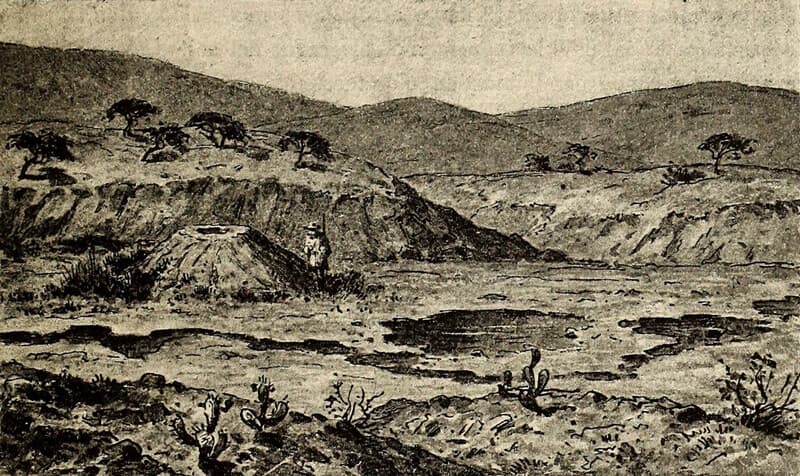
The Volcano of San Vicente
A tiny mud volcano once spat geysers of salty water on Ecuador's coast, and forgotten 19th-century writings reveal the wild site before tourism erased it.

The Men Who Carried Cuenca's Light on Their Shoulders
Electric light, the first car and even a protest jeep all reached Cuenca carried on human shoulders. The most epic isolation story in the Andes.

Knock on Wood: The Real Origin of the Superstition
Almost everyone thinks knocking on wood comes from Celtic tree worship. But the documented trail leads to a far more recent origin: a children's game.