
The Men Who Carried Cuenca's Light on Their Shoulders
Electric light, the first car and even a protest jeep all reached Cuenca carried on human shoulders. The most epic isolation story in the Andes.

Cuenca is a picturesque Ecuadorian city, set deep in the Andes and an inspiration to renowned writers. But it was not always easy to visit: for centuries it lived cut off from the rest of the country, without a single decent road leading to its charms. This is the story of how a city solved that confinement in the most literal way possible: by carrying things —an electric plant, an automobile, even a jeep— on the shoulders of its people.
One figure is enough to grasp the isolation: by 1926, the entire province of Azuay had barely 57 kilometers of main roads. Cuenca, the country's third largest city, lived days away by mule from anywhere.
The town born of the railroad
While the Trans-Andean Railroad linking the coast with the highlands was being built, Archer Harman's company —the celebrated Guayaquil & Quito Railway— saw a town spring up along its tracks: Huigra, in a beautiful canyon carved by the Chanchán River. The locomotive first reached it in 1902, the formal founding came in 1907 at the hands of Edward Morley —a supplier and partner of the company, who chose to be buried in the town— and in 1908 the G&Q installed nothing less than its general management there. The railroad, as usual, did not pass through Cuenca; neither did the National Highway. But Huigra was relatively close, so in 1903 the Council of Cuenca signed a contract with the railway company to maintain the bridle path that climbed toward El Tambo, in Cañar, from where a pre-existing trail descended to Cuenca.
Make no mistake: the journey on horseback could take days. But compared to nothing, that muddy little path became the great communication route between Cuenca and the world. Dozens of consignment agencies set up in Huigra, receiving merchandise from Guayaquil by train and loading it onto mules bound for Cuenca; so many Azuay merchants settled there that —it is said— they came to occupy an entire section of town, known as the Barrio Azuay.
The men of the guando
The most delicate or impossible loads did not travel by mule: they traveled on human shoulders. The protagonists were the guanderos, indigenous porters who carried on their backs a wooden litter called a «guando» —the word comes from Quichua and refers to carrying great weights on a stretcher—. They were mostly «concierto» laborers bound to the haciendas of Azuay and Cañar, descendants of the Cañari people —a chiefdom older than the Incas themselves, which fought them before being annexed to the Tahuantinsuyo— and they were famed as the most skilled at skirting precipices. On their guandos, sugar mills, church bells, lamps, mirrors and even European grand pianos unloaded at Guayaquil crossed the cordillera.
The light that arrived on shoulders
But the most astonishing mission ever entrusted to the guanderos was worthy of a film. The Cuenca businessman Roberto Crespo Toral decided his city would have electric light, and undertook it as a family venture: his brother-in-law Rafael María Arízaga, then a diplomat in Washington, bought in the United States a 37.5-kilowatt General Electric generator with its Pelton turbine, its switchboards, its transformers and its rolls of cable. All of it traveled by ship to Guayaquil and by train to Huigra. And from Huigra to Cuenca, the old way: it is said that up to three thousand guanderos were mobilized, with ox teams from the neighboring haciendas dragging the heaviest pieces. It is also told that several were lost along the way: some to exhaustion, some over the cliffs, others to illnesses caught during the crossing.
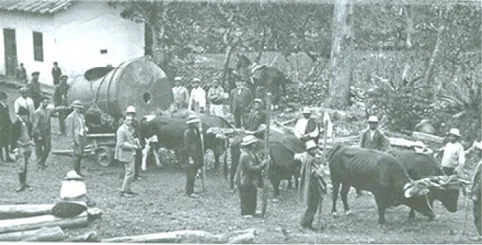
The machinery entered Cuenca around July 1914, and on August 10, at seven in the evening, the city lit up: five hundred bulbs illuminated the corner of Crespo's house, there were bands, bugles, bells ringing out, and a luminous sign that read, simply, «Luz en Cuenca» — Light in Cuenca.
That epic march left its mark on Ecuadorian literature: the novel Los guandos —begun by Joaquín Gallegos Lara in the 1930s and completed by Nela Martínez decades later— tells exactly that story: hundreds of indigenous porters carrying the machinery of light from Huigra to Cuenca.
The first car arrived before the first road
And since nobody is ever satisfied with what they have, light was followed by the automobile. The extremely curious thing is that cars were rolling through Cuenca as early as 1912, half a century before the railroad arrived and decades before any highway. The first was a French Clément-Bayard that businessman Federico Malo Andrade bought in Paris: it arrived just like the electric plant —disassembled, in pieces, on guanderos' backs— and was put together in the city. Its celebrated debut came in February 1913, carrying a newlywed couple to Ucubamba, the farthest point one could «drive» to. The pious ladies of the time, they say, crossed themselves swearing that the devil was rumbling through the streets.
The train, on the other hand, took its time: the first locomotive entered Cuenca only on January 6, 1965. Even the airplane had beaten it, by 45 years: the Italian pilot Elia Liut crossed the Andes and landed near the city in 1920. And when the train finally arrived, it arrived late: the Durán–El Tambo road had existed since 1947, and trucks had already stolen its cargo.
The day they carried a jeep
What was missing was the direct road to the coast. The government considered it all but impossible, so the people of Cuenca resorted to their lifelong formula: carrying something improbable on their backs — this time, as a protest. On the morning of Sunday, October 19, 1969, a Land Rover jeep —provided by the Cuenca tire factory, maker of General tires— rolled out of Calderón Park surrounded by some twenty drivers of the Club Deportivo Choferes (the drivers' union, more prudent, had refused), led by union leader Julio Bueno and by the parish priest of Molleturo, Roberto Samaniego, the great agitator of the cause. The crowd saw them off with cheers and accompanied them to the outskirts of the city.
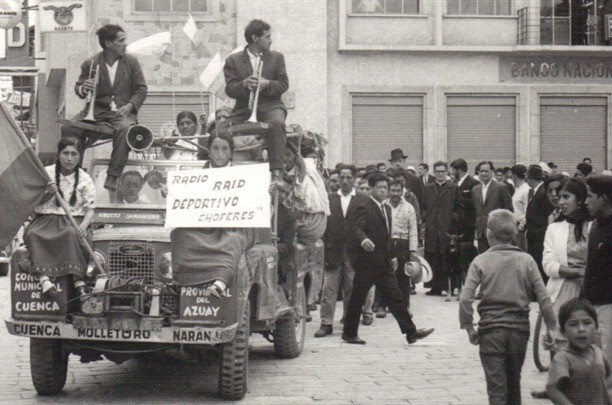
They followed the old «Garciano» trail —the route García Moreno had dreamed of toward the sea—: Sayausí, the Cajas highlands, Tres Cruces, Migüir, Molleturo. Where the jeep could roll, it rolled; where it could not, it was literally carried on shoulders, with some three hundred Molleturo villagers clearing the way with picks and shovels. Seven days later, at noon on October 26, the Land Rover rolled into Naranjal, on the coastal plain. They had proven, by the most Cuencan method possible, that the «impossible» road was a matter of wanting to build it.
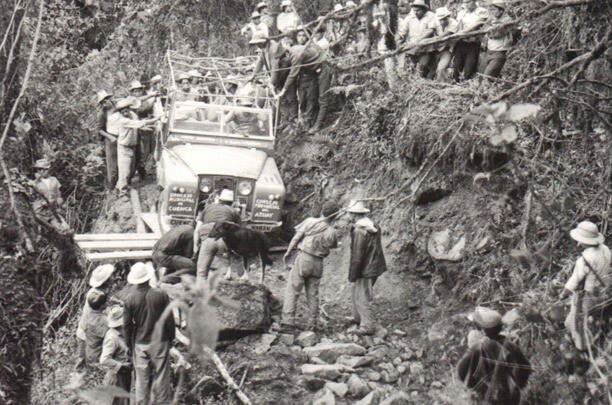
The gambit worked… halfway. On October 31, President Velasco Ibarra sent a DC-3 airplane to fly a delegation of the «raiders» to Quito, where they witnessed the signing of the contract to build the Cuenca–Molleturo–Naranjal highway. The paper, however, proved lighter than the jeep: real construction only began in the early 1990s, and the modern road —today's E582, crossing Cajas National Park— was finished at the end of that decade. The promise took twenty years to begin to be kept.
Today the trip from Cuenca to Guayaquil takes about three hours along that very route. Whenever the ride feels long, remember: there was a time when light, the first automobile and even the hope of a road all reached Cuenca the same way — on the shoulders of its people.
References
- Eugenio Lloret Orellana, «Los guanderos», Revista Avance, Cuenca, November 2013. revistavance.com
- Moisés Aveiga, «103 años han transcurrido desde que la luz llegó a Cuenca», El Telégrafo, August 19, 2017. eltelegrafo.com.ec
- Joaquín Gallegos Lara and Nela Martínez, Los guandos, Quito, Editorial El Conejo, 1982.
- «Hace cien años rodó el primer carro en Cuenca», Revista Avance, No. 248, Cuenca, July 2012. revistavance.com
- Jacinto Landívar Heredia, «1969 fue el año del memorable raid Cuenca-Molleturo-Naranjal», El Telégrafo, July 9, 2016. eltelegrafo.com.ec
- Ricardo Tello Carrión, «Raid Cuenca-Molleturo-Naranjal, 40 años después», El Universo, September 17, 2009. eluniverso.com
Categories
The books · born from this blog
Atahualpa con su abrigo de pelo de murciélago
y otras 49 historias verdaderas que parecen mentira
Available on Amazon
Tocar madera
Pequeña historia de las supersticiones que el mundo no ha podido soltar
Available on Amazon
100 futuros
Cien escenarios del mundo que viene con la inteligencia artificial
Available on AmazonYou may also like
The Volcano of San Vicente
A tiny mud volcano once spat geysers of salty water on Ecuador's coast, and forgotten 19th-century writings reveal the wild site before tourism erased it.

The miraculous malaria cure that became a gin and tonic
The malaria cure born from Andean cinchona bark became quinine, then tonic water, and finally the gin and tonic we still raise in our glasses.
Knock on Wood: The Real Origin of the Superstition
Almost everyone thinks knocking on wood comes from Celtic tree worship. But the documented trail leads to a far more recent origin: a children's game.