
Rescuing the Bardellini Tower
It stood on Guayaquil's Malecón for only four years before falling to a structural miscalculation. I rebuild in 3D the clock tower the city almost forgot.
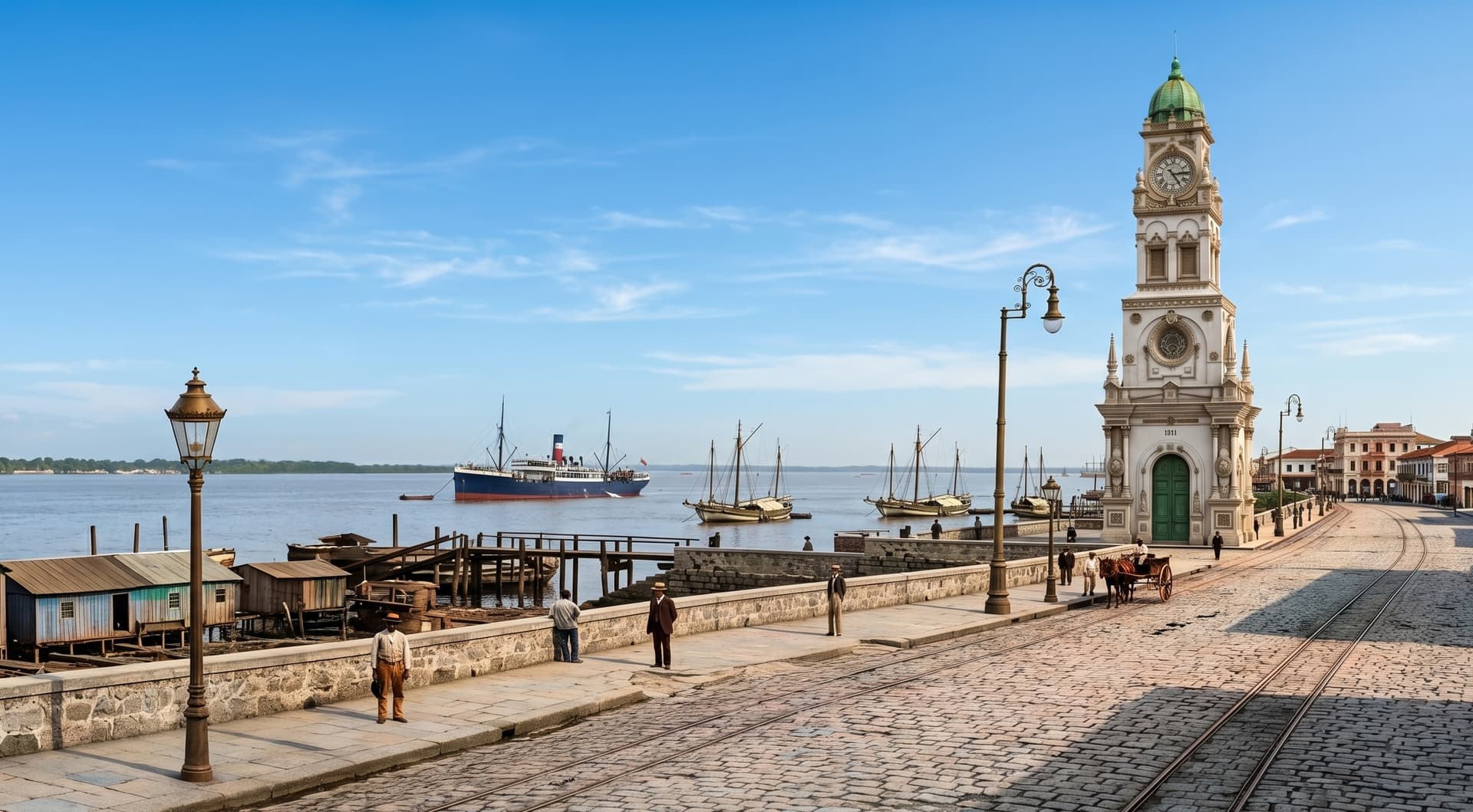
There are buildings that disappear and yet keep circling around in your head.
It’s not that they’re in the way. They keep circling, precisely, because they’re no longer there. That’s what happened to me with the Bardellini Tower. I had seen it a few times in old photos of Guayaquil’s Malecón, but almost always the way things appear when history didn’t have time to portray them well: in the background, blurred, hidden behind cables and posts, clipped by the bad luck of having existed before everyone carried a camera in their pocket.
It isn’t the Moorish Tower we know today — it’s an earlier one: a strange, elegant, fleeting experiment that for barely four years held up Guayaquil’s public clock.
It was built on the Malecón, across from 10 de Agosto Street. The contract went to engineer Nicolás Virgilio Bardellini —whose name it took— and it was inaugurated on April 25, 1923. It stood about 23.5 meters tall, was made up of four cubic volumes growing upward, and ended in a dome. The mechanism of the municipal clock was installed at the top (Urbipedia — Torre del Reloj, Guayaquil).
It didn’t last long. In 1927 the clock was taken down, stored away, and the tower demolished. The reason that keeps coming up in the chronicles is blunt and simple: the structure had calculation problems and couldn’t properly support its own weight.
It’s one thing to know that a tower once existed. It’s quite another to know what it looked like. There’s no detailed plan, no descriptive report, no high-resolution photograph that tells us for sure. Reconstructing it in 3D, working from the surviving images and the architectural language of the period, is the most honest way I can find to say: “maybe it looked like this.”
3D model of the Bardellini Tower
Drag with the mouse or your finger to rotate it; use the wheel or pinch to zoom in.
A transitional tower
Before the Bardellini, the public clock had moved through other places. There are references to clocks and towers going back to colonial times, even linked to the Jesuits, and later the clock was installed in the Casa del Cabildo. In 1842 a new mechanism arrived from England, brought in during Vicente Rocafuerte’s government, and that clock would go on to live inside Guayaquil’s successive towers.
After the Bardellini came the Moorish Tower, inaugurated in 1931, the one we know today near the City Hall (Municipality of Guayaquil — Moorish Tower). The Bardellini was, rather, the in-between tower: an idea of city that was raised, tested, failed structurally, and was replaced.
That period matters. Guayaquil was moving from an architecture dominated by wood to one heavier, more “modern,” more fire-resistant, built with cement, iron, and concrete. By the late twenties and early thirties, concrete construction was already widespread, and several construction companies —including firms with Italian engineers— played an important role in that urban transformation (El Telégrafo — The architecture of Guayaquil).
It was a modernity with ornaments: cornices, domes, pilasters, arches, oversized clocks, and buildings that spoke with solemnity. It’s no coincidence that a few years later the Moorish Tower would adopt an even more recognizable language, with its Arab-Byzantine dome and Moorish details. The Bardellini, by contrast, was something else: less famous, less long-lived, perhaps less refined. But not for that reason any less interesting.
Sources
- Urbipedia — Torre del Reloj de Guayaquil
- Municipality of Guayaquil — The Moorish Tower turns 92
- El Telégrafo — The architecture of Guayaquil and the Bicentennial
The Bardellini Tower is one more piece of the Guayaquil that only half-survives in old photographs. Keep rescuing that memory: the hidden details in a photo of a tram, the city in restored video, and more corners of the country in Ecuador.
Categories
The books · born from this blog

Atahualpa con su abrigo de pelo de murciélago
y otras 49 historias verdaderas que parecen mentira
Available on Amazon
Tocar madera
Pequeña historia de las supersticiones que el mundo no ha podido soltar
Available on Amazon
100 futuros
Cien escenarios del mundo que viene con la inteligencia artificial
Available on AmazonYou may also like

The Transistor: The Tiny Switch That Built the Digital Age
In 1947, three Bell Labs physicists invented the transistor and shrank electronics forever. The story of the tiny switch that built the digital age.

Tagua: the Vegetable Ivory That Buttoned Europe
Tagua, the seed of an Ecuadorian palm, mimicked ivory and buttoned the world's clothes for decades, until cheap plastic pushed it aside almost overnight.
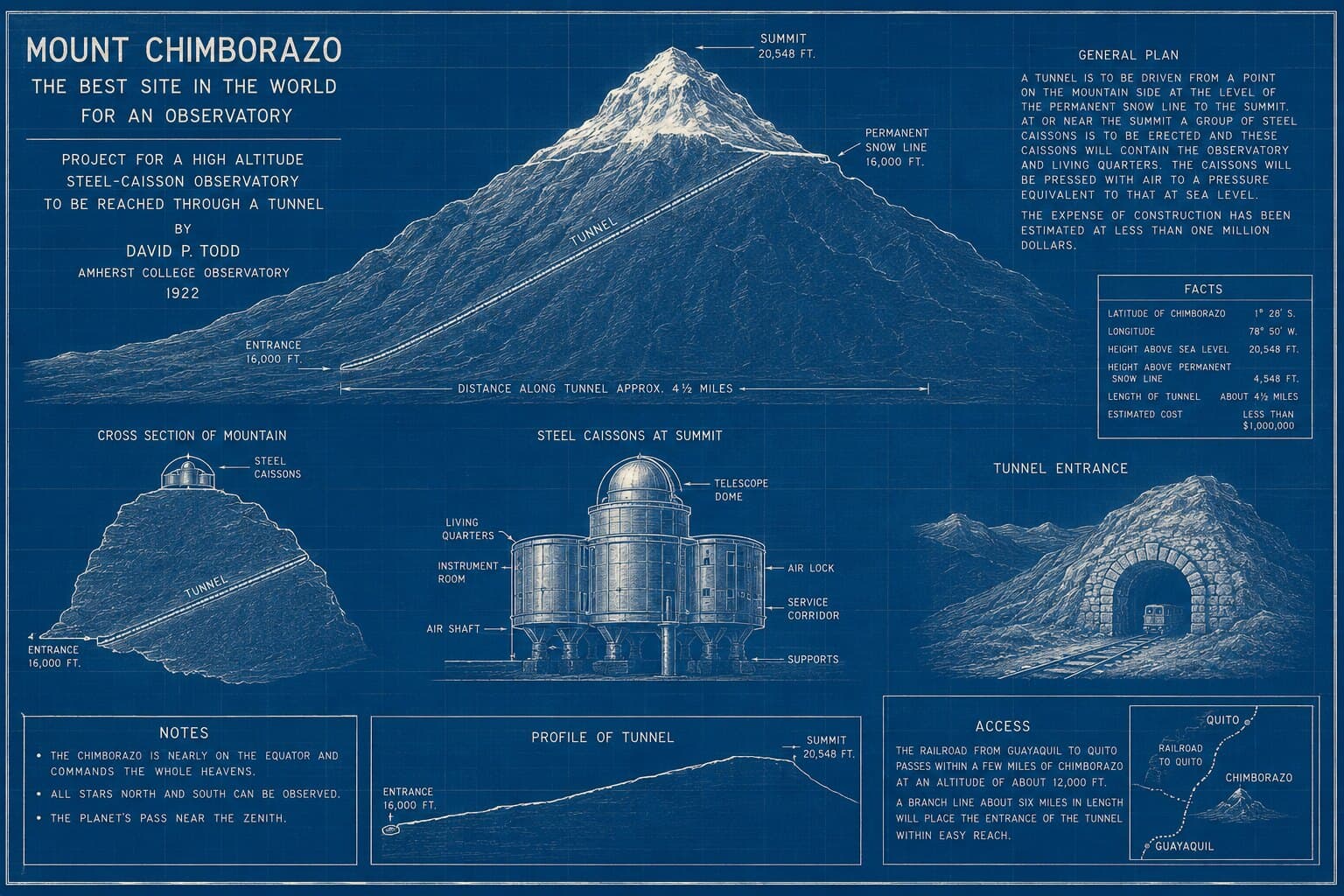
David Todd and his tunnel to the top of Chimborazo
In 1922 astronomer David P. Todd proposed boring a tunnel into Chimborazo all the way to the summit to build a pressurized steel observatory inside it.