
Serendipity: The Word Born in a Letter From 1754
Few words have an exact birth certificate. Serendipity was born on January 28th, 1754, in a private letter — and its root is the old name of Sri Lanka.
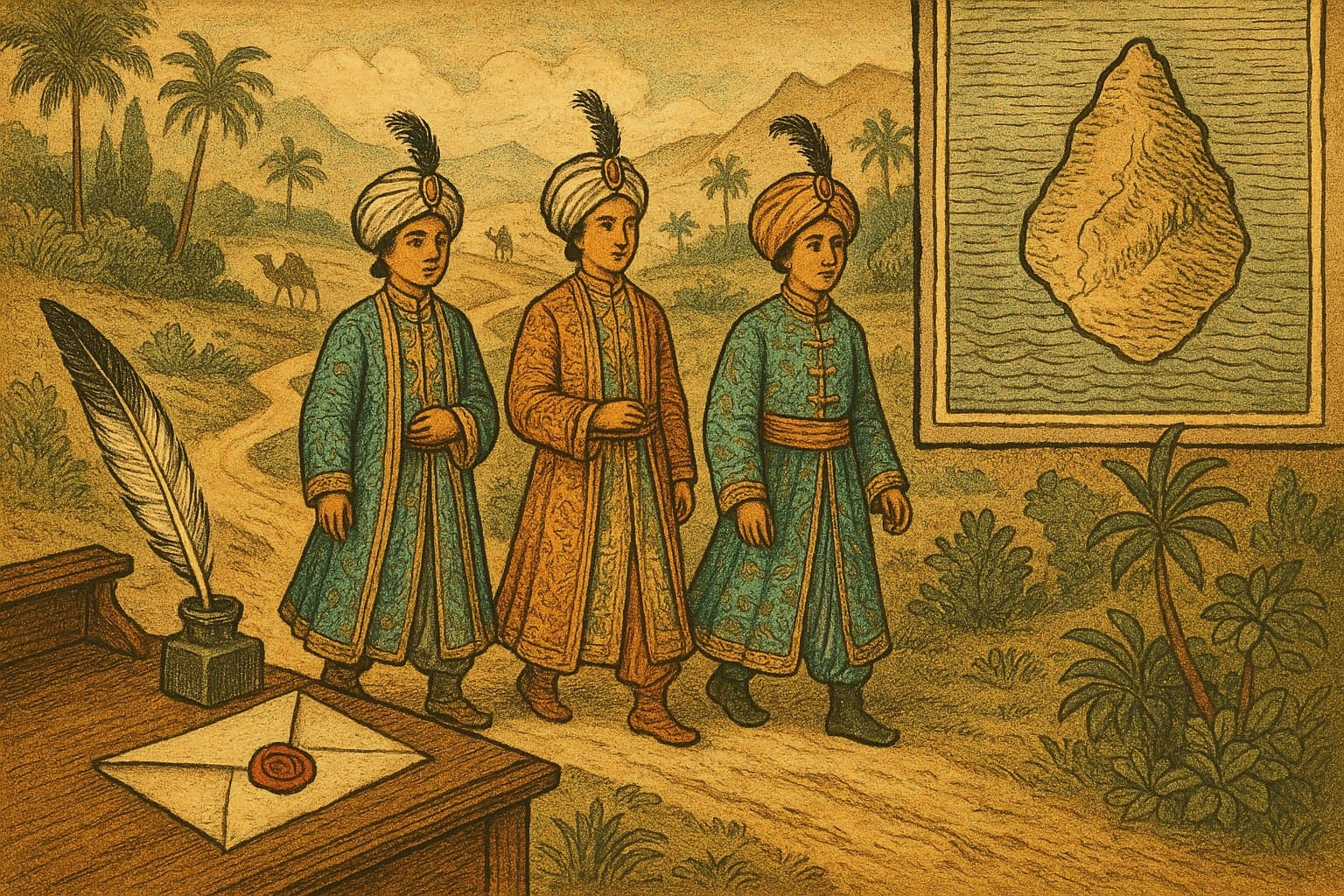
Words, as a general rule, have no birth certificate: they simmer for centuries in anonymous mouths, and by the time someone writes them down they have been rolling around for generations. That is why serendipity is a collector's rarity: we know the exact day it was born —January 28th, 1754—, we know who invented it, in what document, and even what mood its author was in. It is the word we use for the happy finds we weren't looking for, and its own history is, fittingly, a chain of coincidences: an idle earl, a Persian tale, and the old name of Sri Lanka.
An earl with too much free time
Horace Walpole was the son of Britain's first prime minister, owner of a whimsical little Gothic castle, and author of the first horror novel in history. But his great work was his correspondence: thousands of delicious letters written over decades to his friends. In one of them, addressed to his friend Horace Mann, a diplomat in Florence, Walpole told him —delighted with himself— about a small discovery he had just made by sheer fluke while researching a coat of arms. And since English had no word for that kind of find, he manufactured one on the spot: serendipity, explaining that he took it from a fairy tale he had read, “The Three Princes of Serendip”, whose protagonists “were always making discoveries, by accidents and sagacity, of things which they were not in quest of”.
The detective princes
The tale deserves its own paragraph. Published in Venice in 1557 as a translation of Eastern stories, it narrates the journey of three princes of Serendip — and Serendip is none other than the old Persian and Arabic name of Sri Lanka, derived in turn from Sanskrit. In the most famous episode, the princes cross paths with a merchant who has lost a camel and, without ever having seen it, describe it in detail: blind in one eye, missing a tooth, lame, loaded with butter on one side and honey on the other. Accused of stealing it, they explain their deductions: the grass eaten only on the uglier side of the road (one eye), the badly cut mouthfuls (the tooth), the tracks of a dragged foot (lame), the ants on one side of the road and the flies on the other (butter and honey). Sherlock Holmes, a hundred and thirty years before Sherlock Holmes — Voltaire in fact borrowed the episode for his Zadig. The detail matters: the princes weren't merely lucky; they were ferocious observers of other people's accidents. Walpole chose his tale well.
The sleeping word
What followed is the second oddity of this story: nobody cared about the word. It slept in that private letter for decades, was used a handful of times in the 19th century among eccentric bibliophiles, and only truly woke up in the 20th century, when scientists —who knew perfectly well how many of their great discoveries had arrived sideways— adopted it as the technical term for fruitful chance. From there it exploded into common speech. It reached Spanish so late that the Royal Academy only admitted serendipia into its dictionary in 2014: a word two hundred and seventy years old that in Spanish is practically a newborn. We have already met, in this series, another word with a birth certificate — petrichor, invented by two chemists in 1964; serendipity is its literary great-aunt.
The accident is not enough
The roll call of celebrated serendipities is the word's best argument: penicillin, which arrived in a mold that ruined Fleming's culture; the microwave oven, discovered because a radar melted an engineer's chocolate bar; X-rays, the Post-it, Velcro. But Walpole's nuance —that “by accidents and sagacity”— is what separates serendipity from plain luck: the mold fell on Fleming as it could have fallen on anyone; what wasn't just anyone's was looking at the ruined dish and seeing an antibiotic. As Pasteur would put it, chance favors the prepared mind.
And there remains the final irony, very much from this side of the world: the greatest accidental discovery in history happened when a Genoese sailed out to find the Indies and bumped into an entire continent — ours. Columbus starred in the supreme serendipity and failed at half the recipe: he had the accident, but not the sagacity, and died convinced he had been to Asia. The three princes of Serendip would have deduced the truth from three footprints and a couple of ants.
References
- Horace Walpole, letter to Horace Mann, 28 January 1754, in The Yale Edition of Horace Walpole's Correspondence, ed. W. S. Lewis, New Haven: Yale University Press, vol. 20, pp. 407–411. Digital facsimile: Yale University Library. libsvcs-1.its.yale.edu
- Robert K. Merton and Elinor Barber, The Travels and Adventures of Serendipity, Princeton: Princeton University Press, 2004, ch. 1 ("The Origins of Serendipity"). assets.press.princeton.edu
- Oxford English Dictionary, "serendipity, n.", Oxford University Press (online entry): earliest evidence 1754, Horace Walpole. oed.com
- Real Academia Española and ASALE, "serendipia", Diccionario de la lengua española, 23rd ed., 2014 (word first included in that edition). dle.rae.es
Enjoy the stories behind words? Continue with procrastination, the vice that infuriated the Romans and the chilling origins of the word “defenestrate”, or browse the whole etymology series.
Categories
The books · born from this blog
Atahualpa con su abrigo de pelo de murciélago
y otras 49 historias verdaderas que parecen mentira
Available on Amazon
Tocar madera
Pequeña historia de las supersticiones que el mundo no ha podido soltar
Available on Amazon
100 futuros
Cien escenarios del mundo que viene con la inteligencia artificial
Available on AmazonYou may also like
Cipher and zero: two words born from the same void
«Cipher» and «zero» come from the same Arabic word, sifr, meaning «empty». How one void gave us two words that today seem like opposites.
Algebra: the Arabic word that also set broken bones
«Algebra» comes from the Arabic al-jabr, «to reunite broken parts». A book by Al-Khwarizmi gave birth to a science, and in medieval Spain an «algebrista» set bones.
The origin of the word alcohol: from makeup to the glass
«Alcohol» comes from the Arabic «al-kuhl», a black powder used as eye makeup. How a cosmetic ended up naming the most famous drink in the world.