
When the Amazon Was the Richest Place on Earth
The rubber boom raised an opera house in the jungle and delirious fortunes in Manaus and Iquitos. Then 70,000 seeds wiped it off the map.
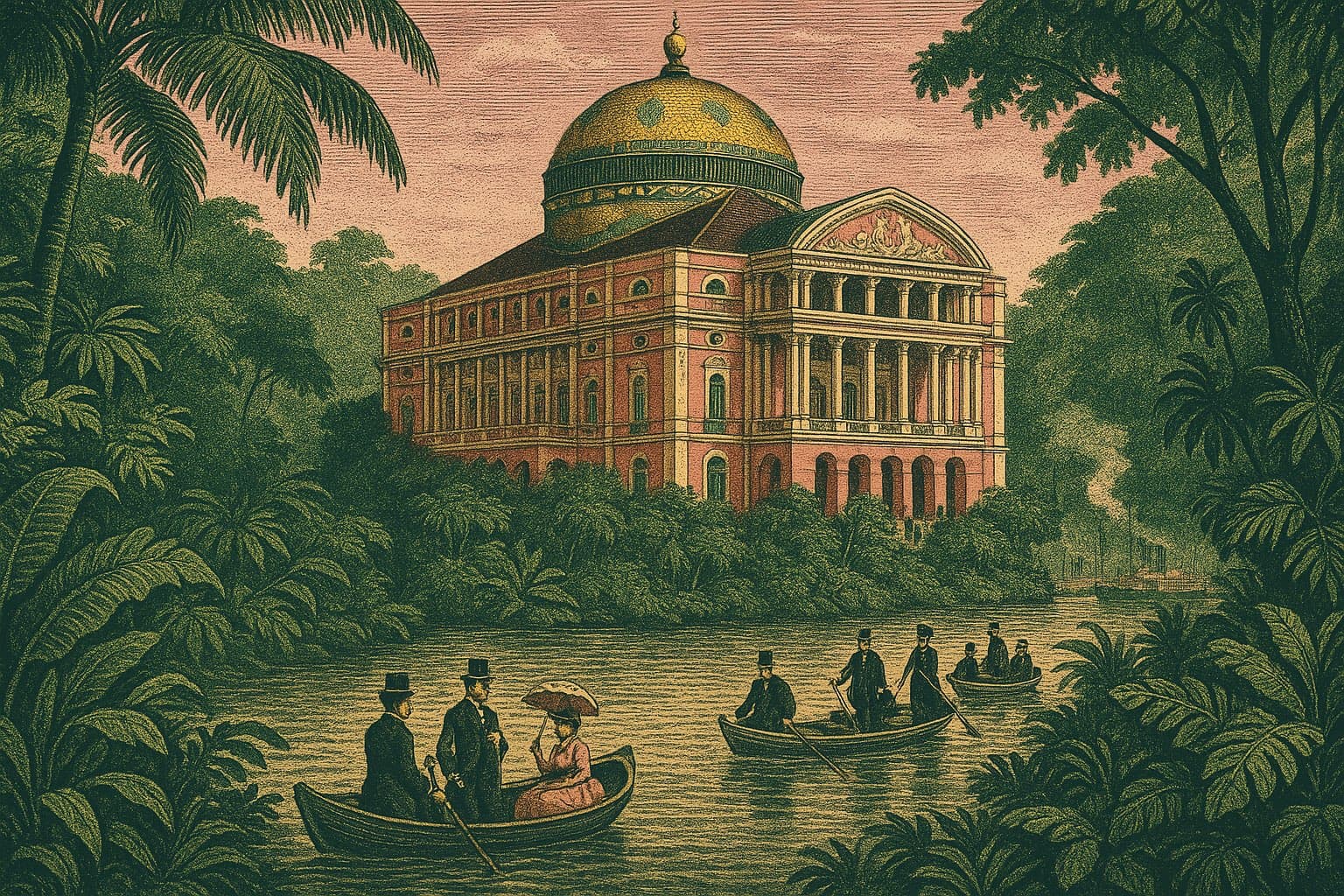
In the heart of the Amazon rainforest, fifteen hundred kilometers from the sea, there is an opera house with a dome of 36,000 glazed tiles, Carrara marble, French chandeliers and Glasgow steel. The Teatro Amazonas of Manaus opened on the last night of 1896, and its mere existence sums up one of the most delirious eras in the Americas: the three decades when the Amazon was, per capita, one of the richest places on the planet. All thanks to a tree that wept elastic milk — and all destroyed by a handful of smuggled seeds.
The weeping tree
The Hevea brasiliensis, the rubber tree, grew wild and scattered across the Amazon basin, and for centuries its latex was little more than a curiosity. Until industrialization discovered it needed the stuff for everything: hoses, belts, insulation, and finally the invention that drove prices mad — the tire. Between 1880 and 1910, the entire world rolled on rubber, and all the world's rubber came out of the Amazon. Manaus in Brazil and Iquitos in Peru went from villages to capitals of luxury: Manaus had electric streetcars by 1899, earlier than most European cities, plus telephones, sewers, and the opera house where companies brought from Italy performed.
The legends of the era are so good they must be handled with tongs, and this house has rules: it is said that the rubber barons sent their laundry to Lisbon and Paris —the rational version says the dark waters of the Rio Negro stained white linen—, and it is said that they lit cigars with banknotes. Documented or not, that was the spirit. And Iquitos preserves its own relic, debunking included: the famous Casa de Fierro (Iron House), bought by a rubber baron at the 1889 Paris Exposition and reassembled piece by piece in the middle of the jungle. Half the internet attributes it to Gustave Eiffel; the records point to a design by the Belgian Joseph Danly and workshops in his country. Even the souvenirs of the rubber boom have false etymologies.
The dark side of paradise
It must be said without ornament: that wealth was extracted with blood. Wild rubber isn't harvested on plantations but tree by tree, deep in the forest, and the system that made it profitable was the forced peonage of Indigenous peoples. The most atrocious case, that of the Casa Arana on the Putumayo —in territory disputed between Peru and Colombia—, was so brutal it triggered an international investigation: the British consul Roger Casement documented slavery, torture and extermination, and his report, published in 1912, scandalized the world. Estimates of Indigenous deaths in that single region run from tens of thousands upward. The Manaus opera house was paid for with that.
The 70,000 seeds
The end of the rubber empire has a date, a protagonist and an economic moral. In 1876, the Englishman Henry Wickham shipped from Santarém some 70,000 hevea seeds —the figure is his own, and historians note that Brazil didn't even prohibit exporting them at the time, so the famous “theft of the century” was really a shipment without drama— bound for Kew Gardens in London. Fewer than four thousand germinated, but they sufficed: from those seedlings came the orderly plantations of Ceylon and Malaya, where the trees grew in rows and the harvest cost a fraction. By 1913, Asian rubber had overtaken the Amazonian kind, prices collapsed, and the entire region fell into ruin with a speed we already know on this blog: that of every bubble — only this one was made of sap, not bulbs.
The monuments of the hangover remain: the opera house that spent decades nearly silent, the Iron House converted into shops, and the story of Fitzcarrald —the Peruvian rubber baron who in 1894 had a steamship hauled disassembled across a jungle isthmus by Indigenous forced labor; when Herzog made the film, he dragged the ship whole, which is more cinematic but less true. The Amazon went back to being whatever the world market chooses to ignore between fevers. From that delirium endures one lesson that never expires: wealth that depends on a single product lasts exactly until someone, somewhere else in the world, gets the seeds to germinate.
References
- Warren Dean, Brazil and the Struggle for Rubber: A Study in Environmental History, Cambridge University Press, 1987. cambridge.org
- Angus Mitchell, "The Putumayo Atrocities", Oxford Research Encyclopedia of Latin American History, Oxford University Press, 15 Jan 2015. DOI: 10.1093/acrefore/9780199366439.013.1111. doi.org
- Warren Dean, Brazil and the Struggle for Rubber: A Study in Environmental History, Cambridge University Press, 1987 (collapse of Amazonian rubber against Asian plantations). cambridge.org
Categories
The books · born from this blog
Atahualpa con su abrigo de pelo de murciélago
y otras 49 historias verdaderas que parecen mentira
Available on Amazon
Tocar madera
Pequeña historia de las supersticiones que el mundo no ha podido soltar
Available on Amazon
100 futuros
Cien escenarios del mundo que viene con la inteligencia artificial
Available on AmazonYou may also like
The history of the stethoscope and Laennec's modesty
In 1816 a French doctor felt too awkward to press his ear to a patient's chest, so he rolled up paper — and the stethoscope was born.

Placebo: the Latin word that means «I shall please»
«Placebo» means «I shall please» in Latin and began as a medieval funeral chant. Here is how it jumped from the church to medicine and its famous effect.
Scurvy: the disease that killed more sailors than storms
Scurvy killed more sailors than battles and shipwrecks combined. Its cure was discovered, forgotten, and rediscovered over and over for centuries.