
Narcissus Didn't Fall in Love With Himself: The Myth Behind “Narcissist”
Half the internet wants to know what a narcissist is. The Greek myth that named the word doesn't tell the story you think — and it's far better.
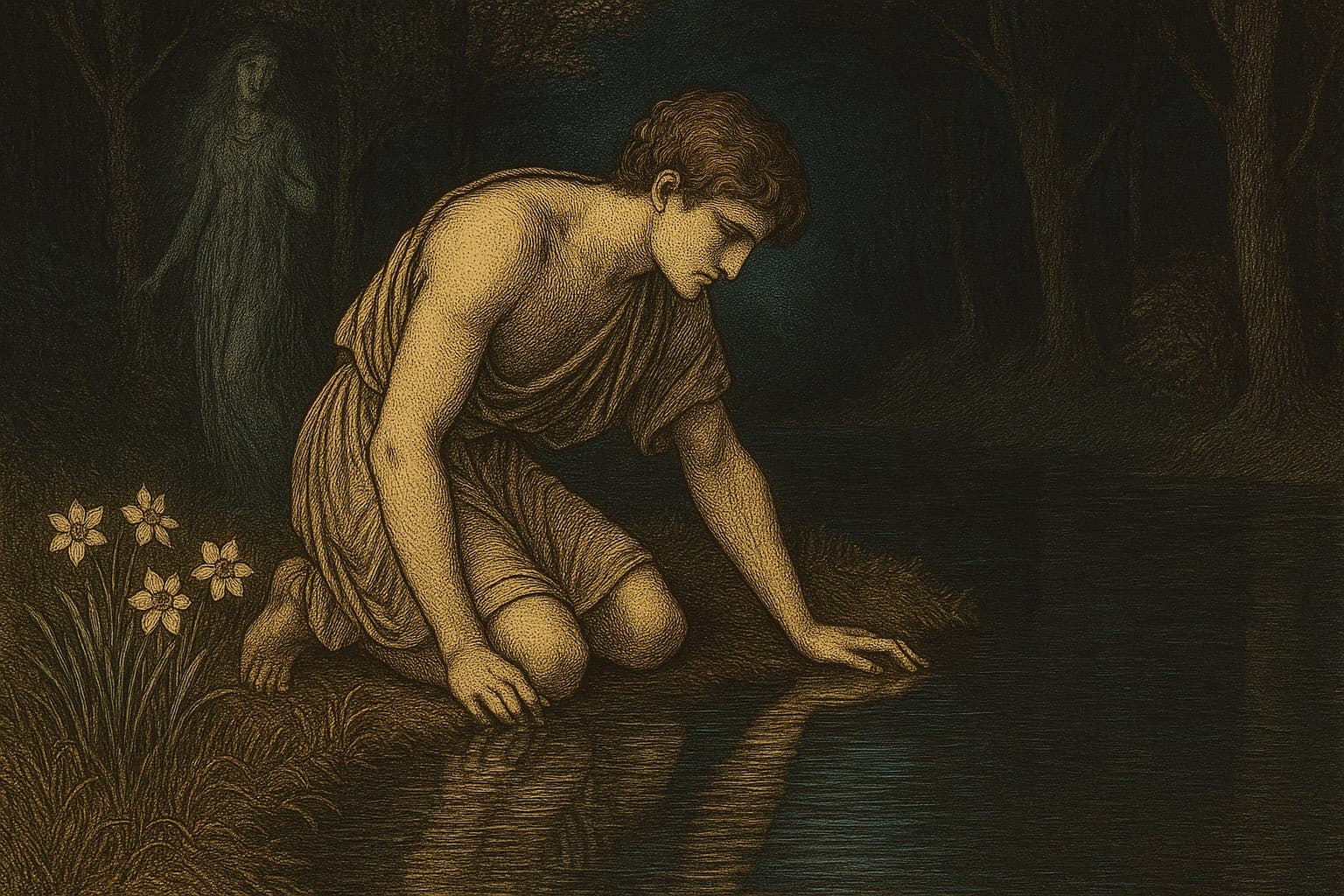
Few words work as hard these days as narcissist. Half the internet looks it up to diagnose the boss, the ex or the brother-in-law, and we all think we know the myth behind it: Narcissus, the youth so vain he fell in love with his own reflection and drowned in the pool. It makes a fine fable against vanity. The problem is that the original myth doesn't say that. What Ovid wrote two thousand years ago is stranger, sadder and —here is the interesting part— far closer to the narcissist modern psychologists describe than the cartoon version is.
The prophecy turned inside out
In Ovid's Metamorphoses, the story begins with a consultation. Narcissus' mother asks the seer Tiresias whether her scandalously beautiful son will live to old age. The blind man's answer is one of the sharpest lines in ancient literature: he will live long... “if he never comes to know himself.” Read it twice: it is the famous “know thyself” of the Delphic oracle, the founding motto of Greek wisdom, inverted. For this boy, self-knowledge will not be a virtue but a death sentence. The whole myth hangs from that irony.
Echo, the lover who could only repeat
Before the pool, the myth gives us another story — and another word. The nymph Echo, punished by Juno so that she can say nothing of her own, only repeat the last words of others, falls in love with Narcissus and follows him through the woods unable to declare herself: she can only hand him back his own phrases. Rejected like every other suitor, she wastes away with grief until nothing remains of her but sound — the voice that still answers us in mountains and empty rooms. Yes: the same story gave us both “narcissist” and “echo”, two words that each describe, in their own way, a conversation with oneself.
The detail everyone forgets: he didn't know it was him
One of the spurned suitors prays for justice, and Nemesis, goddess of retribution, grants it. Narcissus leans over a still pool to drink and sees an exquisitely beautiful face. And here is the heart of the matter, the part the cartoon version skips: Narcissus does not know it is him. He believes it is someone else: a youth of the water, perfect, who smiles when he smiles and leans in when he leans in. He doesn't fall in love with himself; he falls in love with a stranger who doesn't exist. He spends hours, days, begging that creature to come out of the water, unable to understand why it mimics him and never reaches him.
The tragedy arrives with lucidity. In the most famous line of the episode, Narcissus understands: “iste ego sum” — “that one is me!”. Tiresias' prophecy is fulfilled: he has come to know himself, and it kills him. And he doesn't even die the way the popular version says: in Ovid he doesn't drown — he stays at the edge, unable to leave, consumed by a love without an object until he fades away, as Echo did before him. When the nymphs come for the body, they find in its place a white and yellow flower bending toward the water: the narcissus. (Etymological bonus: the flower's name is associated with narke, “numbness” — the same root as narcotic. Narcissus and anesthesia are linguistic relatives, which, on reflection, is quite a commentary.)
There are stranger variants still: a papyrus discovered in Egypt preserves a version older than Ovid in which the ending is a suicide, and the traveler Pausanias recorded a moving rationalist version: Narcissus gazed into the pool to remember his dead twin sister, identical to him — he wasn't admiring himself: he was grieving with the only photograph antiquity could offer.
From myth to diagnosis: what is a narcissist?
So how did this boy end up in the consulting room? In the late 19th century, the pioneers of psychiatry borrowed the myth to name love directed at one's own body; Freud elevated it to a central concept in 1914 with On Narcissism, and in 1980 narcissistic personality disorder entered the diagnostic manuals. From there it descended, brakes off, into pop psychology, where “narcissist” today means approximately “person who hurt me”.
But serious psychology holds a surprise that returns the myth to its original shape: the clinical narcissist is not someone who loves himself. He is, in the most accepted description, someone who loves a grandiose, idealized image of himself — an embellished reflection — precisely because he cannot bear to look at what lies beneath. That is: someone in love with a stranger in the water whom he does not recognize as his own. Ovid wrote it down twenty centuries ago with textbook precision: Narcissus' problem was never loving himself too much, but not knowing himself at all. Tiresias, as usual, was right — and language, as we saw with “travel” and its torture device, keeps the nuances better than our memory does.
References
- Ovid, Metamorphoses, Book III, lines 339-510 (Echo and Narcissus episode; "iste ego sum" at line 463), Spanish edition and translation by Consuelo Álvarez and Rosa M.ª Iglesias, Madrid, Cátedra (Letras Universales, 228), 1995.
- Pausanias, Description of Greece, 9.31.7-9, trans. W. H. S. Jones (Loeb Classical Library); Spanish trans. M.ª Cruz Herrero Ingelmo, Madrid, Gredos, 1994. perseus.tufts.edu
- Sigmund Freud, "On Narcissism: An Introduction" [Zur Einführung des Narzißmus, 1914], in Obras completas, vol. XIV, trans. José Luis Etcheverry, Buenos Aires, Amorrortu, 1979 (Standard Edition, vol. XIV).
Enjoy the stories behind words? Continue with why “bizarro” doesn't mean what you think and serendipity, the word born in a letter from 1754, or browse the whole etymology series.
The books · born from this blog

Atahualpa con su abrigo de pelo de murciélago
y otras 49 historias verdaderas que parecen mentira
Available on Amazon
Tocar madera
Pequeña historia de las supersticiones que el mundo no ha podido soltar
Available on Amazon
100 futuros
Cien escenarios del mundo que viene con la inteligencia artificial
Available on AmazonYou may also like

Chicle: the Maya resin behind your chewing gum
Chewing gum wasn't born in a factory: chicle was tree sap the Maya and Aztecs chewed for centuries before Wrigley ever wrapped it in pink paper.

The origin of the word sabotage: the clog myth
«Sabotage» does not come from throwing clogs into machines: that is the legend. The real word was born from the clatter of wooden shoes.

Assassin: the mountain sect and the hashish myth
«Assassin» comes from the Arabic hashshashin, «hashish users»: the nickname of a medieval sect led by Hasan-i Sabbah from the fortress of Alamut.