
The Doctor Who Toasted With Bacteria and Won a Nobel
Nobody believed a bacterium caused ulcers. Fed up, Barry Marshall drank a culture of it, made himself sick on purpose, and changed medicine.
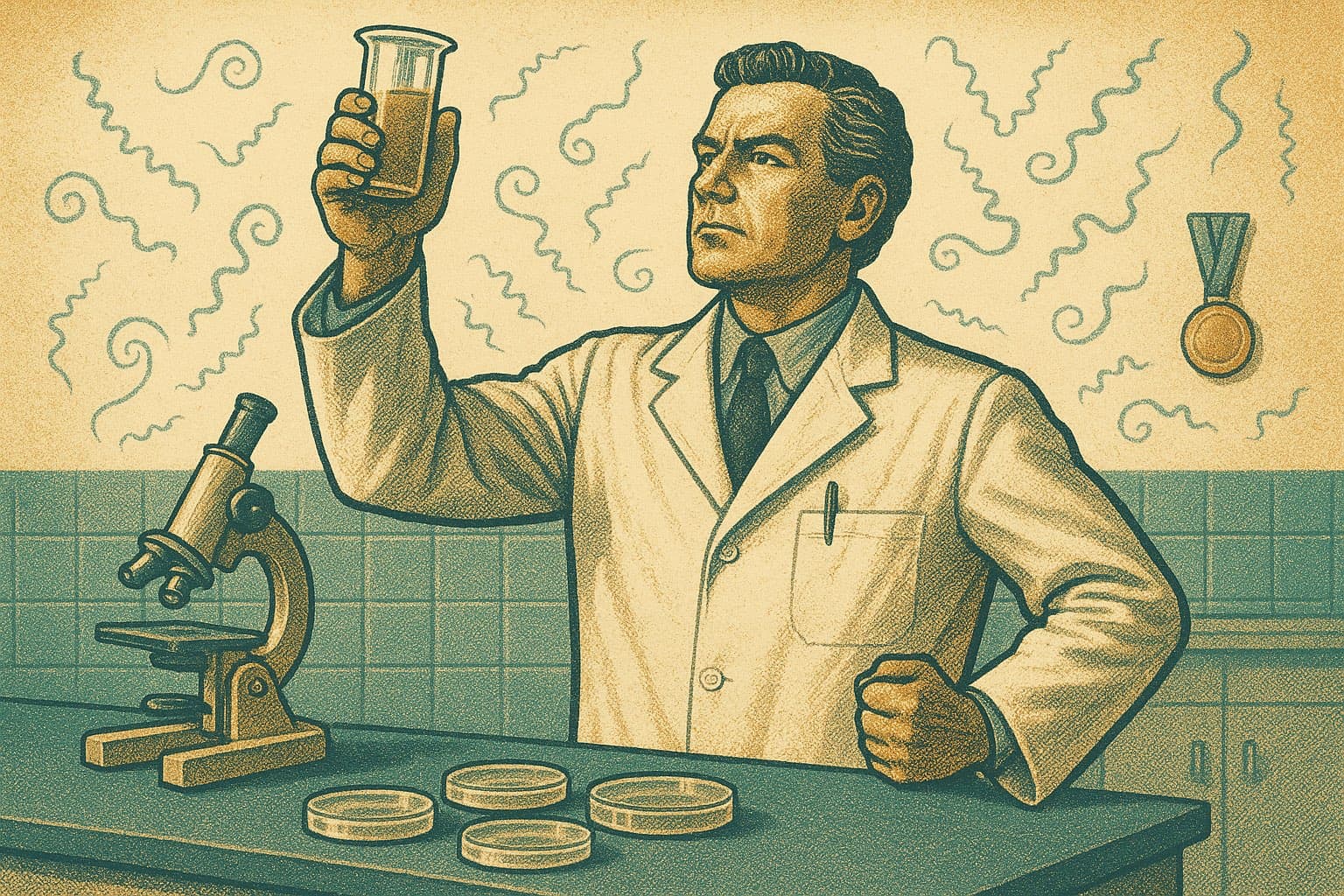
In 1984, a 32-year-old Australian doctor walked into his laboratory, prepared a cloudy broth with billions of bacteria taken from the stomach of a sick patient, and drank it down in one gulp. It was neither an accident nor an act of madness: it was, quite possibly, the most stubborn and elegant experiment in modern medicine. His name was Barry Marshall, he was furious that nobody believed him, and twenty-one years later that glass of bacteria took him to Stockholm to receive the Nobel Prize.
The dogma everyone repeated
You have to understand what he was fighting against. In the 1980s, “everyone knew” that stomach ulcers were caused by stress, spicy food and excess acid. It was one of medicine's most solid certainties: the stomach, with its brutal acidity, was a sterile environment where no bacterium could survive. Treatments calmed the acid temporarily, the ulcer came back, and a multibillion-dollar pharmaceutical business lived comfortably off that perpetual relapse. The patient never fully recovered, but the model worked — for everyone except the patient.
The bacteria that weren't supposed to exist
Marshall, a young physician, crossed paths with an older, meticulous pathologist, Robin Warren, who had for some time been seeing something impossible under the microscope: spiral-shaped bacteria living quite happily in the stomachs of patients with gastritis and ulcers. The organism —which today we call Helicobacter pylori— not only survived the acidity: it seemed to cause the damage. Together they formulated a heretical hypothesis: ulcers are an infection, and they are cured with antibiotics.
The medical establishment's reaction was contempt. Marshall and Warren's papers were rejected, ridiculed at conferences, treated as the notions of provincials —they worked in Perth, at the far edge of the academic world. The problem, moreover, was real: ethics forbade them from deliberately infecting a healthy person to prove causation, and in animals the bacterium wouldn't take. The hypothesis was stuck for lack of a guinea pig.
“I am the guinea pig”
Here Marshall made the decision that turned him into a legend. If he couldn't infect anyone, he would infect himself. He first had an endoscopy to prove his stomach was healthy, and then he drank the culture of H. pylori. Within days the ordeal began: nausea, vomiting, bad breath, exhaustion. The follow-up endoscopy confirmed it: his healthy stomach had filled with inflammation and with the very same bacteria, in a matter of days. He had demonstrated in his own body, beyond any possible argument, that the microbe caused the disease. Then he cured himself with antibiotics — closing the experiment with the final proof: if antibiotics cured him, they cured the cause.
As the anecdote goes, he didn't even warn his wife before drinking it; she found out when he came home sick. Heroic science is rarely considerate of the family.
From heretic to laureate
The evidence was so brutal that the dogma began to give way, though it took medicine years to swallow its pride. Today ulcers are cured in one or two weeks with antibiotics — a chronic and profitable disease turned into something that resolves and doesn't return. In 2005, Barry Marshall and Robin Warren received the Nobel Prize in Medicine for having shown that a microbe, not stress, lay behind one of humanity's most common ailments.
Marshall belongs to a lineage we admire on this blog: that of the obsessives who change the world from the margins, without permission and against the current. His lesson is not that you should drink bacteria —please don't—, but something more uncomfortable: that each era's most unanimous certainties tend to be, precisely, the least examined. Sometimes it takes a stubborn man in Perth, willing to use his own stomach as an argument, for the truth to break through. Next time “everyone knows” something, remember Marshall's glass.
References
- Barry J. Marshall and J. Robin Warren, “Unidentified curved bacilli in the stomach of patients with gastritis and peptic ulceration,” The Lancet, vol. 323, no. 8390, 1984, pp. 1311-1315. doi.org
- Barry J. Marshall, J. A. Armstrong, D. B. McGechie and R. J. Glancy, “Attempt to fulfil Koch's postulates for pyloric Campylobacter,” Medical Journal of Australia, vol. 142, no. 8, 1985, pp. 436-439. doi.org
- The Nobel Foundation, “The Nobel Prize in Physiology or Medicine 2005” (Barry J. Marshall and J. Robin Warren), NobelPrize.org. nobelprize.org
Categories
The books · born from this blog
Atahualpa con su abrigo de pelo de murciélago
y otras 49 historias verdaderas que parecen mentira
Available on Amazon
Tocar madera
Pequeña historia de las supersticiones que el mundo no ha podido soltar
Available on Amazon
100 futuros
Cien escenarios del mundo que viene con la inteligencia artificial
Available on AmazonYou may also like
Why veins look blue when your blood is red
Human blood is never blue—it is always red. So why do veins look blue under the skin? The answer lies in how light travels through your body and how you see.

The nocebo effect: when expecting harm creates it
The nocebo effect is the placebo's dark twin: believing a treatment will hurt can make it hurt. Its origin, real cases and what science says.

The History of the Match: Fire in Your Pocket
The friction match was born by accident in 1826, poisoned thousands of factory women, and only later became the safe fire we carry in our pocket.