
The Man Who Has Edited a Third of Wikipedia
Steven Pruitt has made nearly 7 million Wikipedia edits without earning a cent. The story of the most generous obsession on the internet.
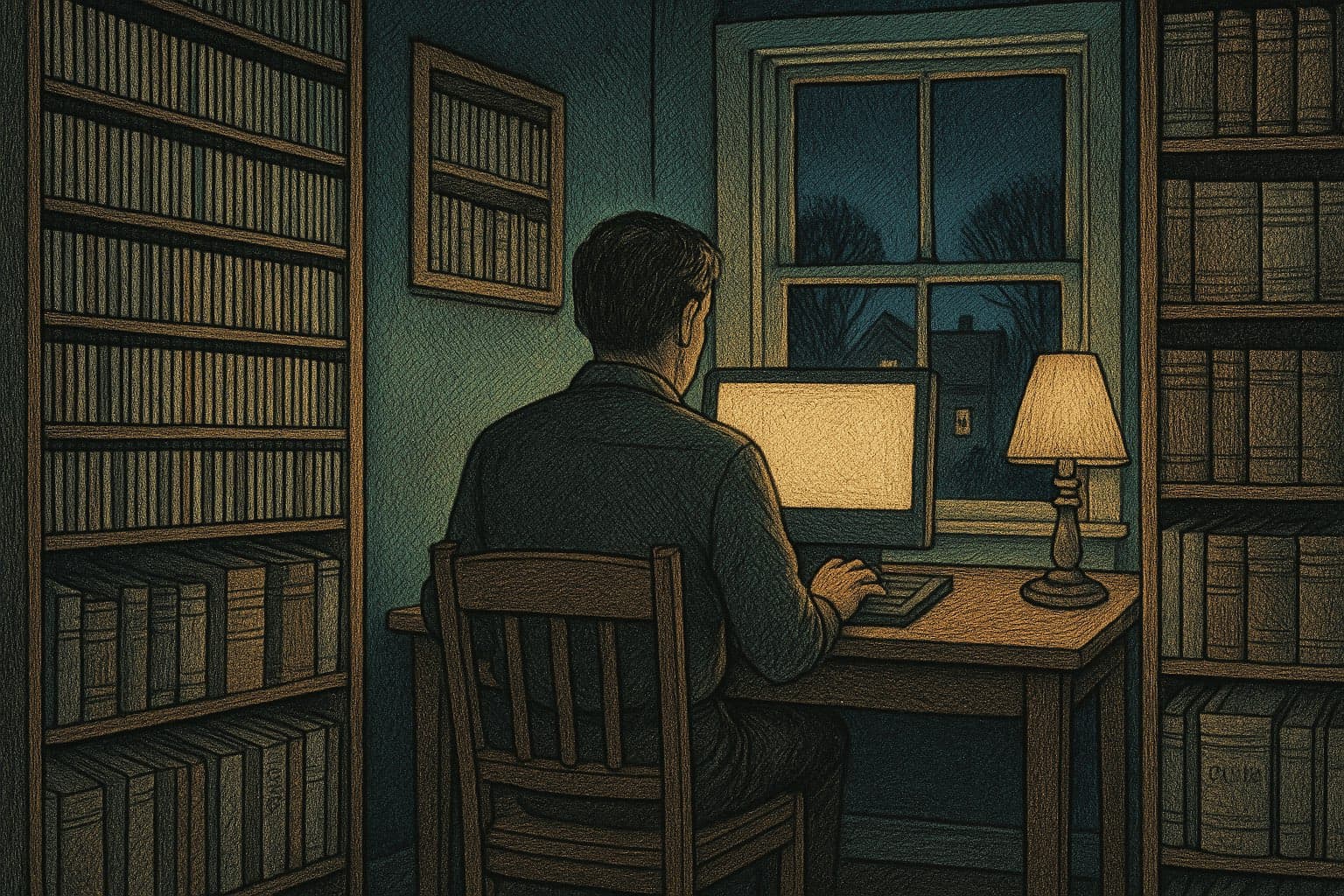
As you read this, it is statistically likely that a 42-year-old man in Virginia is editing Wikipedia. His name is Steven Pruitt and, at the time of writing, he has accumulated nearly seven million edits on the English Wikipedia — the all-time number one, more than a million edits ahead of second place. He has created over 33,000 articles and has touched, by one estimate, a third of everything that exists on the English-language encyclopedia. I checked before writing this: his latest edits are from this very morning. And for all that work —twenty years of it, every single night— he has been paid exactly zero dollars.
An opera notary
On Wikipedia he doesn't sign as Steven Pruitt but as Ser Amantio di Nicolao: the notary from Gianni Schicchi, Puccini's opera. The pseudonym is a full statement of identity, because Pruitt is a classical music devotee —he sings first tenor in a Washington choir, and his workroom, with its turquoise walls, is lined with hundreds of CDs— and because a notary is, deep down, exactly what he is: the man who certifies, records and keeps in order the paperwork of civilization.
In daytime life he is an art historian by training and a records-management official for the U.S. government — the perfect job, almost suspiciously coherent: he organizes records at the office and organizes human knowledge when he gets home. He lives in his childhood house in the Virginia suburbs, caring for his parents.
He started with his own great-great-grandfather
His first article, back in 2004, settled a family debt: the biography of Peter Francisco, a hero of American independence nicknamed “the Virginia Hercules”... and Pruitt's direct ancestor. He wrote about his own forefather, liked the feeling of leaving something useful where there had been nothing, and never stopped. Since then he keeps a personal rule of at least one edit per day; his longest break in twenty years has lasted two or three weeks.
The method is almost industrial in its discipline. About three hours every weeknight, more on weekends. He works from lists prepared in advance —he once mentioned in an interview having “a list of just over 3,000 edits” pending— and with semi-automated tools that let him dispatch hundreds of corrections per hour while saving his attention for what matters to him. He sums it up himself, without anesthesia: “You don't get numbers like mine without being a bit obsessive.”
The motivation: a Soviet mother
And here is the heart of the story. Pruitt's mother, Alla, is a Russian Jew who emigrated from the Soviet Union in 1979 — a country where information was state property, encyclopedias were censored, and knowing the wrong things carried a price. Pruitt grew up hearing what that meant. His explanation of why he gives away thousands of hours of his life is one of the cleanest ever offered about the internet: “The idea of making it all free fascinates me. My mother grew up in the Soviet Union... so I'm very conscious of what it can mean to make knowledge free.”
That awareness has a concrete chapter: fed up with the fact that fewer than 16% of Wikipedia's biographies were about women, he threw himself into the Women in Red project and has single-handedly written more than 600 biographies of women — scientists, artists, pioneers who had no article. His favorite, he says, is Fati Mariko, a singer from Niger. “We're changing the conversation,” he explains. The percentage has climbed a few points since then; several of those points carry his signature.
“You're on the list with Kim Kardashian”
In 2017, Time magazine named him one of the 25 most influential people on the internet, alongside Donald Trump, J.K. Rowling and Kim Kardashian. The email arrived in the middle of a work meeting and his reaction was “excuse me, what?”; his colleagues, suddenly discovering who the quiet guy from the records department actually was, shouted: “Oh my God, you're on the list with Kim Kardashian!”. Two years later, national television introduced him as “the man behind a third of Wikipedia”, and Jimmy Wales, the encyclopedia's founder, has called his work “absolutely incredible”. Even Wikipedia's one-billionth edit —on January 13th, 2021— turned out to be his: he was, of course, adding a link.
In this series we have told the story of Maecenas, the Roman who funded poets and ended up a synonym for cultural generosity. Pruitt is the inverse and perhaps purer case: a patron without a fortune, who instead of money donates the one thing that truly cannot be bought — twenty years of evenings. His advice to everyone else is the best invitation to free culture I know: “Take the plunge. If I can do it, anyone can.”
References
- Stephen Harrison, "Wikipedia's top editor is this mild-mannered Virginian", The Washington Post Magazine, October 2, 2018 washingtonpost.com
- CBS News, "Meet the man behind a third of what's on Wikipedia", CBS This Morning, January 26, 2019 cbsnews.com
- Time, "The 25 Most Influential People on the Internet", Time, June 26, 2017 time.com
- BBC Science Focus, "How one man made six million Wikipedia edits (and counting)", BBC Science Focus Magazine, November 1, 2025 sciencefocus.com
Categories
The books · born from this blog
Atahualpa con su abrigo de pelo de murciélago
y otras 49 historias verdaderas que parecen mentira
Available on Amazon
Tocar madera
Pequeña historia de las supersticiones que el mundo no ha podido soltar
Available on Amazon
100 futuros
Cien escenarios del mundo que viene con la inteligencia artificial
Available on AmazonYou may also like
Stockholm Syndrome Was Born to Silence a Hostage
The famous syndrome didn't come from a study: the police's own psychiatrist coined it to discredit a hostage who criticized him. It isn't in the DSM.
The Fifth Sleep: when we slept in two shifts
For centuries we did not sleep eight hours straight, but in two sleeps with a waking hour in between. The history of segmented sleep, from Cervantes to science.

Are We Raising an Overstimulated Generation?
Are we raising an overstimulated generation? A look back at childhoods full of empty hours, boredom, and the lost art of inventing your own fun.