
Asimov: The Man Who Wrote About Everything (Literally)
Isaac Asimov published some 500 books: science fiction, yes, but also history, chemistry, Shakespeare, the Bible and even humor. This is his story.
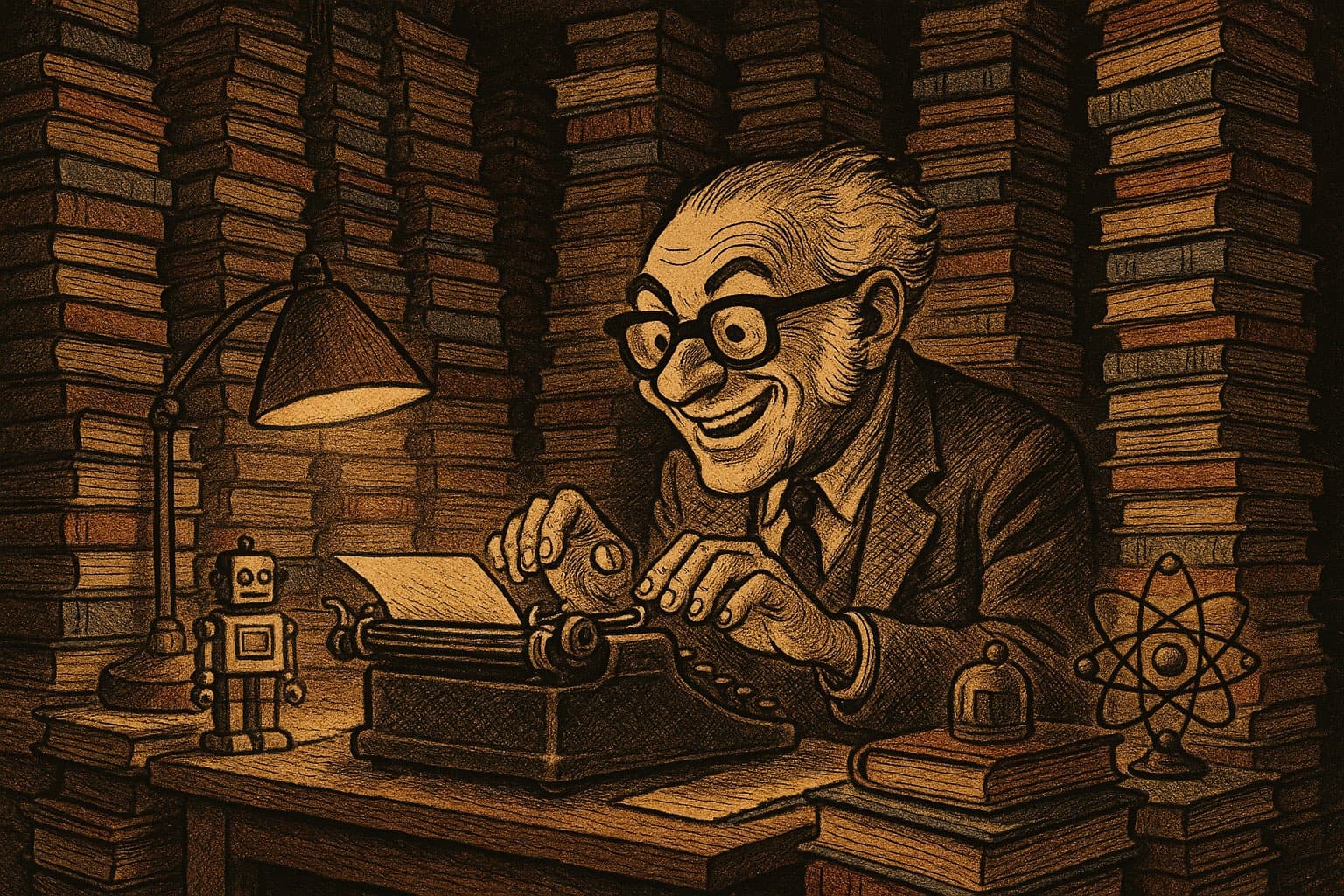
The world's libraries organize their books with the Dewey decimal system, which divides all human knowledge into ten great categories: philosophy, religion, social sciences, language, pure science, technology, the arts, literature, history and general works. Well: there is one author of whom it is commonly said that he has books in nine of the ten categories — and there are librarians who swear it's all ten. That author is Isaac Asimov, and the fact sums up better than any praise the most overflowing career in modern letters: around five hundred published books. The world remembers him as a science fiction writer, and he was one, gloriously. But that is barely one drawer of his library.
The candy store kid
Asimov was born in 1920 in a Russian village and arrived in Brooklyn at age three. His parents bought a candy store that opened from six in the morning to one in the morning, and there, among sweets and newspapers, the boy discovered the pulp magazines his father sold but forbade him to read — except the science fiction ones, which were spared because they had the word “science” in them. Everything came out of that crack. The kid turned out to be gifted, earned a PhD in biochemistry at Columbia and became a professor at Boston University's school of medicine, where he discovered the thing he truly did better than anyone: explaining. He defined it himself with one of his trademark lines: “I am not a speed reader. I am a speed understander.”
The famous drawer: robots and empires
His science fiction alone would have sufficed for immortality. The Foundation saga —a galactic empire collapsing and a mathematician who calculates the future with his “psychohistory”— won the Hugo for best series of all time, defeating none other than The Lord of the Rings. His robot stories gave us the celebrated Three Laws of Robotics, and along the way an exquisite detail: Asimov invented the word “robotics” without realizing it — he used it in a 1941 story convinced it already existed, and the dictionary ended up proving him right in advance. Few writers can claim to have named a scientific discipline by accident.
The other nine drawers
But here comes what many people don't know, and it is the heart of this article: science fiction is a minority within Asimov's work. The bulk of his five hundred books is popular science and essay, with a breadth that reads like a joke: a two-volume Guide to the Bible and a Guide to Shakespeare, play by play. Histories of Greece, of Rome, of Egypt, of England, of France, even a chronology of the entire world. Handbooks of physics, chemistry, astronomy, mathematics. He annotated Milton's Paradise Lost and Gulliver's travels. He wrote mystery stories without a drop of science fiction, a treasury of humor, and —the drawer that most startles the solemn— several volumes of off-color limericks. For 33 years, moreover, he published 399 consecutive monthly science columns in a magazine without missing a single one, until illness stopped him at the doorstep of number 400. He added three autobiographies, because his favorite life to narrate was his own.
The happy typewriter
How does one write five hundred books? With a method we already know on this blog: joyful obsession. Asimov typed at ninety words per minute, worked from eight in the morning to ten at night seven days a week, and unlike almost any writer, he did not suffer: the keyboard was his happy place. He hated traveling —he flew twice in his life and swore never again—, declared himself a “claustrophile” (he loved enclosed spaces; he dreamed of writing in a windowless ship cabin) and dispatched the matter with his usual humor: “If my doctor told me I had only six minutes to live, I wouldn't brood. I'd type a little faster.”
He died in 1992; a decade later his family revealed that the cause was HIV contracted through a transfusion during heart surgery, a secret kept on medical advice — an unjust, silent ending for the most communicative man of his century. His visible inheritance is the books; the invisible one is the lineage he left behind: that of those who turn a bottomless curiosity into a public gift, like Wikipedia's Steven Pruitt, who is, without knowing it, his spiritual grandson. Asimov summed up that family's creed in a line that remains the best defense of the explainer's trade: he wrote for the same reason he breathed — because if he didn't, he would die.
Categories
The books · born from this blog
Atahualpa con su abrigo de pelo de murciélago
y otras 49 historias verdaderas que parecen mentira
Available on Amazon
Tocar madera
Pequeña historia de las supersticiones que el mundo no ha podido soltar
Available on Amazon
100 futuros
Cien escenarios del mundo que viene con la inteligencia artificial
Available on AmazonYou may also like
Entomology and aviation
Pilots' children tell good stories. This one starts with a floodlight left burning in an Amazon hangar and ends inside a museum-grade insect collection.
Cigarrón and His Intellectual Carriage
A childhood memory of Guayaquil's PPG flea market and Cigarrón, the cigar-smoking bookseller who hauled an entire library in a wooden cart.

Love Beyond the Grave
A treasure hunt at Mar Bravo ends in murder and a fiancée's leap into the sea, sparking a haunting legend of lovers bound beyond the grave.