
The Programmers Who Gave Away Empires
Torvalds, Bellard, Hipp: they wrote the software the modern world runs on, it was worth trillions, and they chose to give it away for free.
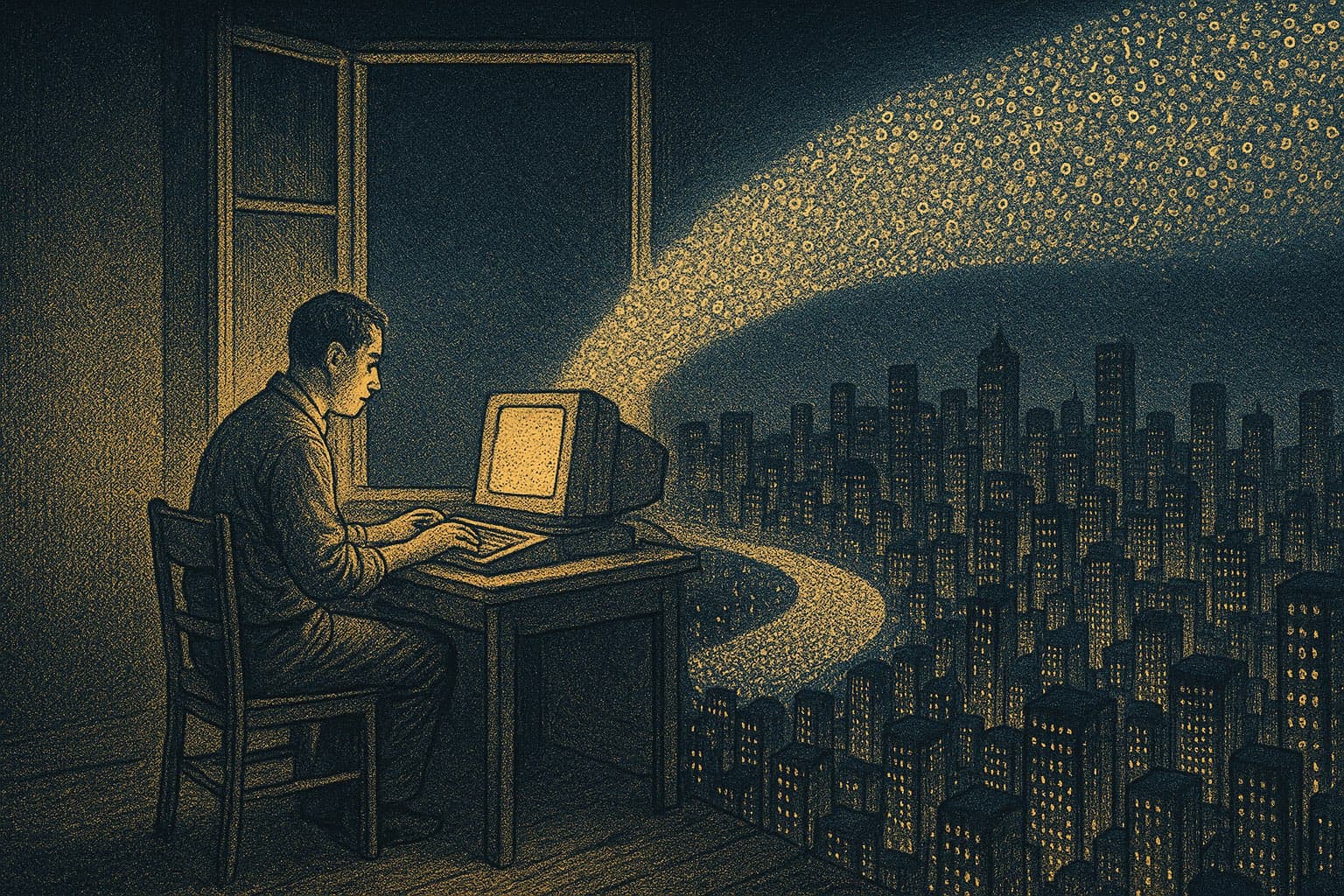
In 2024, a Harvard Business School study tried to put a price on something that has none: what would free software be worth if we had to pay for it? The demand-side answer was 8.8 trillion dollars. If open source vanished tomorrow, the world's companies would spend 3.5 times more on software than they already buy. And the strangest finding in the study: 96% of that value was created by barely 5% of the developers. A handful of people wrote the planet's infrastructure and left it at the door, free of charge. These are three of those people.
Linus Torvalds, or “just a hobby”
On August 25th, 1991, a 21-year-old Finnish student posted to a Usenet forum one of the most celebrated texts in computing history: “Hello everybody out there... I'm doing a (free) operating system (just a hobby, won't be big and professional...) for 386(486) AT clones.” Thirty-five years later, the hobby runs on the 500 most powerful supercomputers on Earth — all 500 of them, 100% of the list since 2017—, on more than three billion Android devices, and on the crushing majority of cloud servers; even on Microsoft's own cloud, over 60% of virtual machines run Linux.
And Linux isn't even his only given-away empire. In 2005, a licensing crisis left him without the tool he used to coordinate the kernel, so he wrote his own: by his account, it took “about 10 days until I could use it for the kernel”. He called it Git — “I'm an egotistical bastard, and I name all my projects after myself. First Linux, now git,” he joked, well aware of what git means in British slang. Today Git is the system on which practically all the world's software is written. The supreme irony: Microsoft —whose CEO called Linux “a cancer” in 2001— ended up buying GitHub, a company built on top of Git, for $7.5 billion in 2018. In other words: it paid roughly 150 times the estimated net worth of Torvalds himself for a house built on his invention, while he lives on a good foundation salary and some shares gifted to him in the nineties. Does it sting? His interviews suggest not: “Money really isn't that great of a motivator. It doesn't pull people together. Having a common project — that motivates people.”
Fabrice Bellard, the one-man orchestra who gives no interviews
If Torvalds is the public face of free software, the Frenchman Fabrice Bellard is its invisible legend. At 17, in 1989, he wrote LZEXE —the executable compressor half a generation of MS-DOS users relied on without knowing where it came from— because his diskettes held 360K and he kept running out of space; he gave it to a few friends, someone uploaded it to a BBS, and he became famous without lifting a finger. The pattern would repeat for the rest of his life.
In 2000 he created, under a pseudonym, FFmpeg: the Swiss Army knife of digital video. It lives inside VLC, Chrome and Firefox, and is a standard component in the video pipelines of YouTube and Netflix. Every time you play a video on the internet, there is a very high probability that Bellard's code is working somewhere along the route. In 2003 he created QEMU, the emulator that became the standard companion of Linux virtualization — one of the foundations on which cloud computing was built. He also wrote a tiny C compiler, a JavaScript engine, and in 2009, for sport, he broke the world record for digits of π —2.7 trillion— on a desktop PC costing less than $3,000, dethroning multi-million-dollar supercomputers. Programmer forums repeat the same joke: “Bellard is a hundred-person team sharing a single body.” He, meanwhile, has no social media and declines interviews — when a journalist tried to profile him in 2011, he politely answered that he preferred to let his code do the talking — and funds his freedom with Amarisoft, his company that fits an entire 4G/5G base station inside software.
Richard Hipp and the warship database
The third story begins in the least expected place: a U.S. Navy destroyer. In 2000, Richard Hipp was a contractor on the damage-control software of the USS Oscar Austin — the system that, with pipes broken and the ship listing, tells the crew which valves to close. The program depended on a commercial database whose server kept going down, and the fed-up engineer's question Hipp asked himself changed computing: “Why do we even need a server?” Thus was born SQLite, a database that lives in a single file.
Hipp then did something more radical than open source: he dedicated it to the public domain. No license, no copyright, no permission to ask. Today SQLite is, by a wide margin, the most deployed database engine in history: it's in every iPhone, every Android, every Mac, every Windows, every browser, in the Airbus A350 and on missions to Mars — the official estimate speaks of more than one trillion active SQLite databases. So what does its author live on? On a business model the industry itself designed for him: Mozilla's chief told him “you're doing this all wrong — the developers have to be in control,” and helped him set up a consortium where Apple, Google and company pay annual memberships for priority support. And the detail that paints the man: he tests SQLite to the FAA's aviation-software standard, with total coverage of every branch of the code. “Once we got to that point,” he says, “we stopped getting bug reports from Android. It just worked from there on out.”
The gift economy
The list goes on: Daniel Stenberg maintains curl from his home in Sweden, installed some 20 billion times in phones, cars and consoles; Tim Berners-Lee convinced CERN to place the entire World Wide Web in the public domain on April 30th, 1993 — the most profitable legal document ever given away—; and at the far end of mystery, the fortune of more than a million bitcoins attributed to Satoshi Nakamoto hasn't moved since 2010: tens of billions of dollars its creator has never touched.
On this blog we've already met Steven Pruitt, the man who has edited a third of Wikipedia for free, and Maecenas, the Roman who funded poets. These programmers belong to the same lineage, with one difference we still struggle to process: their patronage didn't fund the culture — it built it. Torvalds explained why years ago, and it remains the best explanation available: “Most good programmers do programming not because they expect to get paid, but because it is fun to program.” The modern world runs, quite literally, on the spare time of people who were having fun.
Categories
The books · born from this blog
Atahualpa con su abrigo de pelo de murciélago
y otras 49 historias verdaderas que parecen mentira
Available on Amazon
Tocar madera
Pequeña historia de las supersticiones que el mundo no ha podido soltar
Available on Amazon
100 futuros
Cien escenarios del mundo que viene con la inteligencia artificial
Available on AmazonYou may also like

Morse Code: How It Works and Why It Saved Lives
Morse code turns letters into dots and dashes that travel down a wire or a flash of light. Here is how it works, where it came from and why it is still used.

The Telegraph: The Victorian Internet
The telegraph shrank weeks of mail into minutes of cable. How Morse, Cooke and a wire under the Atlantic built the Victorian internet and shrank the world.

Why veins look blue when your blood is red
Human blood is never blue—it is always red. So why do veins look blue under the skin? The answer lies in how light travels through your body and how you see.