
Cigarrón and His Intellectual Carriage
A childhood memory of Guayaquil's PPG flea market and Cigarrón, the cigar-smoking bookseller who hauled an entire library in a wooden cart.
Back in the 80s, there was a hideaway in Guayaquil where countless trinkets were displayed on the sidewalk: useless junk to some, priceless treasures to others. That was the PPG flea market (short for Pedro Pablo Gómez, the name of the street where it was located). In 2004, the city's mayor shut it down, reorganizing some of the informal vendors into a two-story market not far from the original spot. The mayor's pretext was to end the disorder and informality, since stolen goods were undoubtedly hidden among the trinkets.
The truth is that the newly built facility, with all its amenities, never attracted crowds in the same numbers as before. Perhaps that air of informality, street chaos, and the din of commotion were the invisible draws for regular visitors who, like me, came searching for "treasures."
On Sundays we eagerly waited to go with my grandparents and my aunt. We called it the "old junk" market. Over time we got to know some of the vendors—some selling books, others antiques, others broken-down machines. I remember the time my grandfather bought an old Russian adding machine in green; it didn't work, but the price was practically a gift. We spent months repairing it until it worked with the precision of a piece of clockwork. Keep in mind we're talking about a completely mechanical device, with an intricate mechanism that allowed its owner to perform the four basic mathematical operations. I thoroughly enjoyed the time we spent repairing it—it was like assembling a puzzle, except this puzzle multiplied and divided. Magic!
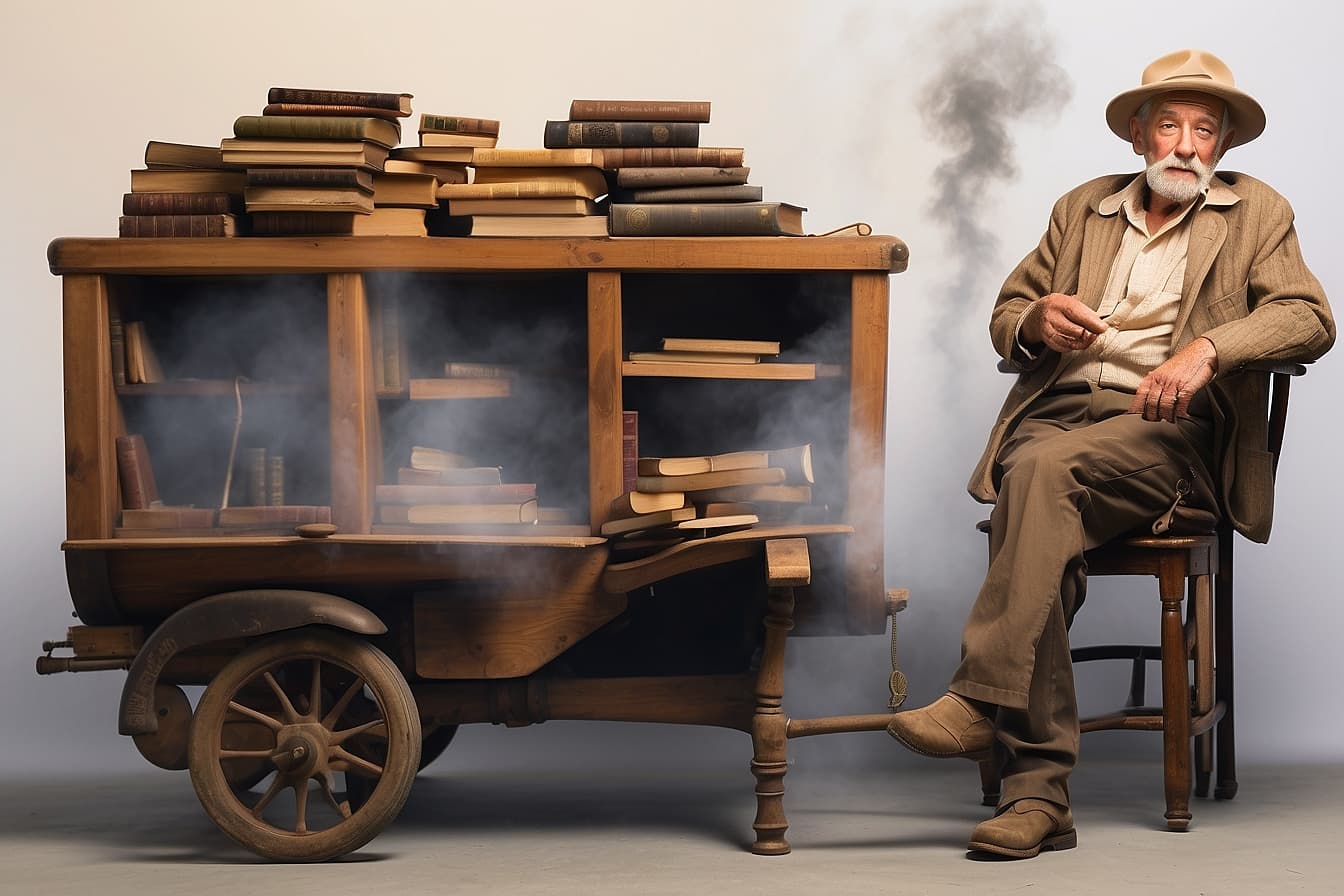
One of the vendors my grandmother and I visited most often was Cigarrón. An extroverted guy who hauled a mountain of books to the market in a huge wooden cart, the kind that used to sell charcoal decades ago. They called him that because he was always smoking a big cigar. He wore a guayabera, a cowboy hat, and always carried a bright, oversized Club Sport Emelec shield that hung from the side of the cart. By some inexplicable neurological mechanism, I've always remembered that shield in great detail.
Among the pile of books, we dove in to search for treasures. I suppose today I'd be afraid to dig through so many old books. Bacteria and viruses have gotten a lot of bad press in recent years; back then we only feared rusty nails, where, according to a strange and unjustified theory, the voracious tetanus virus lurked. Well, now that I think about it, we also feared rabid dogs, lest we receive the dreaded antidote, which consisted of 21 excruciatingly painful injections in the navel, one per day.
Cigarrón didn't just sell books—he had read them all, or at least that's what he said. The truth is he talked to my grandmother about diets and health. With his friends, who always surrounded him, he talked about soccer and political anecdotes (he also sold them sports magazines); with me he talked about the most diverse subjects—most with good judgment, a few he made up, because an intellectual can't afford to appear ignorant. Seeing a child who read must have evoked a certain tenderness in him, because he always gave me a wooden stool so I could take my time browsing his books.
I lost track of Cigarrón for many years, until one day, long after the PPG market disappeared, I saw him with his cart, parked on a corner across from the Enrique Sotomayor maternity hospital. There he was, just as I remembered him. He even seemed not to have aged in the slightest (that struck me as very odd). I greeted him. I suppose he returned the greeting out of courtesy; I don't think he remembered me, once a 12-14-year-old kid and by then over 35. I didn't buy books from him that time. The titles he had no longer caught my attention; their themes had become more mundane, I suppose he had to adapt to the market; his books seemed sloppier or dirtier than usual. At the end of the day, thinking it over, perhaps they were the same books as always and it was I who was different.
His cart was painted with that enamel paint used indiscriminately for diners and public restrooms. The edges of the cart had received a special garish blue. The club's shield was still there, though, intact and bright. From the four corners of the cart now protruded broomsticks from which he'd hung cords displaying old Estadio and Buen Hogar magazines. He also sold lottery tickets. I was glad to see him.
Several more years passed, until not long ago, in the middle of the pandemic, I visited an old bookstall near the central market. It was a shop I hadn't seen before—rolling door, narrow front, but very deep, and as you went in it got darker and darker. I felt like I was entering a mine. A story began to take shape in my head: that this shop had been born from the liquidated remains of some bookstore that closed. I thought this because many of the books were dusty but intact and also duplicated. There were also secondhand copies and some history books. I stayed for a while, picked up a couple, and headed to the exit to pay for them, when suddenly, out of the corner of my eye, I saw something that instantly clicked in my head. Cigarrón's shield was there on the wall, hanging, intact, exact, less shiny, but the same one.
I hurried to ask the attendant how he'd obtained the shield and what its story was. He told me Cigarrón's story. It was sadder than one could imagine behind the façade of the pushcart intellectual. Cigarrón died alone, of lung cancer. Tobacco destroyed his body little by little. He fought the disease for many years, and in the end, his friends—the story listeners by the cart—organized a bingo and a collection to pay his medical expenses. Languishing in the hospital and barely able to breathe, he gave his benefactors the only asset he had left: his bright Club Sport Emelec shield.
This piece is a tribute to that character from Guayaquil, whose name I never knew, but whom his friends nicknamed Cigarrón, the intellectual of the pushcart.
Categories
The books · born from this blog
Atahualpa con su abrigo de pelo de murciélago
y otras 49 historias verdaderas que parecen mentira
Available on Amazon
Tocar madera
Pequeña historia de las supersticiones que el mundo no ha podido soltar
Available on Amazon
100 futuros
Cien escenarios del mundo que viene con la inteligencia artificial
Available on AmazonYou may also like

Entomology and aviation
Pilots' children tell good stories. This one starts with a floodlight left burning in an Amazon hangar and ends inside a museum-grade insect collection.
Asimov: The Man Who Wrote About Everything (Literally)
Isaac Asimov published some 500 books: science fiction, yes, but also history, chemistry, Shakespeare, the Bible and even humor. This is his story.

Love Beyond the Grave
A treasure hunt at Mar Bravo ends in murder and a fiancée's leap into the sea, sparking a haunting legend of lovers bound beyond the grave.