
Tagua: the Vegetable Ivory That Buttoned Europe
Tagua, the seed of an Ecuadorian palm, mimicked ivory and buttoned the world's clothes for decades, until cheap plastic pushed it aside almost overnight.
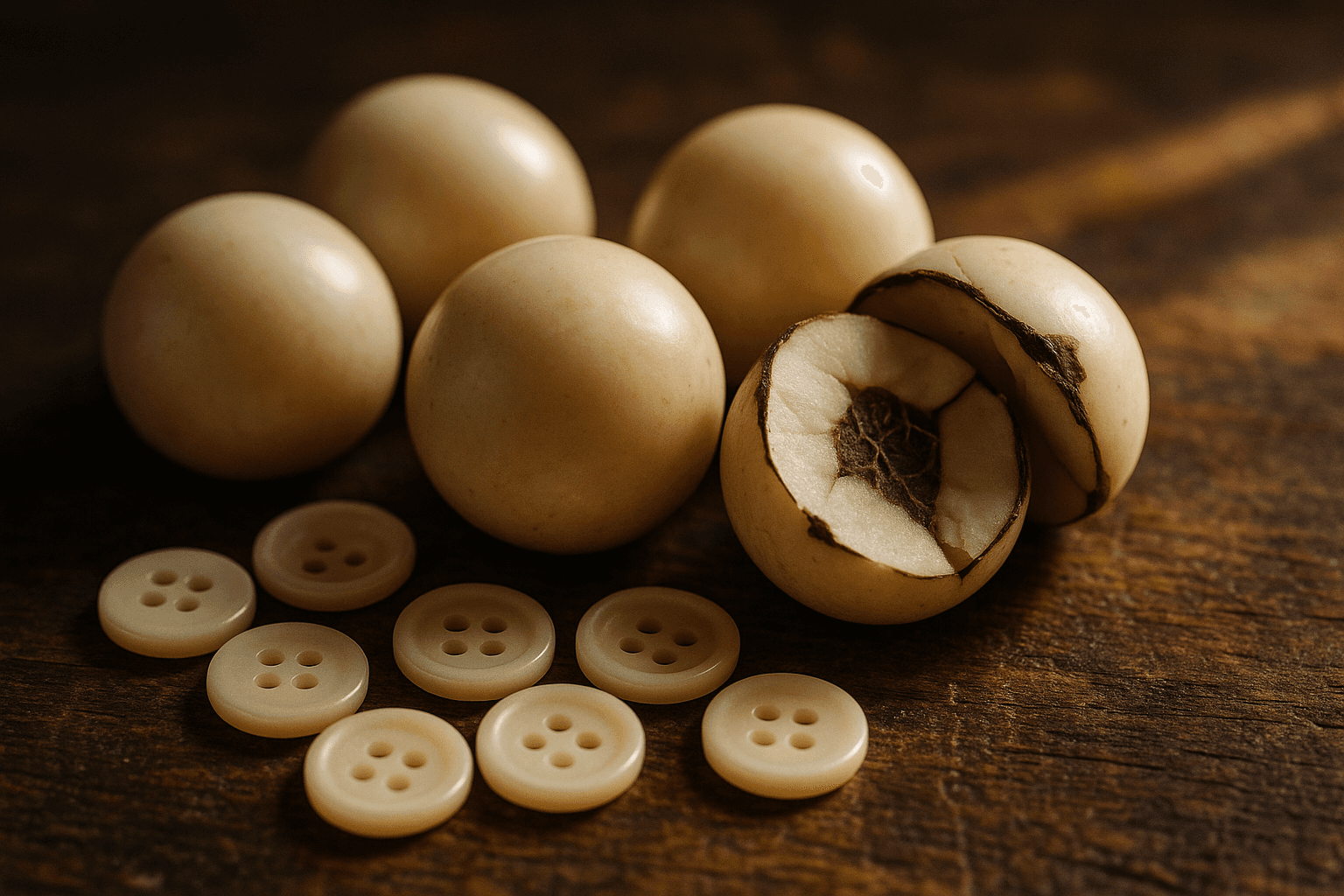
For nearly a century, a large share of the buttons on European and American shirts came from a palm tree in the Ecuadorian tropics. It wasn't plastic or bone: it was tagua, the hardened seed of a coastal palm that people called vegetable ivory because, once polished, it is almost indistinguishable from an elephant's tusk. It is white, dense, and turns and carves just as finely, yet—unlike ivory—it costs no animal its life. The story of how a seed from the humid forests of Manabí ended up fastening the world's clothing, and how it nearly vanished afterward, sums up the fate of almost every natural material of the twentieth century.
A seed as hard as bone
Tagua is the seed of the palm Phytelephas aequatorialis, which grows in the wet lowlands of Ecuador, Colombia, and Panama. The scientific name says it all: Phytelephas means, literally, "plant elephant," a nod to its resemblance to ivory. Its fruits, clustered in spiny heads the size of a human skull, hold several seeds that begin as a milky, edible liquid—much like coconut water—and, as they ripen, solidify into an endosperm hard enough to dull a knife.
That hardness is the whole point. Once dried, the seed can be sliced into disks, turned, drilled, and polished with the same precision as animal ivory, and it takes dyes evenly. The peoples of coastal Ecuador knew it long before Europe put a price on it; what was missing was an industry that needed millions of small, white, sturdy pieces. That industry arrived with mass-produced clothing.
The ship that reached Hamburg
The most repeated account of how tagua leapt into world trade sounds like a legend, but nearly every source tells it: around 1865, a ship leaving the South American coast for Germany loaded tagua seeds as plain ballast to steady the hold. When it unloaded in Hamburg, the dockworkers noticed that those "stones" had the color, shine, and hardness of ivory. Curiosity became business: button makers found that tagua could be machined at scale, and within a few decades it had become one of Ecuador's great exports to Europe.
A whole supply chain soon formed. From the interior of Manabí, the seed came down in mule caravans to the port of Manta, and from there it sailed to workshops in Hamburg, London, Birmingham, and northern Italy. In Europe it was known by its trade name, corozo, and by the late nineteenth century British factories were importing two to three million nuts a year. It was an export boom with a pattern this blog knows well: that of the riches the forest gives away and the world market devours.
The kingdom of the button
Between the late nineteenth century and the first decades of the twentieth, the world buttoned itself with tagua. The rise of industrial clothing sent demand for cheap, durable, elegant buttons soaring, and vegetable ivory delivered all three. In 1920, an estimated one in five of all buttons made in the United States was tagua, most of it imported from Ecuador.
For the country, tagua became the second-largest export, trailing only cacao, and peaked around 1929, when some 25,000 tons shipped out in a single year. Manabí towns like Manta lived their own boom of buyers, trading houses, and whole families who gathered, dried, and sorted the seed. It was, in a way, the quiet everyday counterpart of another Ecuadorian product that conquered the world under a borrowed name: the hat everyone calls a "Panama" though it's woven in Montecristi.
Plastic wins the game
The end came from where it always came in the twentieth century: chemistry. After World War II, petroleum-based plastics—Bakelite, polyester, synthetic resins—could be molded into buttons of any color, shape, and size, in unlimited quantities and at a laughable cost. No need to wait for a palm to fruit or to cross the Atlantic with the cargo: the raw material came out of a factory. By the 1950s, vegetable ivory was all but displaced, and the trading houses of Manabí closed one after another.
It is exactly the same irony that befell another natural material once thought irreplaceable: chicle, the resin the Maya used to chew, was replaced by laboratory gums at almost the same time. The twentieth century is full of these quiet handovers, in which an organic, labor-intensive product falls to a cheaper, more consistent synthetic version.
The comeback: ivory without elephants
Tagua, however, did not disappear. In the 1980s and 1990s, when the international campaign against elephant hunting put animal ivory in the dock, conservationists and designers rediscovered that "seed that grows on trees" as an ethical alternative to the tusk. In 1990, the organization Conservation International launched the Tagua Initiative, meant to give value to the standing forest: if the seed was worth money, there was an economic reason not to cut the palm down. The project went on to sell more than 75 million buttons to brands like GAP, Banana Republic, J.Crew, and Patagonia.
Today vegetable ivory lives a more modest but honest second life: couture buttons in Italian workshops, jewelry and carved, dyed handicrafts in Manabí, and a growing niche of sustainable fashion that prefers a renewable seed to a petroleum-derived plastic. The palm that buttoned the world a century ago now defends itself with a new argument: it is ivory that costs no one their life. And like so many stories from the Ecuadorian coast, its own proves that a resource can fall off the map and, decades later, return through the door no one was watching.
References
- "Vegetable ivory," Wikipedia. en.wikipedia.org
- Acosta-Solís, M. et al., "The vegetable ivory industry: Surviving and doing well in Ecuador," Economic Botany (Springer). link.springer.com
- "Colombia Dispatch 8: The Tagua Industry," Smithsonian Magazine. smithsonianmag.com
- "La tagua: el marfil vegetal que Ecuador podría perder," Mongabay Latam. es.mongabay.com
Enjoy the stories behind the objects and materials that changed the world? Continue with the Amazon rubber boom or explore the whole Ecuador section.
Categories
The books · born from this blog
Atahualpa con su abrigo de pelo de murciélago
y otras 49 historias verdaderas que parecen mentira
Available on Amazon
Tocar madera
Pequeña historia de las supersticiones que el mundo no ha podido soltar
Available on Amazon
100 futuros
Cien escenarios del mundo que viene con la inteligencia artificial
Available on AmazonYou may also like
The Baroness of Galápagos and the Floreana Mystery
In the 1930s, an Austrian baroness tried to rule over Floreana island in the Galápagos. Her disappearance remains an unsolved mystery to this day.
Porcelain: the Chinese secret Europe tried to steal
For centuries Europe paid fortunes for Chinese porcelain without knowing how it was made. This is the story of a hundred-year industrial espionage.
A window to Ecuador from a century ago. Photo restoration.
Restored and colorized photos open a vivid window onto Ecuador a century ago, from presidents and earthquakes to long-vanished railways.