
History of encebollado, Ecuador's fish stew
Encebollado was born on Guayaquil's docks as fishermen's food and is now Ecuador's national dish and the coast's most trusted hangover cure.
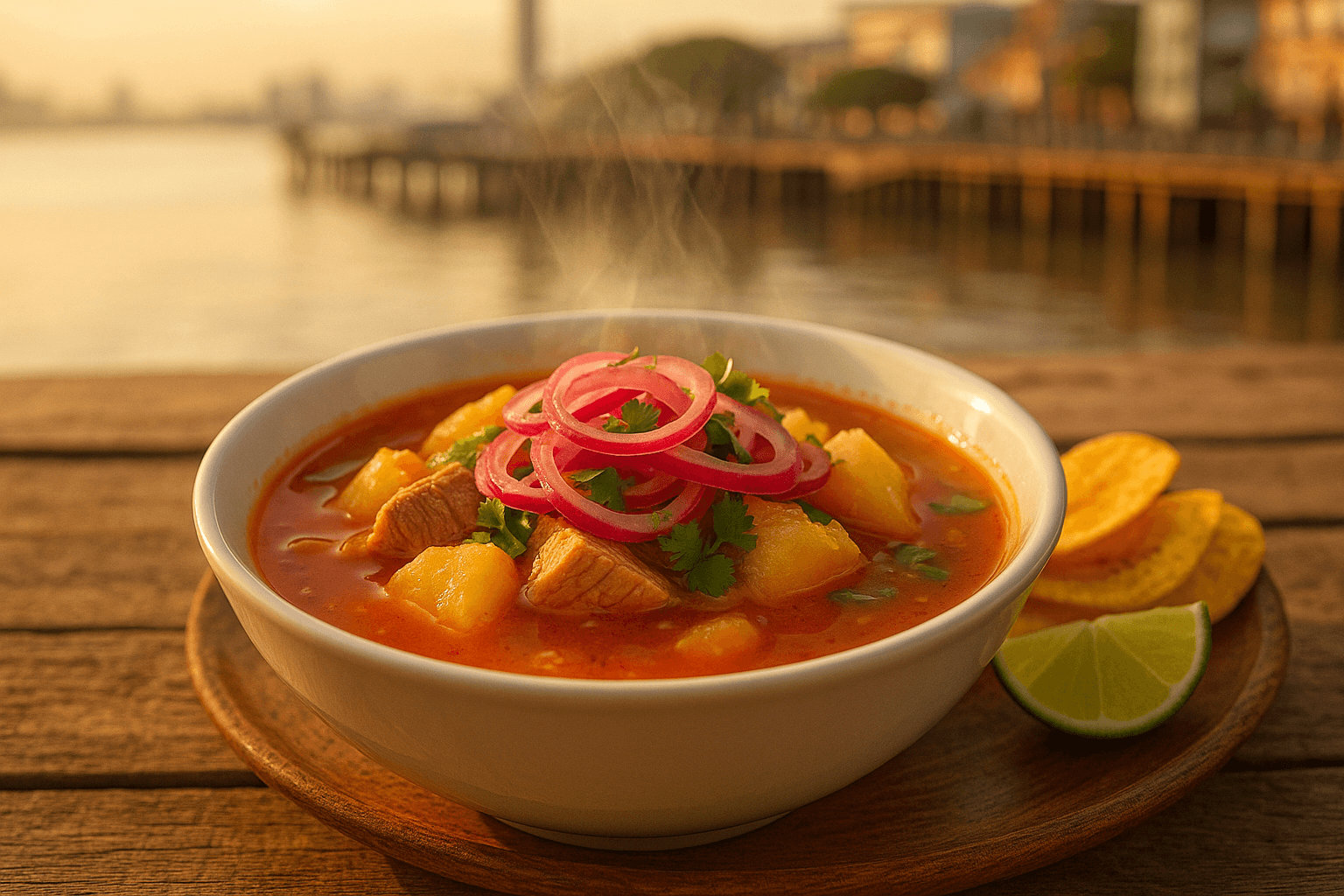
Some foods are eaten, and some are ritualized. Encebollado belongs to the second group. In any city on Ecuador's coast, Sunday morning smells of boiled albacore, of red onion pickled in lime and of chopped cilantro; the line in front of the stall makes no distinction between bricklayers, office workers and whole families arriving to cure the chuchaqui from the night before. Behind that hot bowl lie centuries of history: pre-Hispanic peoples, migrating fishermen and an official recognition that arrived only in 2024.
What encebollado is
Encebollado is a fish soup —traditionally made with albacore, a firm-fleshed tuna— simmered in a broth with yuca (cassava), tomato, cilantro and spices. It is crowned with red onion pickled in lime juice, which is where the name comes from: encebollado literally means «covered in onion». It is served piping hot with chifles (fried green-plantain chips), popcorn, bread or rice, plus creole chili and a squeeze of lime to taste.
The result is a cheap, hearty, comforting dish eaten at any hour, though its natural territory is the morning. Hence one of its most beloved nicknames: the «levanta muertos» broth —the "raise-the-dead" soup— for its reputation of reviving anyone who woke up hungover.
A dish older than Ecuador itself
The long history of encebollado begins well before the country existed. According to the Guayaquil historian Jenny Estrada, its roots reach down to the Valdivia culture, one of the oldest in the Americas, which thousands of years ago was already cooking fish and yuca in clay pots over a wood fire on the coast of present-day Ecuador. The base combination —sea protein and earth root— is pre-Hispanic; everything else came later.
The conquest brought ingredients that now seem inseparable from the dish but are in fact imports: onions and limes came with the Spanish, and both trace back further still to Asia and the Arab world. Encebollado, like so many American dishes, is a blend: the native pantry combined with what crossed the Atlantic. It is the same pattern that explains why half the world eats Ecuadorian cacao turned into chocolate, or weaves toquilla-straw hats the planet knows by a borrowed name.
From the shipyards to the streets of Guayaquil
The modern encebollado, the one we would recognize today, began as food for fishermen and dock workers. The story goes that on the boats it was made in enameled buckets with whatever was on hand: fish, water, onions. Once ashore, the coastal cholos —fishermen and day laborers— carried it to Guayaquil, where they started selling it near the shipyards as a way to make a living.
From there it jumped to street corners. First it was bucket-and-makeshift-table street food; then it earned fixed stalls, picanterías and, finally, the city's restaurants. Along that route it lost its original name —at first it was known as «picante de pescado» (spicy fish)— and gained the one that defines it: the onion that crowns it. It is the classic trajectory of Guayaquil's popular food, the same port city where trade and migration mixed everything, as we saw when telling the story of tagua and other goods that shipped out of its docks.
The soup that raises the dead
No history of encebollado is complete without its reputation as a hangover remedy. In Ecuador it is called the «levanta muertos», and the belief has a simple logic: it is a hot, salty, protein-rich broth that rehydrates, replaces salts and settles the stomach after a night out. Science will say no dish cures a chuchaqui —only time does— but popular culture keeps its own pharmacy, and on Ecuador's coast the prescription is served in a bowl.
That social role explains why encebollado is tied to weekend mornings. It is not a fancy-restaurant dish or a gala-menu item: it is democratic, eaten standing up or on a plastic bench, and it brings together people who in another context would never share a table. That very universality is what turned it into a symbol.
Cultural heritage of Ecuador
On July 25, 2024, Ecuador's Ministry of Culture and Heritage declared encebollado Intangible Cultural Heritage of the country. It was no minor culinary gesture: it officially recognized the dish as part of the national identity, a knowledge passed from one generation to the next that represents the coastal fishing communities who created it.
The declaration put in writing what any Ecuadorian already knew. Encebollado is not just a soup: it is a meeting point, a common language between regions, and —for the Ecuadorian migrants scattered around the world— a piece of home that can be rebuilt with a can of tuna, a yuca and enough onion. A port dish that ended up becoming, without ever meaning to, the portrait of an entire country.
References
- «Encebollado», Wikipedia. en.wikipedia.org
- «Encebollado | Traditional Fish Soup From Ecuador», TasteAtlas. tasteatlas.com
- «El origen del encebollado guayaquileño», Ecuavisa. ecuavisa.com
- «Encebollado, el caldo 'levanta muertos'», Extra. extra.ec
Enjoy the stories behind food and words? Continue with the origin of the word chuchaqui or explore the whole gastronomy series.
Categories
The books · born from this blog
Atahualpa con su abrigo de pelo de murciélago
y otras 49 historias verdaderas que parecen mentira
Available on Amazon
Tocar madera
Pequeña historia de las supersticiones que el mundo no ha podido soltar
Available on Amazon
100 futuros
Cien escenarios del mundo que viene con la inteligencia artificial
Available on AmazonYou may also like
How Long Have We Been Eating Crabs on Ecuador's Coast?
How far back does Ecuador's love of crabs really go? The trail runs from pre-Hispanic mangroves to a vivid 1748 chronicle by Antonio Ulloa.
Ecuador's Año Viejo: The Myth and the Real History
Everyone repeats that Ecuador's Año Viejo burning began in an 1895 epidemic. The historical evidence tells a different and more curious story.
Reviving an Ancient Drink: Plantain Champagne (and Banana, Too)
Plantain champagne once bubbled through old Guayaquil streets, and here's how that lost recipe was chased down and recreated with modern fermentation.