
Gunpowder Before Cannons: Alchemy, Fire and War
Chinese alchemists chasing eternal life invented gunpowder by accident. Before cannons came fireworks, fire lances and centuries of fire medicine.
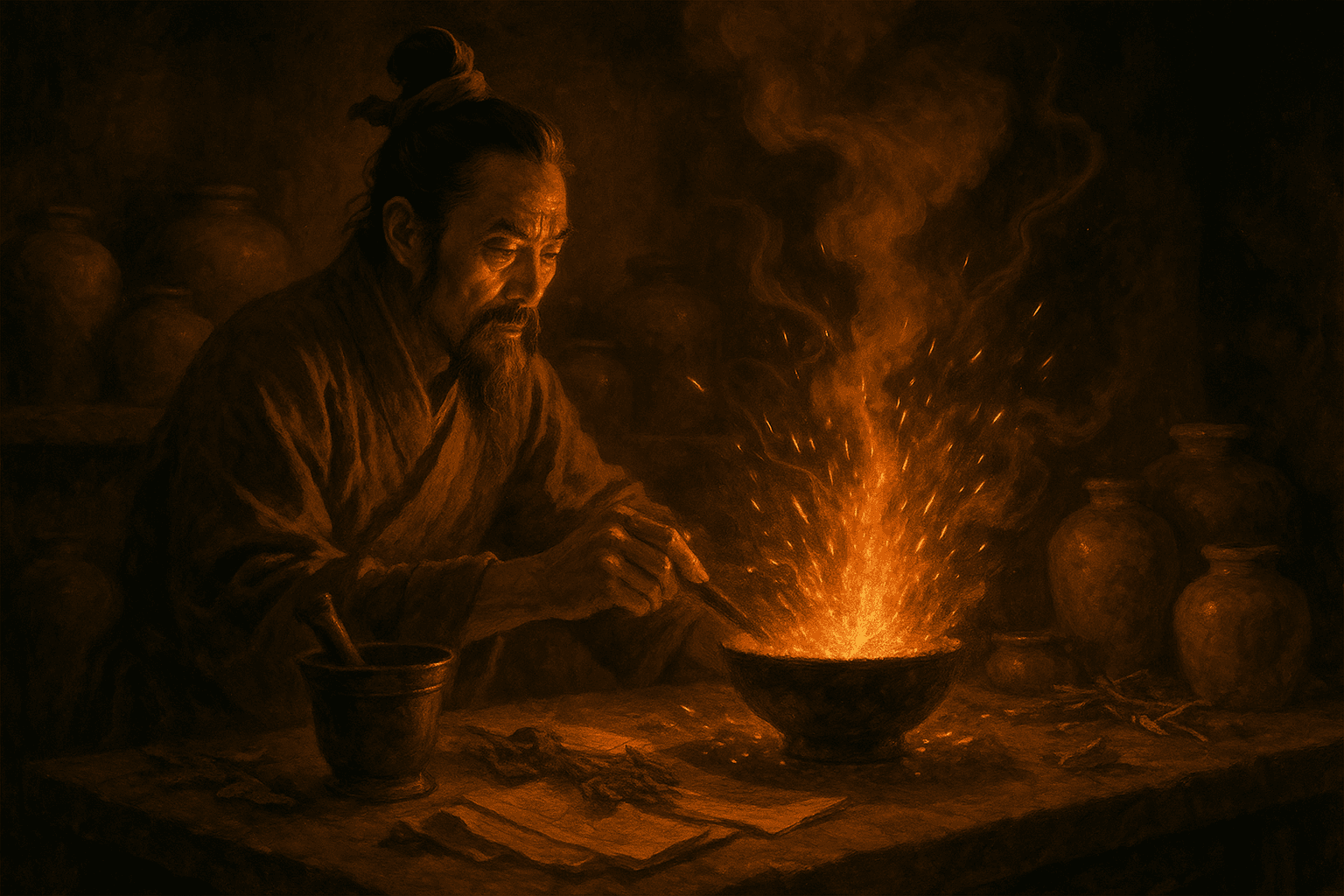
When we think of gunpowder, we almost immediately picture cannons, muskets and battlefields. But for centuries —from its invention to the first firearms— gunpowder was something very different: a failed medicine, a light show, and a fiery toy for scaring off demons. The story of its early years doesn't smell of war, but of incense, of an alchemist's laboratory, and of festival nights.
Alchemists chasing eternal life
Gunpowder was born in China, during the Tang dynasty, around the 9th century. No general was looking for it: it was found by Taoist alchemists obsessed with a far more ambitious goal —the elixir of immortality. Mixing and roasting substances in the search for eternal life, they hit on a combination that did the exact opposite of preserving it: it burned with a sudden, dangerous violence.
They called it huoyao (火药), literally "fire medicine." The name was no metaphor: to those alchemists it really was a kind of drug, one more in their experimental cabinet. The irony is complete. A mid-9th-century Taoist text, the Zhenyuan miaodao yaolüe, already recorded the formula —but not so people would make it. It was a warning, a note to colleagues that mixing sulfur, saltpeter and charcoal could burn their hands and their house down. As in so many discoveries, it was a case of serendipity: looking for one thing, they found another that would change the world.
The three substances
The basic recipe for black powder is three ingredients: saltpeter (potassium nitrate), sulfur and charcoal. The key is saltpeter, which supplies the oxygen the mixture needs to burn without outside air, almost as fast as an explosion. Chinese alchemists had spent centuries getting to know these substances: as early as around the year 492 they had noticed that saltpeter burned with a distinctive violet flame, which helped them identify and purify it.
For a long time, though, the proportions were timid. The earliest formulas carried too little saltpeter to truly explode: instead of detonating, the mixture burned furiously, spitting fire. And it was precisely that quality —burning fast and bright rather than bursting— that defined gunpowder's first long century of life.
Fire to scare off demons
Gunpowder's first great use was not to kill, but to celebrate. Around the 10th century, the Chinese began packing bamboo tubes with the mixture to create the first fireworks. Even earlier there were "natural" firecrackers: bamboo canes that, thrown into a fire, popped with a crack as their hollow joints burst. Gunpowder turned that crack into a genuine burst of light.
The purpose was as practical as it was festive: the noise and the light were believed to drive away evil spirits. Weddings, new year, births and funerals filled with noise and sparks. That tradition is still alive: the firecrackers of today's festivals are direct descendants of those bamboo tubes from a thousand years ago.
From firecracker to weapon
Sooner or later, someone aimed the fire at the enemy. Fire arrows with incendiary packets had been used since the 9th century, but the decisive leap came with the fire lance (huo qiang, 火枪), which appeared in the 10th century. It was a bamboo tube full of gunpowder tied to the tip of a spear; when lit, it shot out a jet of flame and, sometimes, shards or darts toward the enemy. Its range was only a few feet, but it is considered the ancestor of all firearms.
The oldest written record of all this is the Wujing Zongyao, a military compendium of the Song dynasty compiled around 1044. It contains the world's earliest known gunpowder formulas, meant for incendiary bombs and fire lances. Its mixtures hovered around 50% saltpeter: they burned fiercely, though not yet fully explosively. Only later, around the mid-13th century, was the bamboo tube replaced by a metal barrel —the "eruptor"— which could fire a single projectile that plugged the tube. That was the true ancestor of the hand cannon. Everything before it —centuries of fireworks, lances and bombs— happened before a single cannon existed.
The long journey west
Gunpowder took centuries to leave China, and it probably did so on the back of the 13th-century Mongol conquests, which connected Asia and Europe as never before. In the Islamic world, the Syrian Hasan al-Rammah described formulas and incendiary weapons between 1240 and 1280; in Arabic, saltpeter even came to be called "Chinese snow." In Europe, the first clear mention appears in 1267, in the Opus Majus of the English friar Roger Bacon, who marveled at a small device that burst with "a horrible sound and a bright flash." Tellingly, he wasn't describing a weapon: he was describing something much like a firecracker.
Only afterward, in the 14th century, did gunpowder transform irreversibly into the star of cannons and arquebuses that would redraw the map of power. As happened with the compass, another Chinese invention that changed navigation, Europe received a foreign technology and pushed it to an extreme its creators had never imagined.
A medicine that changed the world
Today, the Chinese word for gunpowder is still huoyao: "fire medicine." It's a linguistic fossil, the memory of alchemists who set out to prolong life and found one of the deadliest tools in history. Before cannons, gunpowder was a promise of immortality, a festival light and a bamboo flame. Like the match we learned to carry in our pocket, it began as a chemical curiosity and ended up changing everyday life —except that gunpowder, on top of that, also changed war.
References
- "History of gunpowder," Wikipedia: the alchemical origins in Tang China, the 9th-century warning text, and the spread to the Middle East and Europe. wikipedia.org
- "Wujing Zongyao," Wikipedia: the Song military compendium of around 1044 and the earliest written gunpowder formulas. wikipedia.org
- "Fire lance," Wikipedia: the 10th-century fire lance, its evolution, and its role as the ancestor of firearms. wikipedia.org
- "Gunpowder — Song Dynasty China," Asia for Educators (Columbia University): the festive and military uses of gunpowder and its place in Song society. afe.easia.columbia.edu
Enjoy these stories of inventions that changed the world? Continue with the history of the compass and the history of the match, or explore the whole history section.
Categories
The books · born from this blog
Atahualpa con su abrigo de pelo de murciélago
y otras 49 historias verdaderas que parecen mentira
Available on Amazon
Tocar madera
Pequeña historia de las supersticiones que el mundo no ha podido soltar
Available on Amazon
100 futuros
Cien escenarios del mundo que viene con la inteligencia artificial
Available on AmazonYou may also like
Porcelain: the Chinese secret Europe tried to steal
For centuries Europe paid fortunes for Chinese porcelain without knowing how it was made. This is the story of a hundred-year industrial espionage.
The History of Glass: The Material That Changed the World
Glass went from Egyptian luxury to everyday object thanks to Roman glassblowers, and later gave science its telescope and microscope.
The War of the Currents: Edison vs. Tesla
In the late 19th century Edison, Tesla and Westinghouse fought the war of the currents to decide whether the world would run on direct or alternating current.