
The Origin of the Word “Dollar”: a Bohemian Valley
Where does the word dollar come from? From a silver-mining valley in Bohemia and a 16th-century coin. The story of the thaler that conquered the world.
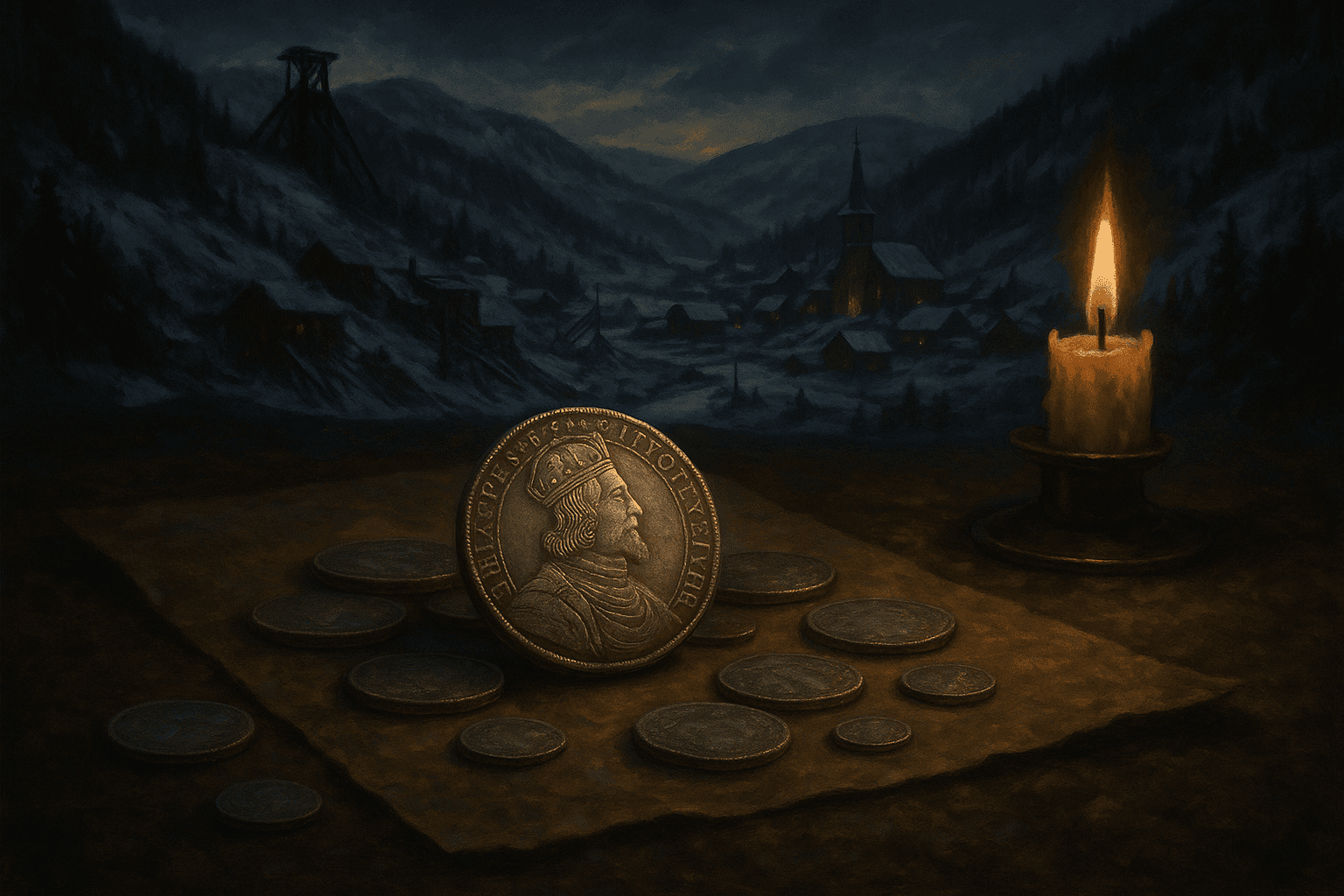
The word dollar —the name of the most powerful currency on the planet— was not born on Wall Street or in Washington. It was born in a remote valley in Bohemia, in what is today the Czech Republic, in a mining town founded half a millennium ago. The dollar is, at bottom, the worn-down echo of the name of that valley: Joachimsthal, “St. Joachim’s valley”. The story of how a 16th-century Czech place name ended up printed on America’s greenbacks runs through a silver rush, a family of counts who grew fabulously rich, and a coin so good that everyone wanted to copy it.
A valley, a mountain of silver
Around 1512, rich veins of silver were discovered in a corner of the Ore Mountains, on the border between Bohemia and Saxony. The news set off a mining rush: within a few years a hamlet of a few thousand people had grown into a town of nearly twenty thousand. Its owners, the Counts of Schlick, christened the place in 1520 as Sankt Joachimsthal —the valley (Thal, now Tal, “valley” in German) dedicated to St. Joachim, the father of the Virgin Mary and the traditional patron of miners.
The key word here is Thal. That small geographic suffix, “valley”, is literally the syllable that survives inside “dollar” five centuries later. Everything that followed was a matter of shortening a name that was too long.
From Joachimsthaler to thaler
On January 9, 1520, the Schlicks began striking large, high-quality silver coins at Joachimsthal: about 27.6 grams of metal with a purity close to 93%. Because they came from that valley, they were called Joachimsthaler —“from Joachimsthal”. But five syllables were too many for everyday use, so people soon clipped the word from the front and kept only the ending: Thaler, “thaler”.
The coin was so good and so plentiful that it became a trusted standard. It is estimated that by the mid-16th century some twelve million thalers struck in those mountains were already circulating across Europe. The name detached itself from the specific valley and came to designate, generically, any large silver coin of that type. Just as the word “money” was born from the name of a Roman temple, “dollar” was born from the name of a mining town: in both cases a place lent its name to the money that came out of it.
The thaler crosses borders (and oceans)
From German Thaler, the name jumped into other languages, warping along the way: in Czech it became tolar, in Dutch daler or daalder, and in English it ended up as dollar. English speakers began using that word for all kinds of large European silver coins, and especially for one that dominated world trade: the Spanish peso, the famous “piece of eight” (peso de a ocho reales), struck from the silver of the American mines.
That Spanish peso was, in fact, the coin that circulated most in Britain’s North American colonies, where English coinage was scarce. The colonists also picked up another piece by a Dutch route: the leeuwendaler or “lion dollar”, a Dutch coin bearing a lion. From calling all those silver pieces “dollars” —Spanish, Dutch or German— the word became firmly lodged in American English long before the United States existed.
Why the United States chose the “dollar”
When the thirteen colonies became independent, they had to decide what to call their new currency. They rejected the British pound —too tied to the empire they had just broken from— and chose the name people already used every day: dollar. In 1792 the young republic officially defined its dollar using the Spanish silver peso as its reference: Alexander Hamilton had a handful of worn pesos weighed and assayed to fix how much silver the American coin should contain (about 24 grams of fine silver). The American dollar was born, quite literally, by measuring Spanish coins.
It is a small historical irony that the name of the currency now associated with the power of the United States comes from a Central European valley, and that its first standard of value was a Spanish coin. Money, like the word “salary” that comes from salt, is almost never named the way you would expect.
And the $ sign?
The symbol $ did not come from the dollar either, but once again from the Spanish peso. The most widely accepted explanation is that it grew out of the handwritten abbreviation ps, with which merchants noted down “pesos”. In the rush of writing, the s gradually drifted on top of the p until the two letters merged into a single stroke with a vertical bar: the sign we recognize today. The earliest examples appear in merchants’ letters from the late 18th century —one from 1778 by the trader Oliver Pollock already shows the nearly final form— and in print around 1797. When the United States adopted the dollar, it also inherited the peso’s scrawl.
So the next time you look at a one-dollar bill, remember that you are holding a chain of borrowed names: the sign of a Spanish peso, the name of a German thaler and, at the very bottom, a valley in Bohemia dedicated to a saint. Like so many words for money and numbers, “dollar” hides inside it a journey of centuries that began very far from any bank.
References
- “Dollar”, Online Etymology Dictionary: from Low German daler, from German Thaler, short for Joachimsthaler, a coin struck from silver of Joachimsthal (“Joachim’s valley”) in Bohemia. etymonline.com
- “Thaler”, Encyclopædia Britannica: origin of the silver coin struck by the Counts of Schlick at Joachimsthal from 1519–1520 and its spread across Europe. britannica.com
- “Predecessor of US dollar minted 500 years ago in Jáchymov”, Radio Prague International: the first thalers struck on January 9, 1520 in Jáchymov (Joachimsthal) and their link to the name “dollar”. radio.cz
- “Dollar sign”, Encyclopædia Britannica (Money): the theory that the $ sign originated in the ps abbreviation for the Spanish peso and was later adopted by the US dollar. britannica.com
Enjoy the stories behind words? Continue with the origin of “money” and that of “salary”, or browse the whole etymology series.
The books · born from this blog
Atahualpa con su abrigo de pelo de murciélago
y otras 49 historias verdaderas que parecen mentira
Available on Amazon
Tocar madera
Pequeña historia de las supersticiones que el mundo no ha podido soltar
Available on Amazon
100 futuros
Cien escenarios del mundo que viene con la inteligencia artificial
Available on AmazonYou may also like

The Origin of the Word “Quarantine”: 40 Days in Venice
Where does the word quarantine come from? From the 40 days that Venice and Ragusa forced ships to wait during the Black Death. Here is its story.
The Origin of the Word “Museum”: House of the Muses
Where does the word museum come from? From mouseion, the temple of the Greek Muses and the great center of learning in Alexandria, long before glass cases.
The Origin of the Word “Candidate”: Togas and Chalk
Where does the word candidate come from? From the chalk-whitened toga that Roman office-seekers wore to look pure before the voters.