
Why Money Is Called “Plata” in Latin America
Why do so many Latin Americans call money “plata” (silver)? The answer lies in a metal, the mountain of Potosí, and coins that once circled the whole globe.
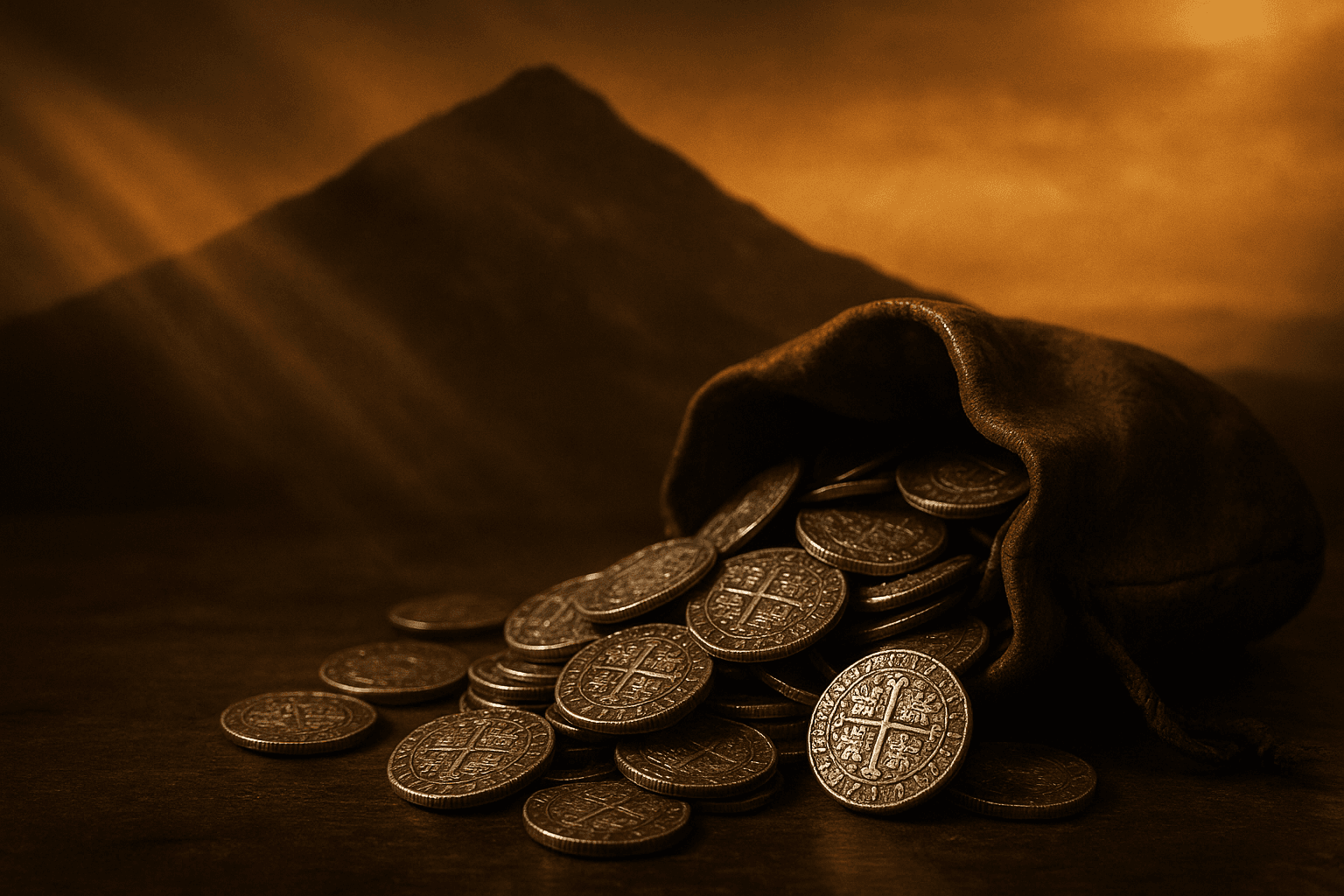
Across most of Latin America, nobody simply «has money»: they have plata —literally, «silver». You borrow plata, you earn plata, you run short of plata. The word is so ordinary that we rarely stop to notice how strange it is to call money by the name of a precious metal. But the habit is no linguistic accident: it is the trace of five centuries of history, of a Bolivian mountain that financed empires, and of silver coins that were, for a very long time, the most trusted money on Earth.
First, where does the word «plata» come from?
The name of the metal does not come, as you might expect, from the Latin argentum —the root that survives in French argent, Italian argento, and the chemical symbol Ag. Spanish took another path. «Plata» comes from Medieval Latin plata, «a sheet of metal», which in turn comes from Vulgar Latin *plattus, «flat» or «flattened», and that from Greek platýs (πλατύς), «broad, flat». The same root sits behind «plate», «plaza» and «plane».
In other words: at first «plata» did not mean the white metal but a metal sheet, something hammered flat. Over time, in the Iberian Peninsula the word narrowed to sheets of that particular metal, and ended up as the everyday name for silver. Spanish was almost the only Romance language to drop the argentum root for daily use and keep the idea of «the flattened thing».
From metal to money: a logical shift
That a metal should lend its name to money is nothing unusual. For centuries, the most valuable and trusted coins were struck precisely in silver, so saying «plata» for «money» was almost a literal description: what you carried in your pocket was, in fact, silver. It is the same logic by which the word «dollar» was born from a silver coin minted in a Bohemian valley, or by which English silver long doubled as a word for money.
The figure of speech is metonymy: naming one thing by another closely tied to it. Just as «salary» comes from the salt with which Roman soldiers were paid —or bought their pay— «plata» slid from naming the material to naming the value. Only, in the case of silver, the association was reinforced with brutal force from the sixteenth century on.
Potosí: the mountain that flooded the world with silver
In 1545, in what is now Bolivia, the Cerro Rico of Potosí was discovered: a mountain holding the richest silver veins ever found. The city that grew at its foot became one of the most populous on the planet, rivaling London or Paris at its height. From its depths —at the cost of appalling forced labor— came wealth so colossal it was carved into the language: «valer un Potosí», to «be worth a Potosí», still means to be worth a fortune. Cervantes already used it in Don Quixote, where neither «the treasure of Venice» nor «the mines of Potosí» would suffice to repay a certain favor.
That American silver did not stay in America. Turned into coins, it crossed the Atlantic toward Spain and the Pacific toward Asia, financing wars, cathedrals and the first truly global trade. When the money that moved the world was, physically and in enormous quantities, silver from the Spanish colonies, it was almost inevitable that «plata» would come to mean «money», plain and simple.
The silver peso, a global coin
The star of that system was the real de a ocho, also called the silver peso or «piece of eight»: a large, reliable coin struck from the silver of Potosí, Mexico and Peru. It circulated across Europe, Asia and the British colonies of North America, where English coin was scarce. For nearly three centuries it was something like a world currency, and its name —peso— stuck so firmly that a dozen Latin American countries still call their money by it.
So while the official name of the coin remained «peso» in many places, the popular name for money in general settled on «plata»: the material those coveted pieces were made of. The word survived even after coins stopped being silver and became nickel, paper or mere numbers on a screen —much as the stones of Yap island stayed money though nobody moved them.
The irony of Argentina
There is one last twist. The country that carries silver in its very name does not call it «plata» in its learned origin: Argentina comes precisely from Latin argentum, «silver» —the root the rest of Spanish abandoned. The name was given by the conquistadors who sailed up the Río de la Plata, convinced that the metal of a legendary sierra flowed down it. The sierra was not there —the real silver lay in Potosí, far inland— but the name endured.
So within a single language the two roots coexist: Latin argentum, fossilized in a country's name and in the symbol Ag, and the flattened plata of everyday speech, which millions of people use each day to say, simply, «money». Behind that most ordinary word lie a metal, a mountain and half a millennium of history.
References
- «plata», Diccionario de la lengua española (RAE-ASALE): from Medieval Latin plata, «sheet of metal», and its narrowing in the Iberian Peninsula to the silver metal. dle.rae.es
- «PLATA», Diccionario etimológico (etimologías de Chile): reconstruction of plata < Vulgar Latin *plattus «flat» < Greek platýs, and its relation to the argentum root. etimologias.dechile.net
- «The Silver of the Conquistadors», World History Encyclopedia: the role of the Cerro Rico of Potosí, the real de a ocho and American silver in world trade. worldhistory.org
- «¿De dónde viene la expresión valer un Potosí?», National Geographic España: the 1545 discovery, the wealth of the Cerro Rico and the Cervantes citation in Don Quixote. nationalgeographic.com.es
Enjoy the stories behind words? Keep going with the origin of «dollar» and the origin of «salary», or explore the whole etymology series.
The books · born from this blog
Atahualpa con su abrigo de pelo de murciélago
y otras 49 historias verdaderas que parecen mentira
Available on Amazon
Tocar madera
Pequeña historia de las supersticiones que el mundo no ha podido soltar
Available on Amazon
100 futuros
Cien escenarios del mundo que viene con la inteligencia artificial
Available on AmazonYou may also like
The Origin of the Word Guagua in the Andes
«Guagua» means baby across much of the Andes and comes from the Quechua and Aymara wawa. Here is the story of the word and its curious double: the bus.

Placebo: the Latin word that means «I shall please»
«Placebo» means «I shall please» in Latin and began as a medieval funeral chant. Here is how it jumped from the church to medicine and its famous effect.
The Origin of the Word “Money”: the Goddess Juno
Where does the word money come from? From a temple of Juno in Rome where the first coins were struck. The story of a goddess who warned.