
Edison's Phonograph: The First Machine That Talked
In 1877 Thomas Edison built the phonograph, the first machine that could record the human voice and play it back. A machine had finally spoken aloud.
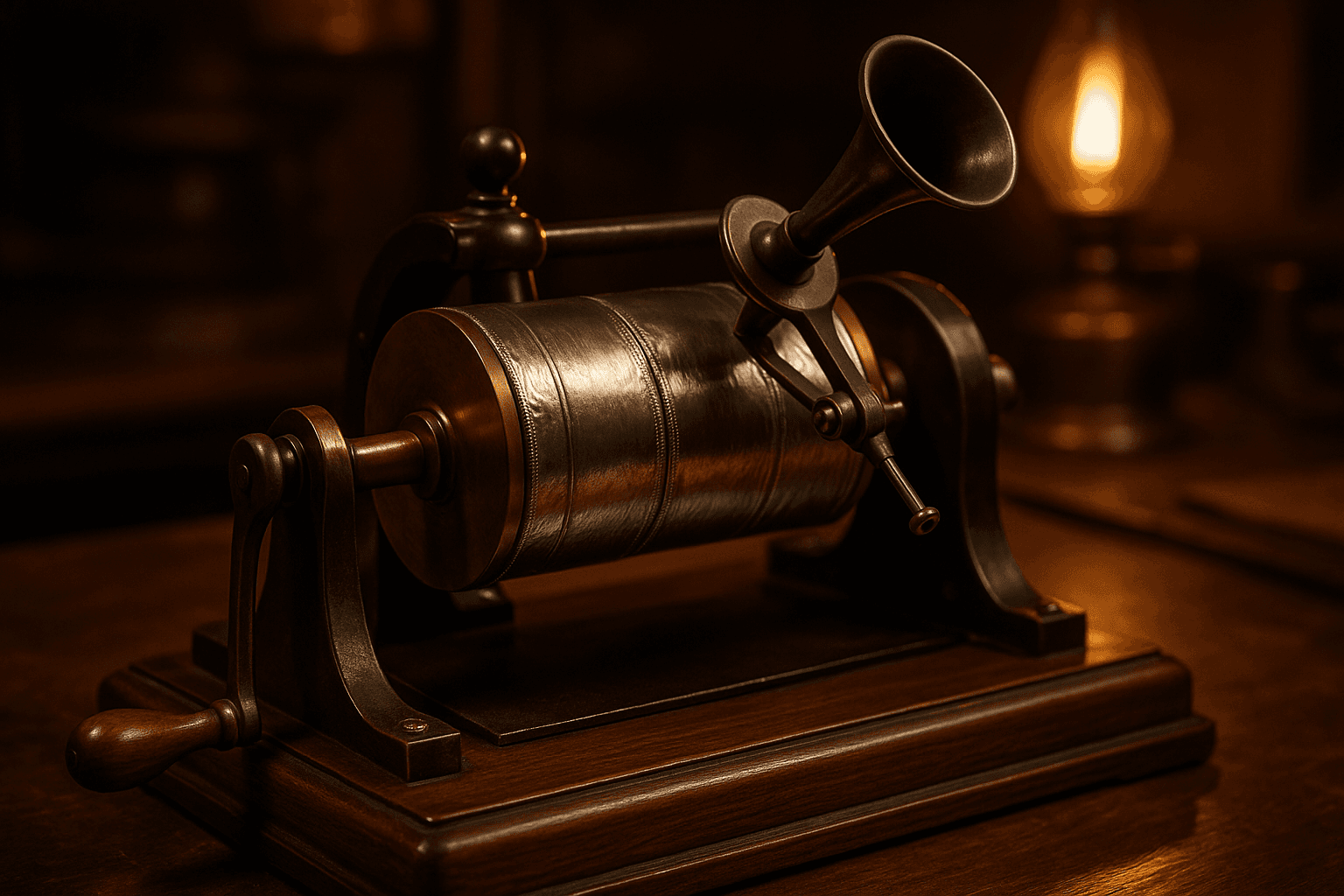
For the whole of human history, no machine had ever been able to give a voice back. We could write it down, sketch it, even "photograph" its vibration, but never hear it again. Until one December afternoon in 1877, when a crude contraption of brass and tin repeated a nursery rhyme and left everyone in the room speechless.
Thomas Edison's phonograph was not the first machine to record sound —that story belongs to a forgotten Frenchman— but it was the first to close the loop: to record the human voice and play it back again. For the first time, a machine spoke. This is the story of how sound stopped being fleeting and eternal and became something you could keep inside a sheet of tin.
The Wizard of Menlo Park
In 1877 Thomas Alva Edison was 30 years old and already famous. He worked at his laboratory in Menlo Park, New Jersey, a kind of invention factory where he was refining the telegraph and the newborn telephone. It was precisely while studying how to record telegraph messages on a paper tape that he stumbled onto an unexpected idea.
Edison noticed that when he ran that marked tape quickly under a needle, the device produced a hum that vaguely resembled a human voice. If the vibrations of speech could leave a physical trace, he reasoned, perhaps that same trace could make a membrane vibrate again and bring the sound back. The intuition was both simple and brilliant.
How it worked: a cylinder of tin
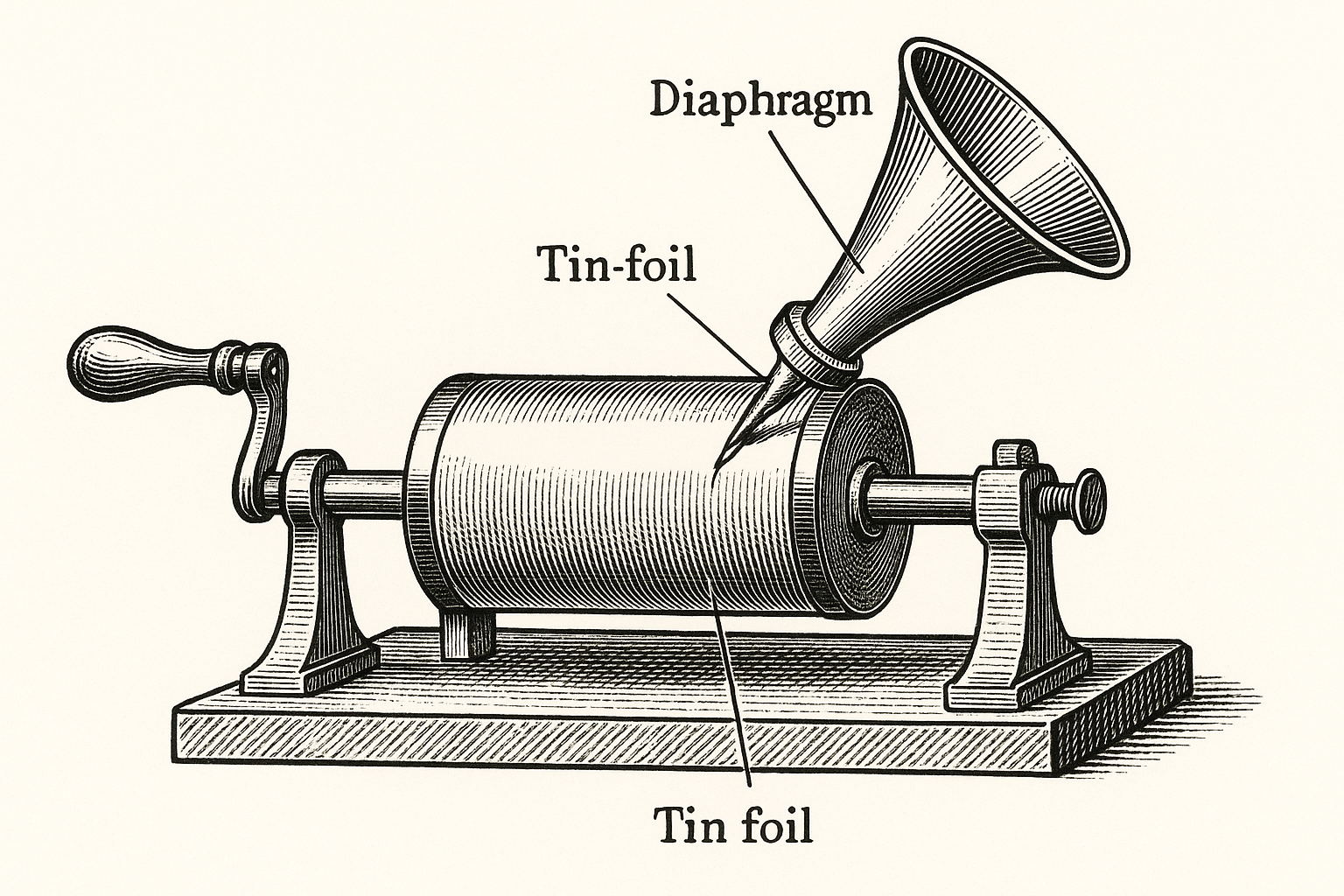
The design Edison sketched was disarmingly simple. A brass cylinder with a spiral groove was wrapped in a thin sheet of tinfoil. On either side of the cylinder sat a mouthpiece holding a membrane and a needle.
To record, you turned a crank and spoke into the mouthpiece: the sound waves made the membrane vibrate, and the needle dug more or less deeply into the tin depending on the loudness of the sound, leaving a wavy indentation along the groove. To play it back, you returned the cylinder to its starting position, rested a second needle on those marks and cranked again. Those indentations now made the membrane vibrate in reverse, recreating the original sound.
Here lies the decisive difference with everything that came before. Seventeen years earlier, the Frenchman Édouard-Léon Scott had managed to draw the shape of the voice onto paper blackened with lamp soot, as we told in the story of the oldest surviving recording of a human voice. But his machine only knew how to write sound, not read it aloud. Edison's phonograph was the first that could do both.
"Mary had a little lamb": the machine answers
Edison handed the sketch to his trusted machinist, the Swiss John Kruesi, who built the device in about 30 hours during the first week of December 1877. Legend has it that Kruesi asked what the thing was for, and Edison replied, without further explanation, that it was going to talk.
When it was ready, Edison leaned over the mouthpiece, turned the crank and recited the opening lines of a nursery rhyme every American child knew: "Mary had a little lamb, its fleece was white as snow…" He returned the cylinder to its place, set down the reading needle and cranked once more. In a metallic, trembling voice, the machine repeated the whole line. According to the witnesses themselves, they were struck dumb: for the first time a machine had given them back a human voice.
A machine that wishes you good night
The next day, December 7, 1877, Edison brought his phonograph to the offices of Scientific American in New York. The scene, as the magazine itself reported in its December 22 issue, had something otherworldly about it: the machine, its editors wrote, "inquired as to our health, asked how we liked the phonograph, informed us that it was very well, and bid us a cordial good night".
Edison filed his patent application on December 24, 1877, and on February 19, 1878, he was granted U.S. Patent No. 200,521, titled "Improvement in Phonograph or Speaking Machines". The invention's name came from Greek: phonḗ (sound, voice) and gráphein (to write). Literally, "the one that writes sound". The press gave it flashier nicknames —"the talking machine"— and Edison, who was already collecting fame, came to be known as the Wizard of Menlo Park.
And what is this good for?
The curious thing is that not even Edison was sure what to do with his invention. In an 1878 article he listed a number of possible uses, and music was hardly at the top: he imagined dictating letters without a secretary, talking books for the blind, teaching diction, clocks that announced the hour aloud, and preserving the last words of the dying as a form of family keepsake. Selling recorded music to the general public struck him as almost an afterthought.
There was also a huge practical problem: the tinfoil sheet deformed after just a few playbacks and was nearly impossible to reuse or archive. The original phonograph was more of a fairground marvel than a useful product, and Edison, absorbed in another project that consumed his attention —lighting up the world with the light bulb, in the middle of the war of the currents against Tesla and Westinghouse— shelved the device for nearly a decade.
From tin to disc: the race for sound
Competition forced him back. In the 1880s, the laboratory of Alexander Graham Bell —the telephone man— improved on the idea by replacing fragile tin with wax cylinders, far more durable and recordable. Edison answered with his own wax cylinders, and at last recorded sound began to become a real business in the 1890s.
The decisive blow came from a third party. The German Emile Berliner swapped the cylinder for a flat disc and called his device the gramophone. Discs were easy to mass-produce and to store stacked, and they eventually won out over the cylinder. From that invention grew the entire vinyl industry that dominated the 20th century. Edison had opened the door, but it was the disc —not his cylinder— that kept the future.
The first voice no one can hear
One final irony remains. That historic 1877 recording of "Mary had a little lamb" does not survive: the original tinfoil sheet was lost. The version circulating online today, with Edison reciting the rhyme in a cracked voice, is not from 1877 but a re-creation he recorded himself in 1927, fifty years later, to mark the anniversary and show how that first device had sounded.
So the first sentence a machine ever spoke was heard only by those present at Menlo Park that afternoon. It is the same fragile fate of so many pioneers of recording: to capture something fleeting for the very first time and, even so, fail to keep it fully. It happened to those who tried to catch light with the first cameras and to those who dreamed of stopping time in a daguerreotype. Edison taught the world that a voice could outlive its owner; it is just that the very first one, paradoxically, fell silent forever.
References
Categories
The books · born from this blog
Atahualpa con su abrigo de pelo de murciélago
y otras 49 historias verdaderas que parecen mentira
Available on Amazon
Tocar madera
Pequeña historia de las supersticiones que el mundo no ha podido soltar
Available on Amazon
100 futuros
Cien escenarios del mundo que viene con la inteligencia artificial
Available on AmazonYou may also like
The Bicycle: The Machine That Freed the City
In 1817 Karl Drais built a running machine with no pedals. A century later the bicycle had reshaped cities and helped set women free.
The First Submarine Was Built Centuries Before You Think
Before Isaac Peral's electric submarine came centuries of trying: Drebbel under the Thames, the Turtle of 1776 and the deadly Hunley of 1864.

The Airship: The Elegant Future That Burned
The airship promised to cross oceans in silent luxury. From Giffard to the Hindenburg, the story of an elegant future that ended in flames.