
Vacuum Tube vs Transistor: The Battle for Electronics
For decades the vacuum tube ruled electronics, until a tiny chip of metal dethroned it. The story of the battle that shrank technology into your pocket.
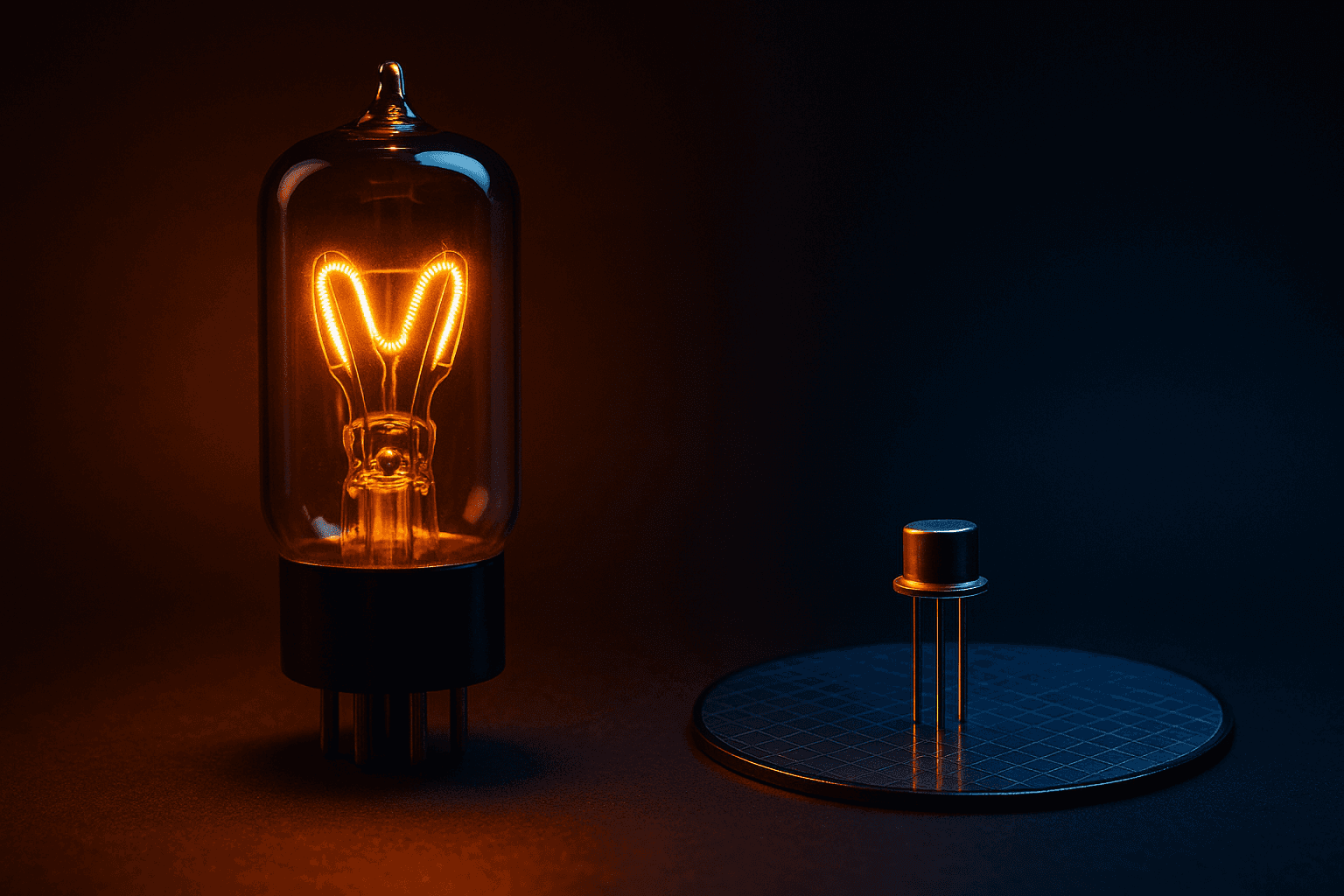
For nearly half a century, any device that amplified or switched a signal —a radio, a television, a computer— relied on a fragile glass bulb with the air pumped out of it: the vacuum tube. Then, in a New Jersey laboratory, a tiny rival appeared that did the same job without heating up, without breaking, and taking up a fraction of the space. The battle between the vacuum tube and the transistor was never a fair fight, and its outcome shrank electronics until it fit in your pocket. But, contrary to how the story is usually told, the tube never fully surrendered.
The champion: how the vacuum tube reigned
The modern tube was born in 1906, when the American inventor Lee de Forest added a third electrode —a grid— inside an evacuated bulb and created the triode, which he named the Audion. That grid let a small signal control a large flow of electrons: for the first time, a device could amplify as well as act as an electronic switch. It was the building block of radio, long-distance telephony, radar and television.
The principle was elegant but demanding. Inside the bulb, a glowing filament heated a cathode that fired electrons toward a plate; the grid in between regulated that stream. It worked beautifully, and for decades there was no alternative.
The champion's Achilles' heels
The tube's problem was its flaws, all at once. To emit electrons it had to heat a filament, so it drew a lot of power and threw off heat like a light bulb. It was large and fragile, made of glass, and its filament burned out over time, just like a lamp. The more tubes you put together, the more often one of them failed.
The extreme case was ENIAC, one of the first electronic computers, finished in 1945: some 18,000 tubes, thirty tons, and an entire room to itself. It broke down so often that keeping it running was almost a feat. It was clear that if electronics were going to grow, it needed something smaller, cooler and more reliable. That something arrived in 1947.
The challenger: a chip of metal that stayed cold
At Bell Labs, three physicists —John Bardeen, Walter Brattain and William Shockley— built a device that did the triode's job using a solid semiconductor material, with no vacuum and no glowing filament: the transistor. We tell that discovery in detail in the history of the transistor. What matters here is the head-to-head, because the challenger won almost every category.
The transistor was tiny next to the bulb; it needed no heat, so it used far less power and turned on instantly instead of waiting for a filament to glow; it was solid, with no glass to break or filament to burn out, so it lasted for years; and it could be mass-produced and, later, integrated by the thousands onto a single chip of silicon. Where the tube was bulky, hot and perishable, the transistor was minute, cool and practically eternal.
Why the tube lost the war
The verdict was handed down by the integrated circuit. A single transistor was already better than a tube, but the real rout came when it turned out that many transistors could be packed onto the same piece of silicon. No one could fit a thousand glass tubes on a fingernail, yet that is exactly what a chip does with transistors today, multiplied by millions.
Through the 1960s, the transistor pushed the tube off one front after another: first out of portable radios, then televisions, and finally computers. For anyone with an old tube device, the reverse road even exists: replacing a vacuum tube with solid-state components. Electronics stopped being measured in centimeters and tons and started being measured in nanometers and grams.
The last strongholds: where the tube still wins
And here is the twist the simple version of the story usually leaves out: the vacuum tube never fully disappeared. It survives in the niches where its way of working is still superior:
- The microwave oven. The heart of nearly every kitchen in the world is a magnetron, a high-power vacuum tube that generates microwaves at 2.45 GHz. It is probably the most common tube on the planet: there is one in your kitchen right now.
- Satellites. Traveling-wave tubes (TWTs) amplify microwave signals in the downlink transmitters of communications satellites. Thousands of tubes orbit the Earth at this moment, still dominating broadcasting from space.
- High power and frequency. In radar, high-power radio and TV transmitters, particle accelerators and X-ray machines, tubes still handle amounts of energy at very high frequencies that a transistor would struggle to bear.
- Sound. Many audiophiles and guitarists swear that the tube amplifier has a warm character that solid-state doesn't quite reproduce. It isn't pure nostalgia: the way a tube distorts when it saturates simply sounds different.
The verdict
The battle between the tube and the transistor was won by the challenger in a landslide across almost everything that mattered for consumer electronics: size, power, reliability and cost. Thanks to that victory, the computer that once filled a room now fits in a phone. But it was a win on points, not a knockout: wherever enormous power at very high frequencies is needed —or simply a sound with character— the old glass bulb is still standing, lit and working, nearly one hundred and twenty years after De Forest added that grid.
References
- "Lee de Forest," Encyclopædia Britannica. britannica.com
- "ENIAC," Computer History Museum. computerhistory.org
- "The Traveling-Wave Tube in the History of Telecommunication," arXiv. arxiv.org
- "Are Vacuum Tubes Still Used (& What Are They Used for)?," Pentalabs. pentalabs.com
Enjoy stories about the technology that changed everyday life? Continue with the history of the transistor or explore the whole electronics section.
Categories
The books · born from this blog

Atahualpa con su abrigo de pelo de murciélago
y otras 49 historias verdaderas que parecen mentira
Available on Amazon
Tocar madera
Pequeña historia de las supersticiones que el mundo no ha podido soltar
Available on Amazon
100 futuros
Cien escenarios del mundo que viene con la inteligencia artificial
Available on AmazonYou may also like
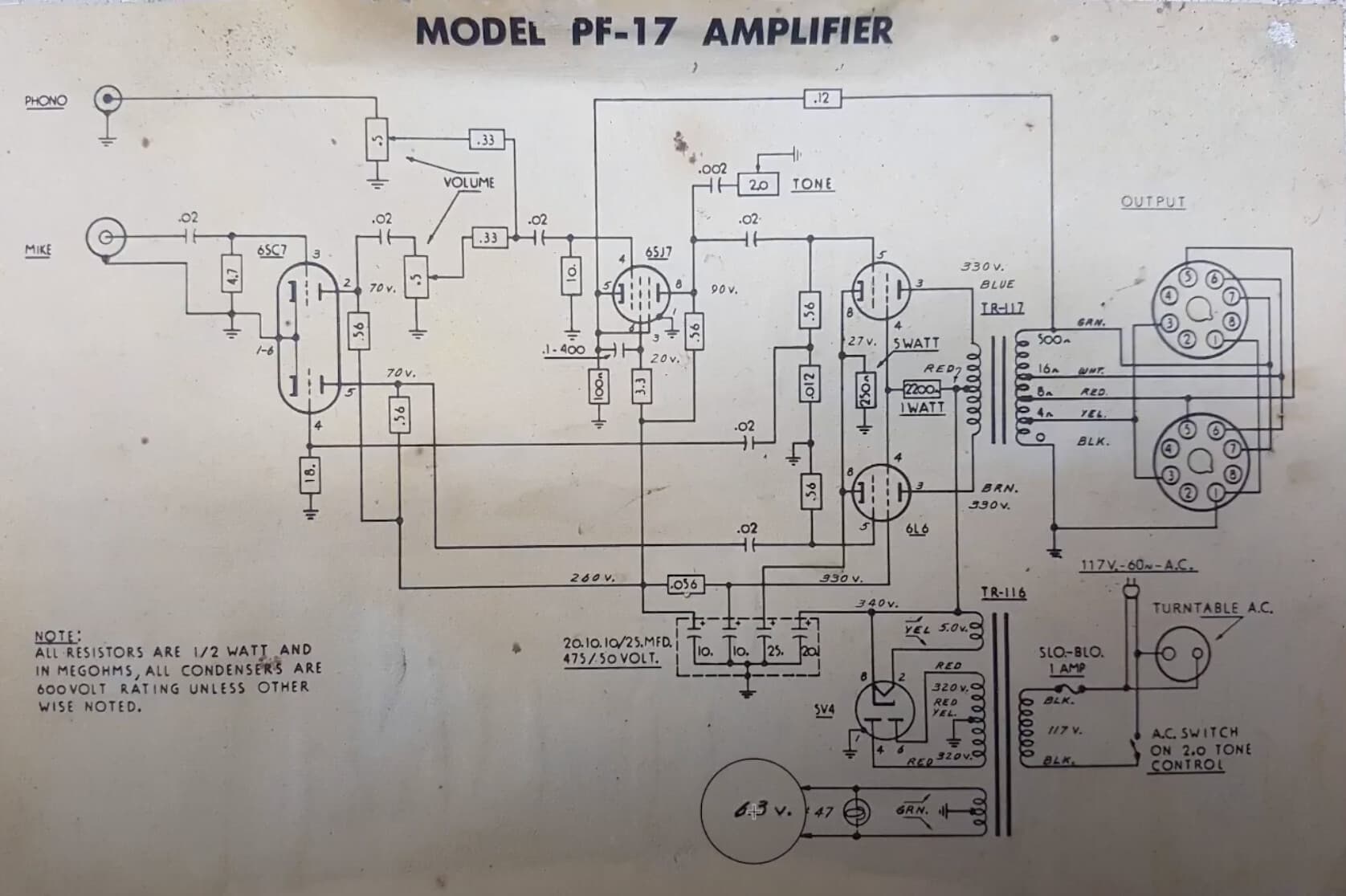
How does a vacuum tube amplifier work?
How a vacuum tube amplifier works, explained stage by stage through a beautiful 1950s Pathfinder amp, from the rectifier to the power output.
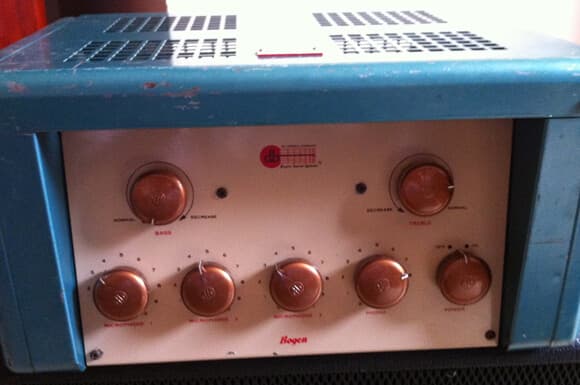
How to replace a vacuum tube with solid state components
When a dead vacuum tube proved impossible to find, I rescued a 1950s Bogen amp by swapping the rectifier valve for simple silicon diodes.

Why One CD Lasts Decades and Another Dies
Some compact discs survive 30 years while others die on their own in a few. Disc rot, CD bronzing and why manufacturing — not age — decides everything.