
The History of Glass: The Material That Changed the World
Glass went from Egyptian luxury to everyday object thanks to Roman glassblowers, and later gave science its telescope and microscope.
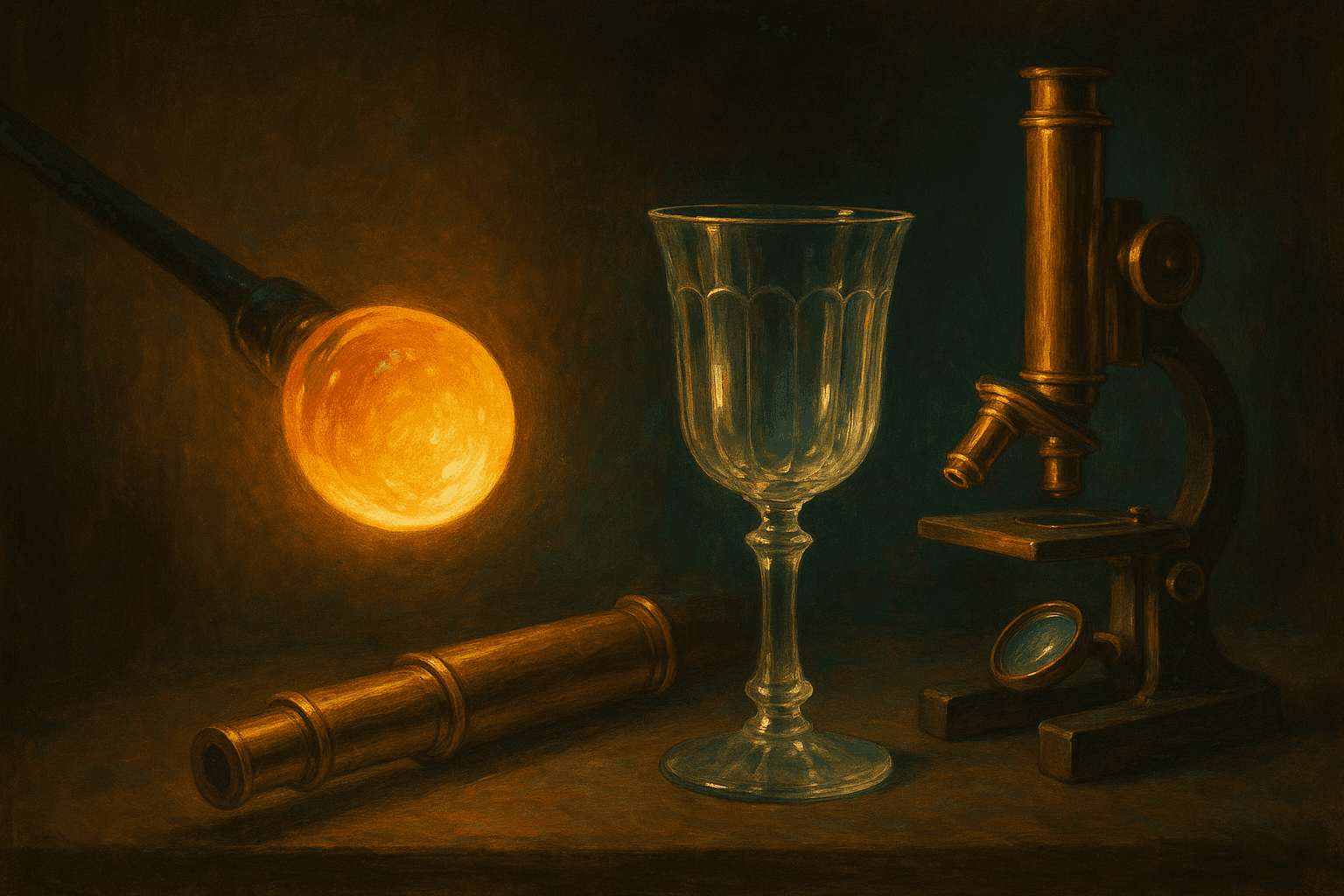
We look through glass so many times a day that we stop seeing it. It's in the window, the drinking cup, the phone screen, the eyeglasses and the bottle on the table. And yet it is one of the strangest and most powerful substances humanity has ever made: a solid that behaves almost like a frozen liquid, transparent yet hard, fragile yet all but eternal. Its story spans four thousand years and explains things as different as Roman wine, Venetian state secrets, and the birth of modern science.
Sand, fire and accident
Glass is born from something as humble as sand. Heated above 1,000 °C together with soda and lime, silica melts and, as it cools, does not reorganize into orderly crystals: it stays "trapped" in an amorphous, transparent state. The oldest known glass objects are Mesopotamian beads from the second half of the third millennium BCE, around 4,500 years ago. The first closed vessels came a thousand years later, around 1500 BCE, in Mesopotamia and ancient Egypt.
Those flasks were not blown: they were made with a slow technique called core-forming. A plug of clay, dung and sand was molded onto the tip of a metal rod, molten glass —thick as treacle— was poured over it, and once decorated and cooled, the hardened core had to be scraped out by hand. It was goldsmith's work. The result was a luxury object, reserved for pharaohs and temples, as precious as a jewel.
The glassblowing revolution
Everything changed toward the end of the 1st century BCE on the coast of the Levant —what is now Syria, Lebanon, Israel, Palestine and Jordan. Someone discovered that if you gathered a blob of molten glass on the end of a hollow tube about a meter and a half long and blew from the other end, the mass inflated like a bubble and could be shaped in minutes. The earliest evidence of blown glass comes from Jerusalem in the final quarter of the 1st century BCE, under Rome's client kings.
It was a leap comparable to the printing press. What had taken days of craftsmanship was now done in moments, and the price collapsed. Under the Roman Empire, a glass cup could cost as little as a single copper coin. Glass stopped being a treasure and became an everyday object: bottles for wine and oil, jars for perfumes and cosmetics, tableware, even the first window panes. Roman pieces have been found as far away as Scotland, Scandinavia, the Sahara and even China. For the first time, ordinary people could store and carry liquids in an inert material that didn't taint the flavor.
The secret of Venice
A thousand years later, glass changed hands again. In 1291, the Republic of Venice ordered all its workshops to move to the island of Murano, officially to prevent fires in the wooden city, but also to concentrate and watch over the master glassmakers. Their formulas became state secrets: artisans were forbidden to leave the Republic, and revealing the recipes abroad could be punished by death.
The great leap came in the mid-15th century with Angelo Barovier, a glassmaker with the soul of a chemist. By purifying the plant ash that supplied the soda and adding manganese as a decolorizer, he achieved a glass of unprecedented transparency, rivaling rock crystal. They called it cristallo. That crystal-clear, almost invisible glass was not just a luxury for the courts of Europe: it was the raw material that science was about to need desperately.
The tool that let us see the invisible
Here is the part almost no one tells: without transparent glass, there would be no modern science. Chemistry was born when alchemists could watch reactions inside vessels that neither contaminated nor hid them. And in the early 17th century, two inventions made of lenses forever changed the scale of the observable.
Around 1590, Dutch spectacle makers, the Janssens, mounted two lenses in a tube and created the microscope. In 1608, another Dutch optician, Hans Lippershey, patented the telescope. With them, Galileo studied the heavens and Anton van Leeuwenhoek discovered a whole universe of tiny creatures in a drop of water. Without those lenses, scientists like Hooke, Pasteur or Koch would never have seen microorganisms, and germ theory —the idea that invisible diseases cause epidemics— would have taken centuries longer to arrive. The same transparency that made a Venetian goblet elegant let us see bacteria, the moons of Jupiter, and living cells.
A frozen liquid that holds up the world
Glass did not change civilization with a single invention, but by dripping across millennia. It held Roman wine, adorned Renaissance courts, opened windows to the light, and finally became the eyes of science. Like gunpowder, which began as medicine, or the mirrors that fascinated antiquity, glass shows that the most transformative technologies are usually the ones we stop noticing. It's still here, invisible by definition: in the optical fiber carrying this text to your screen and its lenses, glass keeps doing what it does best —letting us see what we couldn't before.
References
- "History of glass," Wikipedia: the earliest Mesopotamian beads, the Egyptian core-formed vessels, and the evolution of the technique. wikipedia.org
- "How the invention of glassblowing changed everyday life in ancient Rome," The Conversation: glassblowing in the 1st-century-BCE Levant and its effect on the Roman world. theconversation.com
- "Cristallo Murano Glass," Glass of Venice: Angelo Barovier, the cristallo formula, and its status as a Venetian state secret. glassofvenice.com
- "2002: The microscope and telescope of the scientific revolution," University of Bristol: the role of glass and lenses in the microscope, telescope and the scientific revolution. bristol.ac.uk
Enjoy these stories of materials and inventions that changed the world? Continue with gunpowder before cannons and the Archimedes death ray, or explore the whole history section.
Categories
The books · born from this blog
Atahualpa con su abrigo de pelo de murciélago
y otras 49 historias verdaderas que parecen mentira
Available on Amazon
Tocar madera
Pequeña historia de las supersticiones que el mundo no ha podido soltar
Available on Amazon
100 futuros
Cien escenarios del mundo que viene con la inteligencia artificial
Available on AmazonYou may also like
Lithium: From Medicine to the Battery of the Modern World
Lithium went from miracle cure and soft drink to mood stabilizer and battery of the modern world. This is the story of the lightest metal, from medicine to power.
Porcelain: the Chinese secret Europe tried to steal
For centuries Europe paid fortunes for Chinese porcelain without knowing how it was made. This is the story of a hundred-year industrial espionage.
Gunpowder Before Cannons: Alchemy, Fire and War
Chinese alchemists chasing eternal life invented gunpowder by accident. Before cannons came fireworks, fire lances and centuries of fire medicine.