
David Todd and his tunnel to the top of Chimborazo
In 1922 astronomer David P. Todd proposed boring a tunnel into Chimborazo all the way to the summit to build a pressurized steel observatory inside it.
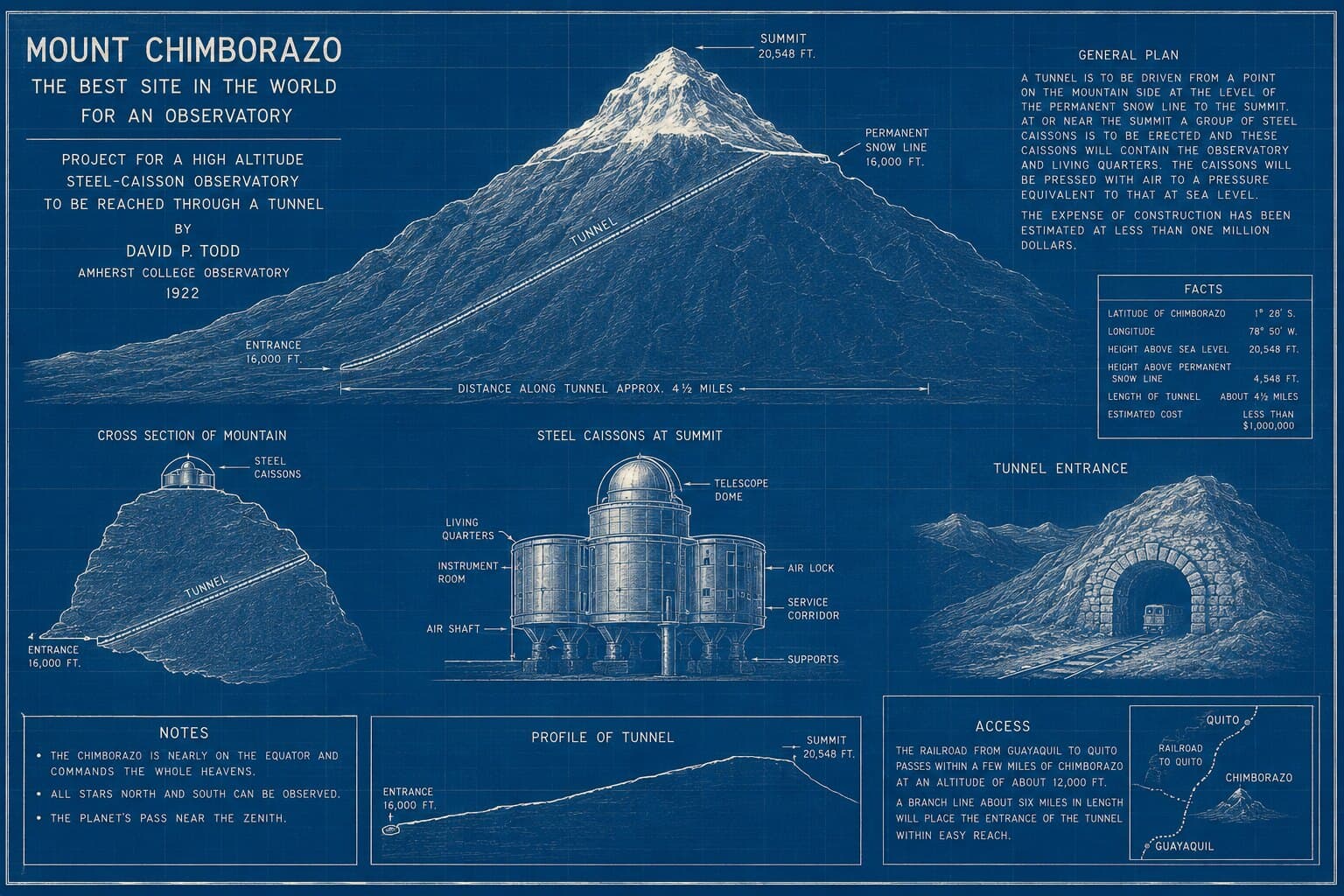
In 2024 I traveled to the United States to gather material for a history book I'm writing, and in the archive of a prestigious university I stumbled, purely by chance, onto a subject that grabbed my attention at once. I was after something else entirely; but among the correspondence and original drawings of an early-20th-century astronomer appeared something that stopped me cold: the sketches of a wild project to bore through a mountain I know well, Chimborazo. What that man was proposing, a century ago, was one of those ideas that sound invented, but aren't.
In 1922, an American astronomer looked at a map of the world and decided that the best observatory on the planet was not in California or the Alps, but inside an Ecuadorian mountain. His plan wasn't to climb up and live on the summit of Chimborazo: it was to drill through it. Bore a tunnel through the volcano's guts up to the peak and build there, beneath the ice, sealed steel chambers where scientists would breathe air at sea-level pressure while watching the stars. It sounds like a Jules Verne novel. But he proposed it in earnest, cost estimate and railway plan included.
There was a time when astronomers didn't dream of putting telescopes in space, but of hauling them up the highest mountains on Earth. The reason was simple: the atmosphere gets in the way. It moves, it shimmers, it absorbs light and distorts the stars, turning the sky into a kind of imperfect glass. The higher an observatory sits, the less air there is between the telescope and the universe. So, in the late 19th and early 20th centuries, astronomers began a quiet race toward the summits. The catch, of course, was that the best mountains for watching the sky were also the worst places to live.
The best place in the world to watch the sky
The author of the proposal was David P. Todd, an American astronomer and director emeritus of the Amherst College Observatory. In 1922 he published Astronomy: The Science of the Heavenly Bodies, a popular-science book that included a plate with a blunt caption: "Mount Chimborazo, the Best Site in the World for an Observatory."
For Todd, Chimborazo had a near-perfect advantage: it sat very close to the equator. From there, he argued, almost the entire sky could be observed —both the northern and southern hemispheres— and the planets would cross the meridian under ideal conditions, nearly straight overhead. In other words: if you had to choose a single point on the planet from which to see the greatest possible amount of sky, Chimborazo looked like an extraordinary candidate. And not just any part of it: not a refuge on the lower slopes, not a comfortable mid-altitude station, but the summit itself.
The small problem of living above 6,000 meters
Chimborazo rises 6,263 meters above sea level, according to the datasheet of the Geophysical Institute of the National Polytechnic School. It is the highest volcano in the Northern Andes and, because of its proximity to the equator, it hides a fascinating geographic oddity: its summit is the point on the surface farthest from the center of the Earth, even more so than Everest, because the planet bulges at the equator.
But for Todd this was neither a tourist nor a patriotic matter; it was astronomical. And the obstacle was brutal: permanent snow, extremely difficult access, and atmospheric pressure so low that settling there for good was nearly impossible. An astronomer could go up for a few hours, perhaps on an expedition, but not move in to work night after night with delicate instruments. The solution Todd devised was so bold it sounds like fiction: instead of crowning the mountain, enter it from below.
The idea: drill through Chimborazo
Todd proposed opening a tunnel from the permanent snow line, which he placed at around 16,000 feet (some 4,900 meters), and advancing diagonally through the inside of the mountain until reaching the summit. Up top there would be no traditional observatory, with astronomers bundled in scarves battling the ice. There would be sealed steel chambers, pressurized with artificial air at a pressure equivalent to sea level. Something like a submarine on a mountaintop: but instead of watching fish through a porthole, it would watch stars.
The image is wonderful: scientists living inside Chimborazo, breathing compressed air, swinging telescopes from sealed compartments, while outside the snow, the wind and the lack of oxygen kept making normal life impossible. Todd even put a number on it: no more than a million dollars of the day. A fortune, yes, but to him it was not an absurd fantasy, but a conceivable feat of engineering.
A rehearsal in the Andes
The most interesting part is that Todd wasn't entirely improvising. Years earlier, in 1907, he had run tests at Cerro de Pasco, Peru, a mining town more than 4,000 meters high. There he experimented with a pressurized steel chamber to relieve altitude sickness, the malaise that in the Andes has a name of its own: soroche.
By his own account, people suffering from altitude sickness were placed inside the chamber and, once the pressure was artificially restored, the symptoms vanished: headache, labored breathing, racing pulse. For Todd, that proved the great obstacle of the summits was not insurmountable; you simply had to carry sea level inside a steel box. The idea today recalls space stations, hyperbaric chambers or extreme habitats. But we're talking about 1922: decades before artificial satellites and before humanity began living in capsules off the Earth. Todd wanted to do something similar, but in reverse: not take the telescope out of the atmosphere, but put the astronomer inside a mountain.
The train that almost made it
The most Ecuadorian part of the plan appears when Todd mentions the Guayaquil–Quito railway. According to him, the line already ran through a high zone near Chimborazo, at about 12,000 feet (close to 3,650 meters), and only about six additional miles of track would be needed to reach the point where the tunnel would begin.
That is: ship to Guayaquil, train into the highlands, a rail spur toward the mountain, a diagonal tunnel to the summit and, at the end, a pressurized observatory beneath the snow. Seen this way, the project was a blend of astronomy, railways, mining, high-altitude medicine and technological delirium. But that was precisely the era: a time when the world still believed any problem could be solved with steel, steam, rails and enough stubbornness.
Why was it never built?
As far as I have been able to find, the Chimborazo tunnel never got past the proposal stage. There is no trace of works, executed plans or any construction expedition. And the reasons are plain to see.
First, the engineering would have been enormously expensive and dangerous: drilling through a mountain of ice, volcanic rock and extreme altitude was no small task. Second, daily operation would have been a puzzle: maintaining pressure, heating, instruments, staff, oxygen, supplies and permanent access in a hostile environment. Third, astronomy kept finding more practical places —less extreme mountains, dry skies, good roads— to build observatories without turning a summit into a submarine. And, in time, the definitive solution was not to dig into mountains but to leave the atmosphere altogether: space telescopes fulfilled Todd's dream by another route, avoiding the air instead of pressurizing it.
A failed idea, but a beautiful one
The easy thing would be to laugh at Todd. A tunnel into Chimborazo, an observatory in steel boxes, astronomers breathing compressed air beneath a frozen summit: it all sounds excessive. But that laughter would be unfair, because the proposal reveals something fascinating about early-20th-century science: it was still very close to adventure. Astronomers weren't just people peering through a telescope; they were expedition members who packed enormous instruments, crossed oceans, climbed mountains, chased eclipses and depended on a single cloud not ruining years of preparation.
Todd belonged to that world: one in which the line between the laboratory and the expedition was thin, and in which an Ecuadorian mountain could appear in an astronomy book as the best site on the planet to watch the stars. The tunnel was never built. The observatory never existed. No one lived inside Chimborazo breathing artificial air while the wind roared outside. But for a moment, on a page from 1922, Ecuador's highest volcano was imagined as a doorway to the universe. And that, even unbuilt, is already a story worth telling.
References
- David P. Todd, Astronomy: The Science of the Heavenly Bodies (1922): includes the plate billing Chimborazo as the "best site in the world" for an observatory and describes the tunnel, the pressurized steel chambers, the Cerro de Pasco rehearsal and the Guayaquil–Quito railway connection.
- David Peck Todd — Wikipedia
- Chimborazo — Wikipedia (elevation, location and its status as the point farthest from the center of the Earth).
Categories
The books · born from this blog
Atahualpa con su abrigo de pelo de murciélago
y otras 49 historias verdaderas que parecen mentira
Available on Amazon
Tocar madera
Pequeña historia de las supersticiones que el mundo no ha podido soltar
Available on Amazon
100 futuros
Cien escenarios del mundo que viene con la inteligencia artificial
Available on AmazonYou may also like
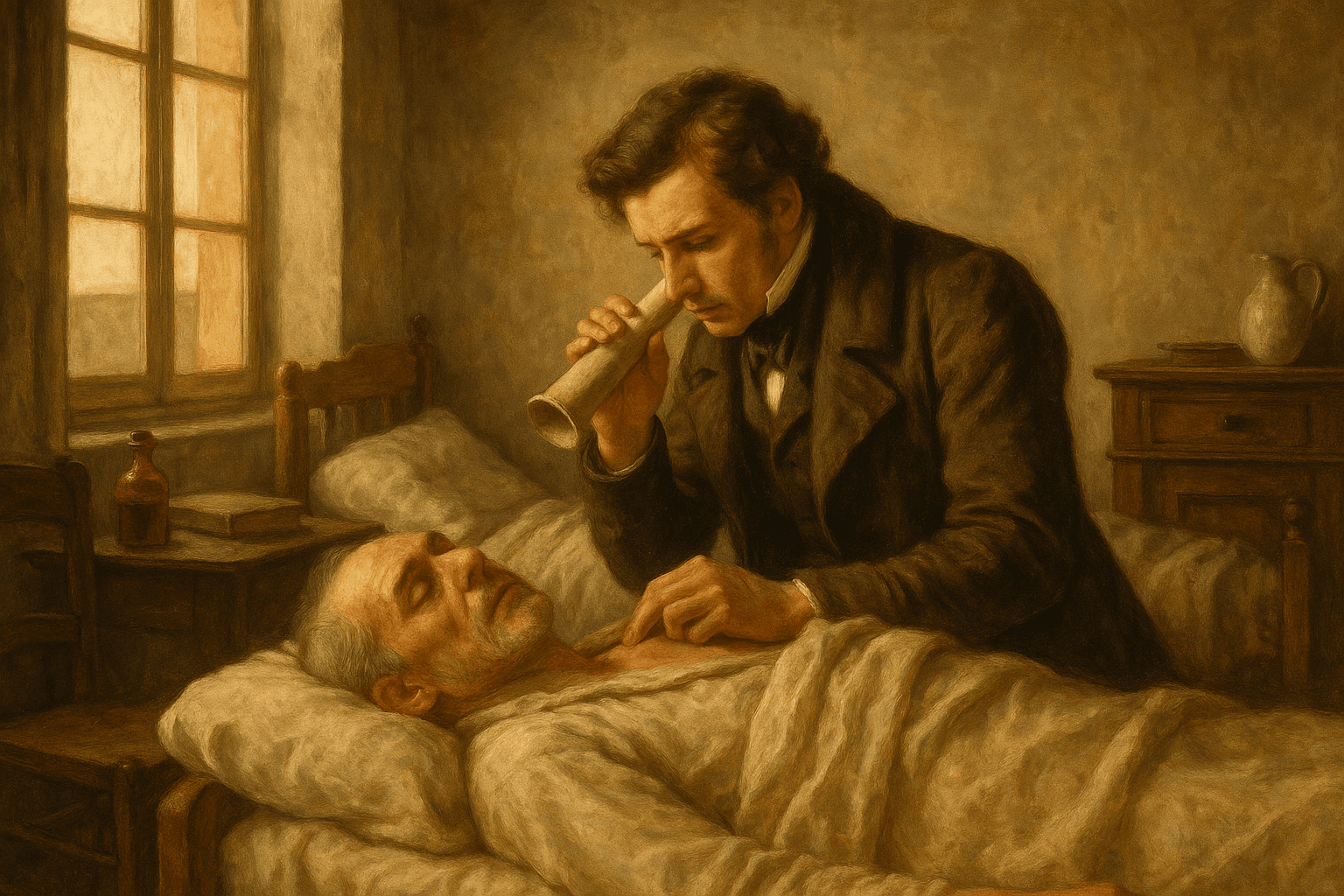
The history of the stethoscope and Laennec's modesty
In 1816 a French doctor felt too awkward to press his ear to a patient's chest, so he rolled up paper — and the stethoscope was born.
Scurvy: the disease that killed more sailors than storms
Scurvy killed more sailors than battles and shipwrecks combined. Its cure was discovered, forgotten, and rediscovered over and over for centuries.
Anesthesia: when surgery was pure torture
Before 1846, surgery meant sheer agony and surgeons who amputated a leg in 30 seconds. This is how anesthesia was born and transformed medicine.