
The Origin of the Word “Pixel”: Born in Space
Where does the word pixel come from? It joins pix (picture) and element, and was first published in 1965 at NASA to describe images from probes to the Moon and Mars.
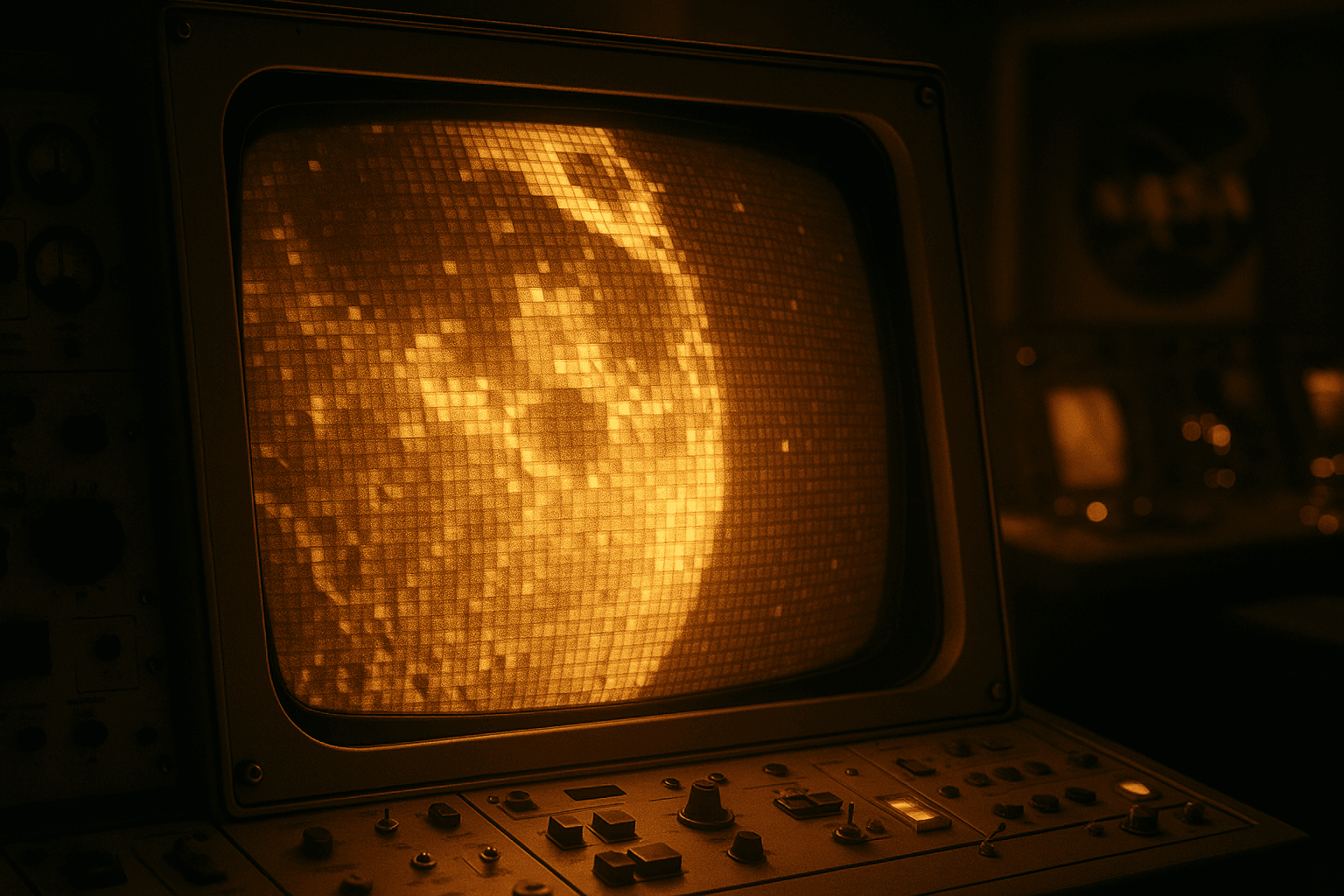
Every photo on your phone, every screen you are staring at right now, every emoji you send is made of pixels: thousands of tiny colored dots so small the eye blends them into a continuous image. The word sounds like it was born in Silicon Valley, among engineers of screens and digital cameras. But pixel is older than almost anyone imagines, and its first documented use had nothing to do with phones or video games, but with something far more ambitious: the first digital photographs ever sent from space.
Pix plus element: a word assembled from parts
Let's start with the anatomy. Pixel is a blend, a word built by joining two pieces: pix —a colloquial form of "pictures"— and el, from element. A pixel is, literally, a "picture element": the smallest indivisible unit from which a digital image is built, like the tiniest brick in a wall.
The first half has its own curious history. Pix appeared in the headlines of Variety magazine around 1932 as an abbreviation of "pictures," meaning movies; by 1938 photojournalists were using it for still photos too. From that pix the word inherited its first syllable. And the pattern proved so handy that it spawned relatives: voxel (the "volume pixel" used in 3D graphics) and texel (the "texture pixel") were formed in exactly the same way, swapping the first part and keeping the -el of "element."
1965: the word blasts off to the Moon and Mars
The earliest known published use of pixel dates to 1965, and it came from an unexpected place: NASA's Jet Propulsion Laboratory (JPL) in California. Engineer Frederic C. Billingsley put it in writing in two technical papers that year to describe the "picture elements" of the photographs that space probes were beaming back to Earth.
Those were no ordinary photos. Billingsley worked on processing the images from the Ranger and Mariner missions, the spacecraft that were sending the first digital photographs of the Moon and Mars. To manipulate those images in a computer, you had to break them into a grid of dots, each with a brightness value, and you needed a short word to name each dot. That word was pixel. In other words: the term that today defines the screen in your pocket was born to talk about other worlds.
Billingsley didn't invent it (and the trail goes cold)
Here comes the most honest twist in the story. Billingsley always made clear that he did not coin the word: he had heard it from a colleague named Keith E. McFarland, at the Link Division of General Precision, in Palo Alto. And when McFarland was asked where he got it, he said he didn't know: it was simply "in use at the time," around 1963.
So the genealogy of pixel blurs just before its first written record. As with other words whose exact origin is disputed, we know who published it first, but not who said it first. It was passing from mouth to mouth among image engineers in the early sixties until someone wrote it down and fixed it forever.
The poor cousin: "pel"
For a while, pixel had a direct rival: pel, an even blunter contraction of "picture element." William F. Schreiber of MIT published it in 1967, and it enjoyed some success in the technical world: IBM used it in the manuals of its first PC, and it still survives today in some corners of image and video processing. But pel never sounded as good or caught on as deeply as pixel, which ultimately won the contest hands down once personal computers and digital cameras reached people's homes.
The idea itself, though, was far older than either word. Breaking an image into dots to transmit it is the founding principle of television, and it already appeared —without a modern name— in an 1888 German patent, where each dot was called a Bildpunkt, "picture point." The concept waited nearly eighty years for someone to give it the label we now use without thinking.
From the lab to everyday language
For more than a decade, pixel and pel stayed locked inside the jargon of image and video specialists; they did not reach textbooks until the late 1970s. Then came the explosion: monitors, video games with blocky graphics, cameras that measure their quality in "megapixels," phones bragging about resolution. The word stopped being technical and became as ordinary as "wifi" or "robot": we say it without thinking about what it means.
And yet, every time we talk about the resolution of a camera or zoom into an image until we see its little colored squares, we are using a word that was born to describe how the surface of Mars looked on a screen in a NASA lab. A pixel is the smallest thing in any image; its history, by contrast, is enormous.
References
- "Pixel," Wikipedia: the formation of the word from pix and element, its first published use by Frederic C. Billingsley in 1965, and the pel variant. en.wikipedia.org
- Richard F. Lyon, "A Brief History of ‘Pixel’," SPIE Proceedings (2006): detailed research on the origin of the term, the roles of Billingsley and McFarland at JPL, and the "in use" date around 1963. dicklyon.com
- "Frederic C. Billingsley," Wikipedia: biography of the JPL engineer who published the word while processing images from the Ranger and Mariner probes. en.wikipedia.org
- "Pixel," Ultimate Pop Culture Wiki: overview of the origin of pix in Variety magazine (1932), Schreiber's pel variant (MIT, 1967), and its use by IBM. ultimatepopculture.fandom.com
Enjoy the stories behind words? Continue with the origin of "robot" and what "wifi" stands for, or browse the whole etymology series.
Categories
The books · born from this blog

Atahualpa con su abrigo de pelo de murciélago
y otras 49 historias verdaderas que parecen mentira
Available on Amazon
Tocar madera
Pequeña historia de las supersticiones que el mundo no ha podido soltar
Available on Amazon
100 futuros
Cien escenarios del mundo que viene con la inteligencia artificial
Available on AmazonYou may also like
The Origin of the Word “Petrichor”
The smell of rain has had a name since 1964: petrichor, “the blood of the gods flowing from stone”. This is its story — and its science.
Why Computer Files Are Called Files
The digital file inherits its name from a real office: papers strung on a thread. From the Latin filum to the file system, this is the story of the file.
The Origin of Unix: Why It Lives in Your Phone
Unix was born in 1969 on a forgotten Bell Labs computer. Today its descendants run your phone, your Mac and nearly every server on Earth.