
The Forgotten War Between VHS and Betamax
Betamax was technically better and still lost. This is the story of the format war between Sony and JVC that decided how we would watch movies at home.
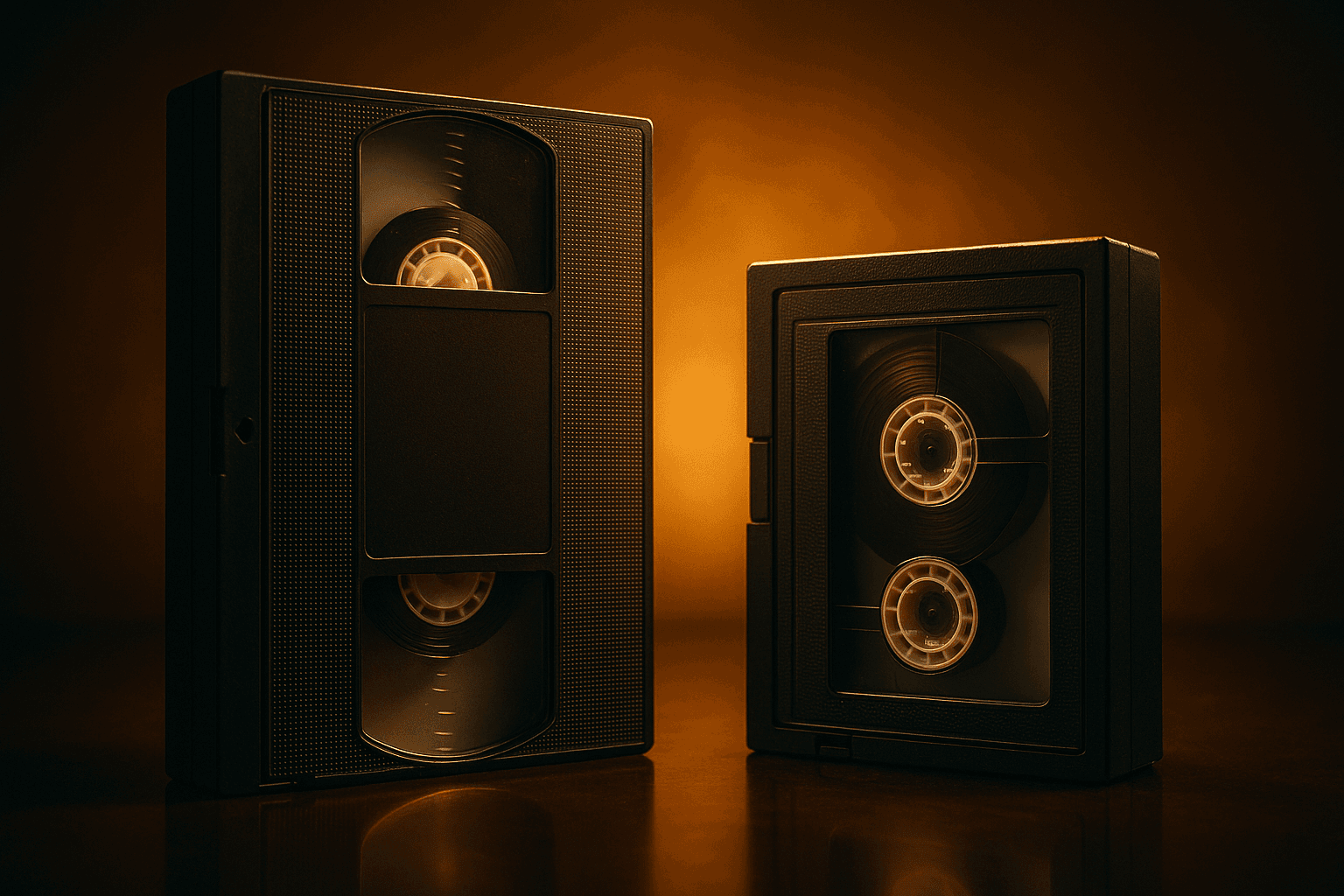
For almost a decade, two videotapes the size of a book fought over the living rooms of half the planet. One was technically superior; the other won. The story of VHS versus Betamax is the classic proof that in technology the best product does not always triumph — the one that plays its cards well does.
Today both sound equally ancient, but between 1975 and 1988 they were bitter enemies. That fight shaped how a whole generation recorded television, rented movies, and discovered you could watch a match whenever you liked. It also produced a lesson that would repeat with the CD, the DVD, and even streaming formats: quality is not enough.
Two Japanese giants and a disagreement
The story begins with a missed chance to keep the peace. In 1974, Sony had its home video system nearly ready and showed the Betamax prototype to other Japanese manufacturers, hoping they would all adopt a single shared standard. Among the guests was JVC (Japan Victor Company), which was already working on its own design and chose to go its own way rather than fall in line behind Sony.
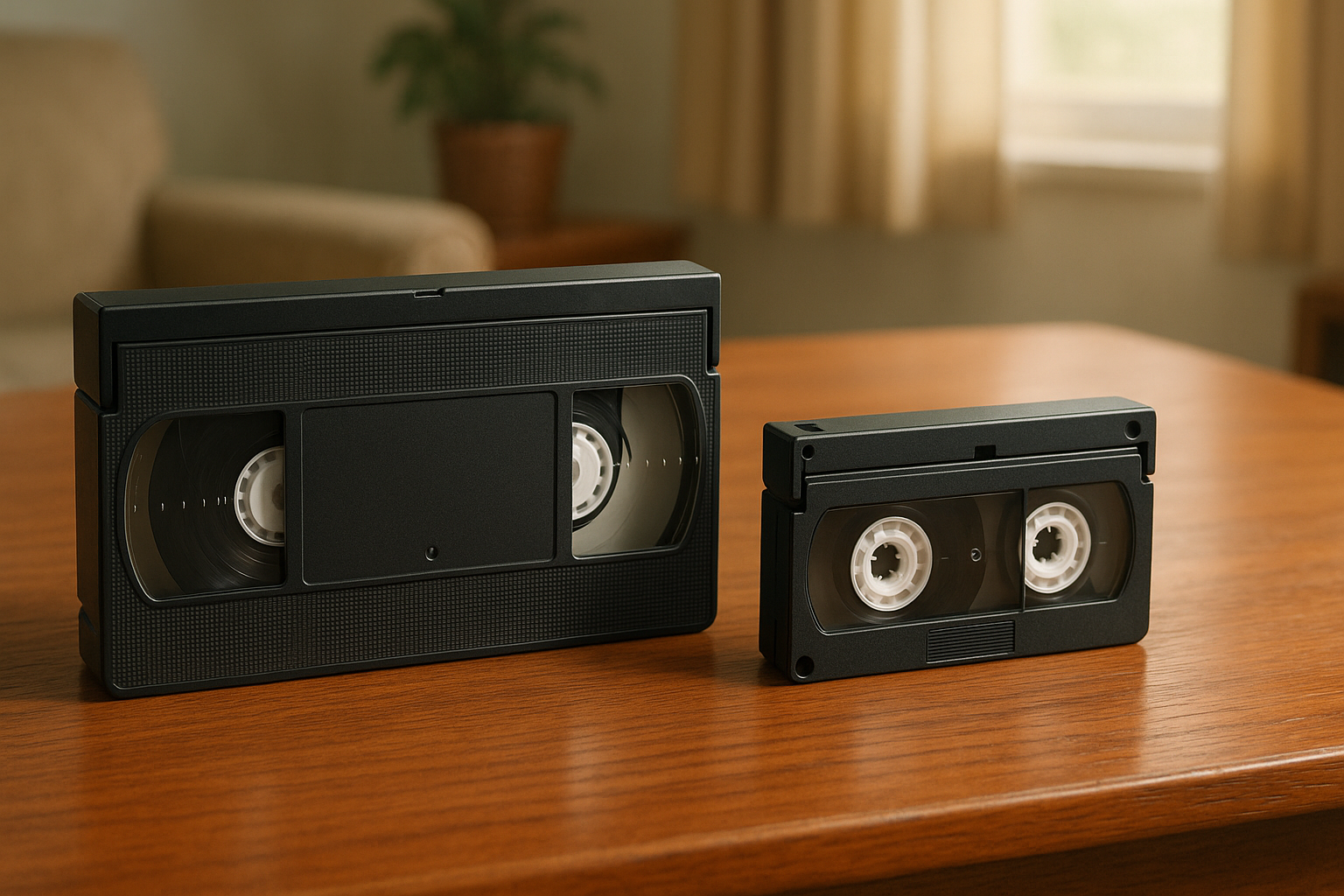
The result was two incompatible formats. Sony launched Betamax in 1975; JVC answered with VHS (Video Home System) in 1976. The cassettes looked alike from the outside, but no machine could ever read the rival's tape. Without realizing it, buyers weren't just choosing a machine: they were picking a side in a war that hadn't started yet.
Betamax was, on paper, the better one
Here is the great irony of this story: Betamax was the technically superior format, and almost no one disputes it. In its original mode, Betamax offered around 250 lines of horizontal resolution against VHS's 240, had less picture noise, better sound, and generally a more precise mechanism. Sony had done things with an engineer's care.
But that advantage hid a trap. To get a better picture, Sony sacrificed the thing people actually cared about: time. And that seemingly minor detail would end up sinking the better product.
The tape that couldn't fit a movie
The first Betamax tapes recorded only 60 minutes. It sounds trivial, but it was the format's Achilles' heel: one hour wasn't enough to record a full movie or a football match. JVC's VHS, by contrast, offered two hours from the start — just what was needed to fit a feature film on a single tape. Later, VHS stretched recording to four and even six hours.
Sony reacted with a slower mode (called β2) that doubled the running time to two hours, but to achieve it the company had to cut resolution, wiping out its main advantage in one stroke. The picture was better, sure — but if the movie didn't fit, what was the point? Consumers voted with their wallets and chose convenience. Recording time is, for most historians, the factor that decided the war.
The master move: opening the format
Recording time explains part of the defeat, but corporate strategy explains the rest. Sony guarded Betamax jealously, reluctant to license its technology to other manufacturers. JVC did exactly the opposite: it licensed VHS widely and cheaply to brands like Panasonic, Hitachi, Sharp, and RCA.
The effect was devastating. Suddenly dozens of manufacturers were making VHS machines, the competition among them drove prices down, and shops filled with compatible players. Sony, alone against that army, couldn't keep up. It is the same open-versus-closed-standards logic that would decide other technology battles decades later, like the one we tell in the history of Ethernet against proprietary networks.
The rental store tipped the scales
There was a third front, perhaps the decisive one: movie rentals. In the late seventies and through the eighties the video rental business exploded, and Hollywood studios and rental shops threw their weight behind the format that already ruled homes: VHS. The more VHS machines there were, the more VHS tapes got rented; and the more rental tapes, the more people bought a VHS deck. A virtuous circle for JVC and a bottomless pit for Sony.
The numbers tell the ending without mercy. By around 1980, VHS already held close to 60% of the North American market. In 1981 Betamax had fallen to about 25% of U.S. sales. And by 1987 VHS controlled roughly 90% of the U.S. market. In practice, the war was over.
The legal battle Sony did win
Losing the commercial war did not mean Sony lost every battle. In 1984, in the famous "Betamax case" (Sony Corp. of America v. Universal City Studios), the U.S. Supreme Court handed down a landmark ruling by 5 votes to 4: recording a television program at home to watch it later — what was called time-shifting — was fair use and did not violate copyright.
Hollywood had sued Sony, convinced that the home recorder would ruin cinema. The ruling not only saved home video: it set a precedent that would later protect photocopiers, MP3 players, and much of digital technology. Ironically, the machine that lost the format war gave its name to one of the most influential rulings of the technology era.
Surrender and a long agony
In 1988, Sony did the unthinkable: it began manufacturing its own VHS players, an implicit acknowledgment of defeat. Betamax didn't die at once, but it was relegated to a professional niche and a handful of loyalists. Sony stopped making Betamax machines in 2002 and, surprisingly, kept producing tapes until March 2016, when it announced the final shipment. Forty years after its birth, the "better" format went dark for good.
The VHS-versus-Betamax war left a moral the industry would repeat over and over: technology doesn't win by being superior alone, but through price, availability, alliances, and that intangible something that makes a format become everyone's standard. It's the same kind of contest already fought, with electric current instead of tape, in the war of the currents between Edison and Tesla, and it would recur with every new medium. King of the living room through the eighties and nineties, VHS would in turn surrender to the DVD, just as the floppy gave up its throne in the history of the floppy disk. No tape reigns forever.
References
Categories
The books · born from this blog

Atahualpa con su abrigo de pelo de murciélago
y otras 49 historias verdaderas que parecen mentira
Available on Amazon
Tocar madera
Pequeña historia de las supersticiones que el mundo no ha podido soltar
Available on Amazon
100 futuros
Cien escenarios del mundo que viene con la inteligencia artificial
Available on AmazonYou may also like

The Airship: The Elegant Future That Burned
The airship promised to cross oceans in silent luxury. From Giffard to the Hindenburg, the story of an elegant future that ended in flames.

The Bicycle: The Machine That Freed the City
In 1817 Karl Drais built a running machine with no pedals. A century later the bicycle had reshaped cities and helped set women free.
The Airplane Before the Wrights: Who Almost Won
Before the Wright brothers flew in 1903, pioneers nearly got there first: Cayley, Lilienthal, Ader and Santos-Dumont. This is their untold story.