
Why One CD Lasts Decades and Another Dies
Some compact discs survive 30 years while others die on their own in a few. Disc rot, CD bronzing and why manufacturing — not age — decides everything.
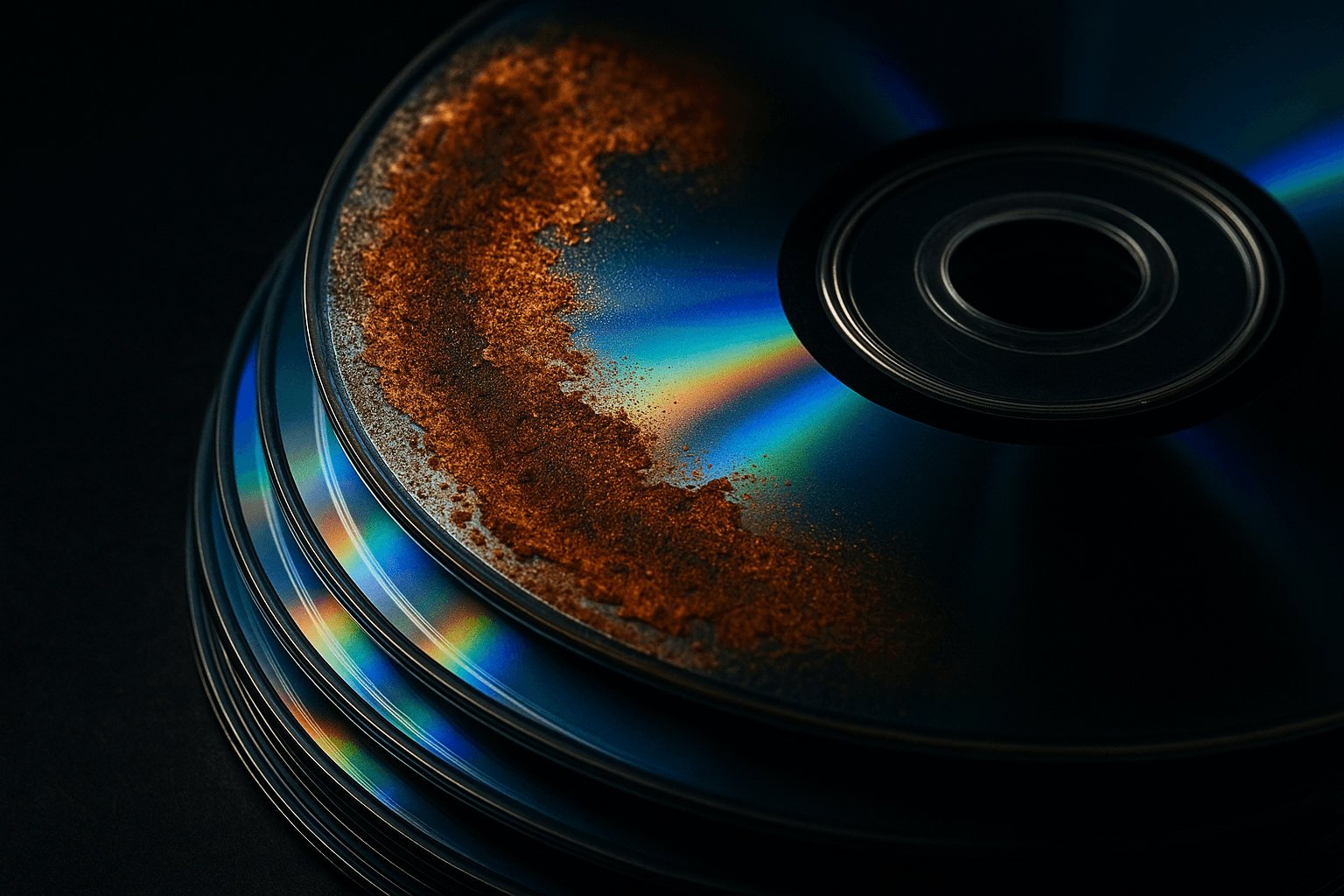
The compact disc arrived with a reputation for being eternal. Against vinyl that scratched and tape that stretched, the CD promised perfect sound «forever»: a laser beam read the music without touching anything, so in theory it never wore out. Decades later, the reality is more awkward. There are CDs from the 1980s that still sound flawless, and others bought the very same year that today return nothing but silence or clicks. Why does one disc last thirty years while its neighbor dies on its own? The answer is hidden in a few layers thinner than a hair.
What is really inside a CD
A CD looks like a single sheet of plastic, but it is a sandwich. Most of its thickness is transparent polycarbonate, and on top of it, on the label side, sits a microscopic reflective layer —usually aluminum— covered by a thin protective lacquer and the print. The information is not on the shiny face you see underneath, but just below the label: millions of tiny pits stamped into the plastic, which the laser reads through the polycarbonate by bouncing off the aluminum.
Here is the first clue to its fragility: the layer that really matters, the reflective aluminum, sits just a few microns below the label surface. Scratching the bottom face is almost never fatal, because the laser can focus «beyond» the scratch. But any damage from above —an aggressive marker, a sticky label torn off badly, or something worse: air— attacks the very heart of the disc.
«Disc rot»: when the aluminum oxidizes
The most famous problem has an almost organic name: disc rot. The CD does not rot like a fruit; instead, its aluminum layer oxidizes. Aluminum, in contact with air and moisture, forms an oxide; it stops being a bright mirror and turns translucent or dull. Where the laser once found a clean reflection, it now passes through the disc without bouncing back, and that part of the music or the data simply disappears.
For that to happen, the air has to reach the aluminum, and this is where manufacturing quality comes in. In a well-made disc, the lacquer seals the metal completely. In a poorly sealed one —lacquer too thin, badly cured, or with micropores at the edge— oxygen and moisture creep in through the rim and start eating the aluminum from the outside toward the center. That is why disc rot almost always shows up first as a damaged ring at the edge of the disc and works its way inward over the years.
The bronzing scandal
The most notorious case has a date and a culprit. Between 1988 and 1993, the plant that Philips & Du Pont Optical (PDO) ran in Blackburn, England, pressed a batch of discs with a fatal flaw. The lacquer they used to protect the aluminum could not withstand the sulfur present in the paper of the booklets packed with the CD. That sulfur slowly reacted with the aluminum and corroded it, tinting the disc a characteristic bronze or coppery shade that began at the edge and advanced toward the center. Collectors christened the phenomenon CD bronzing.
What is striking is that it was not the user's fault or the result of normal aging, but a manufacturing error: the same discs kept with the same care as perfectly healthy ones degraded on their own because the material doomed them from the factory. The failure went public in 1994, when critic John McKelvey described it in American Record Guide, and PDO ended up acknowledging its responsibility. It was proof that «indestructible» was, at the very least, an exaggeration.
Recordable CDs are a different (worse) story
Everything above applies to factory-pressed CDs, the music and software ones bought in a store. But the CD-R discs we burned at home work in a different and, in general, more fragile way. A pressed disc holds the information physically, stamped into the plastic: as long as the aluminum survives, the data is there. A CD-R, by contrast, has no physical pits: it stores the data in a layer of organic dye that the writing laser darkens spot by spot to mimic the holes.
And organic dyes, like any coloring, fade with light, heat and humidity. That is why a cheap CD-R left in the car under the sun can become unreadable in a few years, while a good archival-grade one —with phthalocyanine dye and a gold reflective layer that does not react like aluminum— lasts far longer. Manufacturers went so far as to promise 100 or even 200 years, but those figures come from accelerated lab tests; in the real world, badly stored, many did not make it past a decade. This same problem of preserving bits for the long term is what drives the search for exotic media, like the hard drive made of DNA that promises to last millennia.
So how long does a CD really last?
There is no single number, and that is precisely the answer to the question in the title. Aging tests by the U.S. Library of Congress suggest that a pressed, well-stored CD can comfortably last between 20 and 50 years, and under ideal archival conditions even top a century. But that same research makes clear that the variation between discs is enormous: longevity depends less on age and more on three things —how it was made, how it was handled and where it was stored.
The rules for extending their life are simple: store them on their edge in a cool, dry, dark place; avoid heat, direct sunlight and humidity; and handle them by the rim, never writing on the label face with a pen or sticking labels on it. A CD does not wear out from being played —the laser never touches it— but it does age in storage, and it does so silently.
So the next time an old disc skips or falls silent for no apparent reason, it is not capricious bad luck: it is chemistry. The very technology that read music without grazing the disc could not stop air, sulfur or a tired dye from doing their work inside. CDs were not eternal; they only seemed so as long as the aluminum kept shining. If you enjoy how the everyday technologies we use actually work, see also how Bluetooth works or why one USB-C cable charges fast and another does not.
References
- «Disc rot», Wikipedia. en.wikipedia.org
- «Compact disc bronzing», Wikipedia. en.wikipedia.org
- «Your CD and Blu-Ray collection won't last forever», Engadget. engadget.com
- «CD-Recordable FAQ, section 7», cdrfaq.org. cdrfaq.org
Do you enjoy stories about everyday technology? Continue with the DNA hard drive or explore the whole electronics section.
Categories
The books · born from this blog

Atahualpa con su abrigo de pelo de murciélago
y otras 49 historias verdaderas que parecen mentira
Available on Amazon
Tocar madera
Pequeña historia de las supersticiones que el mundo no ha podido soltar
Available on Amazon
100 futuros
Cien escenarios del mundo que viene con la inteligencia artificial
Available on AmazonYou may also like

Fiction or Prophecy? 20 Cartoons and Films That Predicted Our Present
From the Jetsons to Blade Runner, 20 cartoons and films predicted smartwatches, video calls and AI decades before they became part of daily life.

Vacuum Tube vs Transistor: The Battle for Electronics
For decades the vacuum tube ruled electronics, until a tiny chip of metal dethroned it. The story of the battle that shrank technology into your pocket.

How a Lithium Battery Works and the 1% Myth
The lithium battery powers your phone and your electric car. Here is how it works inside and why the percentage you see is never quite exact.