
The Transistor: The Tiny Switch That Built the Digital Age
In 1947, three Bell Labs physicists invented the transistor and shrank electronics forever. The story of the tiny switch that built the digital age.
Inside the phone you may be reading this on live billions of transistors: tiny switches that flick on and off billions of times per second to do everything a computer does. Yet until less than eighty years ago, the heart of electronics was a fragile glass bulb the size of a finger. The history of the transistor is the story of a small piece of semiconductor metal that replaced those bulbs, shrank the digital world, and quietly lit the technological revolution of the twentieth century.
Before the transistor: the reign of the vacuum tube
Through the first half of the twentieth century, amplifying or switching an electrical signal required a vacuum tube, also called a valve. It was a glass bulb with the air pumped out, in which a glowing filament fired electrons toward a plate. It worked, and worked well: it made radio, television and the first computers possible. If you're curious how that technology behaves on the inside, we explain it in detail in how a vacuum-tube amplifier works.
The trouble was its flaws, all at once. Tubes were big, fragile and expensive; they ran hot as a light bulb and drank power; and their filaments burned out often. The extreme example was ENIAC, one of the first electronic computers: it had roughly 18,000 tubes, filled an entire room, and failed so frequently that keeping it running was almost a feat. Clearly, if electronics was going to grow, it needed something smaller, cooler and more reliable.
Christmas Eve, 1947
That something arrived at Bell Labs in New Jersey, the research arm of the telephone company AT&T. After World War II, physicist William Shockley organized a group there devoted to solid-state physics, with the idea of switching signals using semiconductor materials —substances like germanium, halfway between conductor and insulator— instead of vacuum tubes.
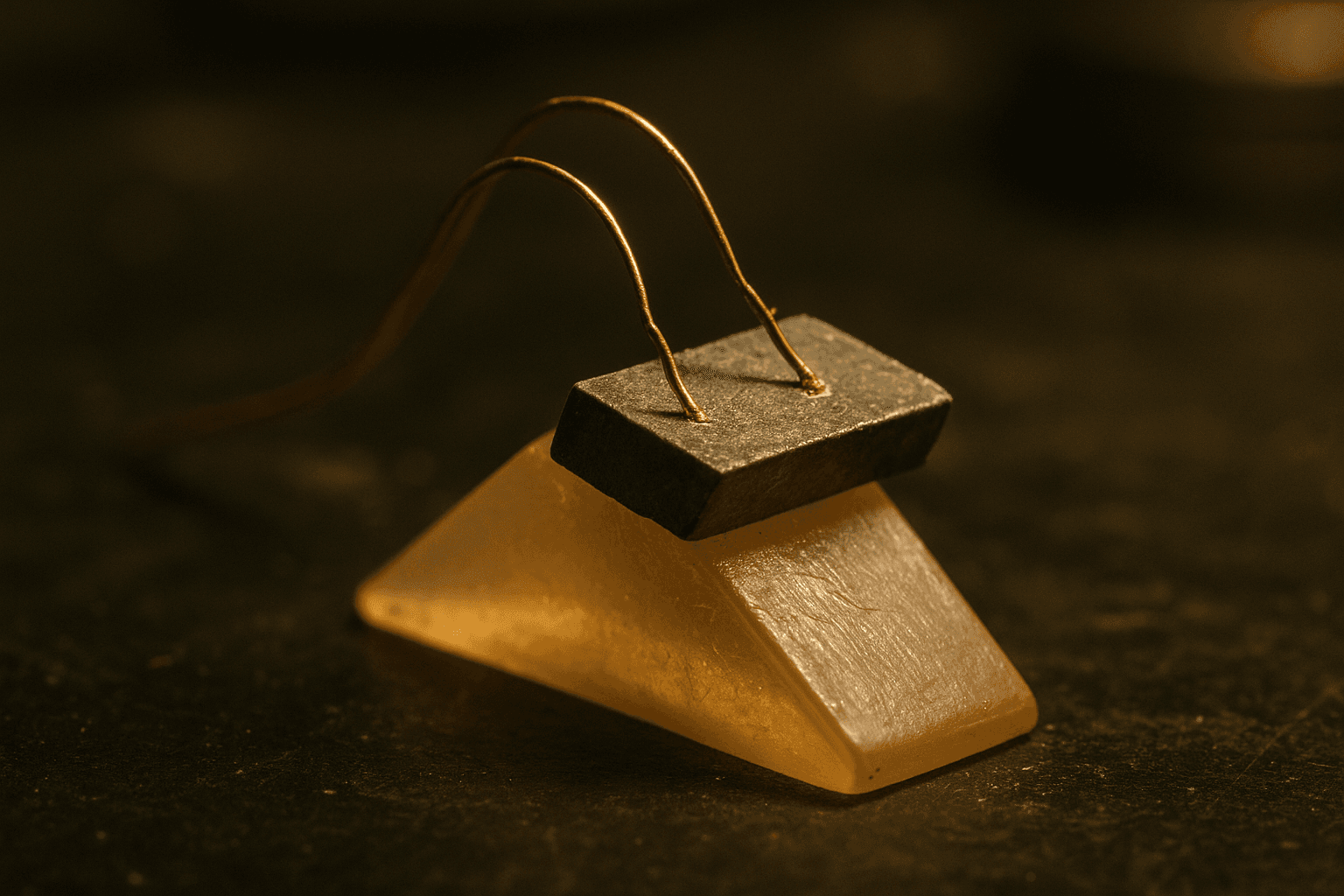
The decisive breakthrough wasn't Shockley's, but that of two members of his team: theorist John Bardeen and experimentalist Walter Brattain. On December 16, 1947, after months wrestling with the behavior of germanium's surface, they placed two gold contacts almost touching on a small slab of the material, held by a plastic wedge. As they varied the voltage on one contact, the current through the other changed, amplified up to a hundred times. They had built the first point-contact transistor. On December 23 they demonstrated it to the lab's officials; Shockley called it "a magnificent Christmas present."
Why "transistor"?
The device needed a name. Bell Labs engineer John R. Pierce supplied it, blending the idea of transfer with that of resistor: "transistor." Bell Labs unveiled the invention to the world at a press conference in New York on June 30, 1948. The reaction was lukewarm: newspapers gave it barely a few lines, never suspecting that this curious laboratory button would end up inside nearly every device on the planet.
A jealous Shockley improves the invention
Shockley took being left out of the key discovery badly. Shutting himself away for weeks, he devised a sturdier, easier-to-make design: the junction transistor, a three-layer sandwich of semiconductor instead of the delicate gold contacts. It was far more practical to mass-produce and became the basis of nearly all the electronics that followed.
The work earned all three the 1956 Nobel Prize in Physics. But personal tensions broke the team apart: Bardeen and Brattain barely worked with Shockley again. Bardeen left and, years later, would win a second Nobel Prize in Physics, for the theory of superconductivity —a feat unique in the history of the award.
From germanium to silicon
The first transistors were made of germanium, a material that worked but behaved poorly with heat. The leap came with silicon, far more abundant —it is, basically, purified sand— and stable at high temperatures. In 1954, Gordon Teal, at Texas Instruments, presented the first commercial silicon transistor and announced, to his colleagues' astonishment, that they were already in production. Silicon would become the sacred material of electronics, eventually giving its name to an entire valley in California.
That same year, the transistor left the laboratory and reached the public's pocket with the Regency TR-1, the world's first transistor radio: four transistors, a size that fit in the hand, and some 150,000 units sold. For the first time, music came with you into the street. Electronics stopped being a piece of furniture and became something portable.
The switch that multiplied into billions
The real revolution wasn't the lone transistor, but the idea of packing many of them onto the same chip of silicon: the integrated circuit, or chip. In 1965, Gordon Moore observed that the number of transistors that fit on a chip was doubling at an astonishing, regular pace; that prediction, Moore's Law, guided the industry for six decades.
The numbers are dizzying. Intel's first microprocessor, the 4004 of 1971, had 2,300 transistors. Today's most advanced chips top 200 billion, with transistors so small they are measured in a few nanometers —millionths of a millimeter. That same invisible switch is what powers everything from the first personal computers to modern processors like RISC-V and the graphics cards that train artificial intelligence.
It's a vertiginous ending for an invention that began as two gold contacts on a piece of germanium, in a laboratory, the week of Christmas 1947. The transistor lit no lights and turned no motors: it simply said "yes" or "no," on or off, billions of times per second. With that minuscule gesture, repeated to infinity, it built the entire digital world.
References
- "1947: Invention of the Point-Contact Transistor," The Silicon Engine — Computer History Museum. computerhistory.org
- "1954: Silicon Transistors Offer Superior Operating Characteristics," Computer History Museum. computerhistory.org
- "Regency TR-1," Wikipedia. en.wikipedia.org
- "Moore's law," Wikipedia. en.wikipedia.org
Enjoy stories of the technology that changed everyday life? Continue with RISC-V, the free processor or explore the whole electronics section.
Categories
The books · born from this blog
Atahualpa con su abrigo de pelo de murciélago
y otras 49 historias verdaderas que parecen mentira
Available on Amazon
Tocar madera
Pequeña historia de las supersticiones que el mundo no ha podido soltar
Available on Amazon
100 futuros
Cien escenarios del mundo que viene con la inteligencia artificial
Available on AmazonYou may also like
The history of the stethoscope and Laennec's modesty
In 1816 a French doctor felt too awkward to press his ear to a patient's chest, so he rolled up paper — and the stethoscope was born.

Placebo: the Latin word that means «I shall please»
«Placebo» means «I shall please» in Latin and began as a medieval funeral chant. Here is how it jumped from the church to medicine and its famous effect.

Scurvy: the disease that killed more sailors than storms
Scurvy killed more sailors than battles and shipwrecks combined. Its cure was discovered, forgotten, and rediscovered over and over for centuries.