
The History of the Match: Fire in Your Pocket
The friction match was born by accident in 1826, poisoned thousands of factory women, and only later became the safe fire we carry in our pocket.
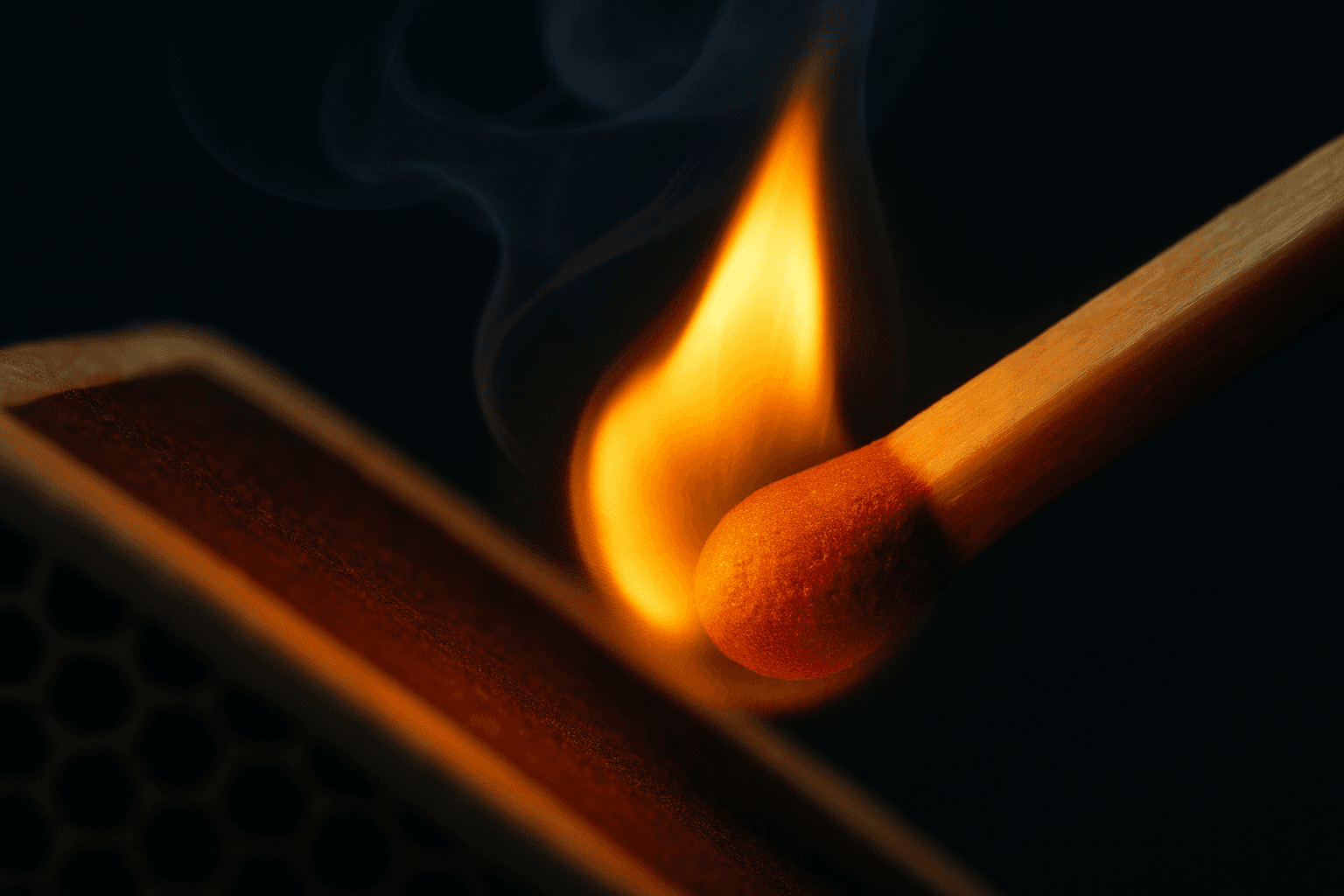
For almost all of human history, lighting a fire was work. You had to rub wood together, strike flint against steel, or keep yesterday's embers alive. That today a one-second gesture will do —scraping a little stick against a box— is a conquest so recent it fits into barely two centuries. And that conquest, the match, began like so many others: by accident, and with a human cost we were slow to acknowledge.
The stick that lit itself
The scene took place in 1826 in Stockton-on-Tees, England. The chemist and apothecary John Walker was stirring a mix of flammable substances with a wooden stick when he noticed a dried lump on the tip. Trying to scrape it off against the floor to clean it, the lump burst into flame. Without looking for it, Walker had just stumbled onto the first practical friction match in history.
Its head blended potassium chlorate and antimony sulfide bound with gum arabic on three-inch splints. Walker sold them in his shop from 1827 under the name "Congreves" —after the rocket inventor William Congreve— in a box with a folded piece of sandpaper through which the stick had to be drawn. As in so many finds, it was a textbook case of serendipity: finding something valuable while searching for something else. Walker never patented his invention; he said it would be "a benefit to the public, so let them have it."
"Lucifers" and the smell of sulfur
That indifference had consequences. In 1829, the Londoner Samuel Jones copied the idea and sold it under a far more marketable name: "Lucifers." They were noisy, threw sparks, and gave off a sulfurous smell so sharp that the boxes warned people "with delicate lungs" not to use them. Even so, the convenience was irresistible, and for a while the word lucifer became street slang for a match.
The next leap came from France and Austria: adding white phosphorus to the head. The result lit smoothly, without the racket of the lucifers, and it also lit far too easily —a rub against almost any rough surface would do it. By the mid-1800s white phosphorus had taken over match factories across half the world. And with it came the dark side of this story.
Phossy jaw
White phosphorus is a poison. The women who made matches —many of them teenagers— breathed its vapors during twelve- and fourteen-hour shifts, and began to develop a horrifying disease: "phossy jaw." It started with toothaches, moved on to abscesses and rotting of the jawbone —which glowed in the dark with a greenish light— and in roughly one in five cases ended in death. The only treatment was usually to remove the jaw.
That injustice erupted in 1888 at the Bryant & May factory in London. Some 1,400 workers went on strike against the miserable wages, the abusive fines, and the conditions that were sickening them. The matchgirls' strike won: the company abolished the fines, and the episode became an early landmark of women's trade unionism. As in the age of when lead was in almost everything, a useful substance hid a harm society took far too long to admit. White phosphorus was not fully banned until the early twentieth century.
The safety match we still use
The chemical solution already existed. In 1844, the Swede Gustaf Erik Pasch had the key idea: take the poison out of the match head and split the mixture in two. His countryman Johan Edvard Lundström refined it and patented the safety match, which triumphed at the 1855 Paris World's Fair, where it won a medal precisely because its workers were no longer being poisoned.
The trick lives on in any modern box. The head carries an oxidizer (potassium chlorate) and fuel, but the phosphorus moves to the striking strip on the side, in its red form, which is far less dangerous. When you strike, the heat of friction turns a speck of red phosphorus into white, which reacts with the chlorate and unleashes the flame. That is why a safety match lights only on its own box: the two ingredients stay apart until the instant of the strike. The Lundström brothers even invented the sliding-drawer box we still use, with the striking strip along the sides.
A one-second gesture
It's hard to grasp what it meant. Before the match, lighting a candle or a stove demanded time, skill, or a saved ember; afterward, anyone could carry fire in their pocket. It was one of those quiet inventions that —like the electricity that later lit the cities— changed daily life without making a sound. The next time you strike a match, think of John Walker's little stick, of the matchgirls of London, and of the Swedish chemist who separated the poison from the flame so that this one-second gesture could, at last, be safe.
References
- "John Walker (inventor)," Wikipedia: the 1826 accident, the "Congreves," and his refusal to patent the friction match. wikipedia.org
- "Phossy jaw and the matchgirls," Royal College of Surgeons: the white-phosphorus disease and its toll on 19th-century factory women. rcseng.ac.uk
- "Matchgirls' strike," Wikipedia: the 1888 walkout at Bryant & May and its victory over fines and unhealthy conditions. wikipedia.org
- "The invention of safety matches," Sharing Sweden: Gustaf Erik Pasch, Lundström, and the shift from white phosphorus to red on the striking strip. sharingsweden.se
Enjoy these stories of everyday inventions? Continue with the history of Teflon and when lead was in everything, or explore the whole science and technology section.
Categories
The books · born from this blog
Atahualpa con su abrigo de pelo de murciélago
y otras 49 historias verdaderas que parecen mentira
Available on Amazon
Tocar madera
Pequeña historia de las supersticiones que el mundo no ha podido soltar
Available on Amazon
100 futuros
Cien escenarios del mundo que viene con la inteligencia artificial
Available on AmazonYou may also like
The History of the Floppy Disk and the Save Icon
The floppy disk held 80 KB in 1971 and survives today as the «save» icon many young people never touched. This is the full history of the floppy disk.
The nocebo effect: when expecting harm creates it
The nocebo effect is the placebo's dark twin: believing a treatment will hurt can make it hurt. Its origin, real cases and what science says.
The first computer virus was called Brain
In 1986, two brothers in Lahore wrote Brain, the first PC virus. It destroyed nothing: it guarded their software and left their name, address and phone.