
The Count of Monte Cristo
The Count of Monte Cristo was the prize a boy won in a composition contest, then was denied, in a vivid memoir of a tiny Ecuadorian railway town.
By: Raúl Guerrero
The first book I read cover to cover was an illustrated summary of The Count of Monte Cristo by Alexandre Dumas. I won it in a composition contest when I was seven years old. I suppose I read it with such relish because after winning the contest, they denied me the prize.
We lived in Huigra, a tiny, charming town. The Guayaquil & Quito Railway Company, builder of Ecuador's railroad, directed by engineer Archer Harman, decided to establish the company's management headquarters in Huigra—the railway that in 1908 finally completed the monumental enterprise of connecting the coast and the Andean highlands. Half a century earlier, the French had abandoned the project, claiming it would be easier to make a donkey fly than to overcome the barrier of the Andes.
Two streets crossed Huigra: the Street of the Train, parallel to the Chanchán River, and on the other side of the river lay the other street, naturally called The Other Side. Huigra is a valley half a kilometer wide and two long. In Huigra begins an ascending passageway toward the imposing rocky wall of the Andes where an enormous nose-shaped peak rises like an infernal sentinel. The builders soon dubbed the rocky peak Devil's Nose.
There were three schools: two public schools, the boys' school and the girls' school, and Father Paredes's co-ed school. Father Paredes organized the composition contest for Ecuadorian Student Week.
Forty years later, with nostalgia, I remember Huigra as the setting of a Western with diners, shops, cantinas, the church atop the hill, a hotel run by the widow of the English owner who gave it its name, Hotel Morley, and to the north, a quarter kilometer away, the railway compound with an enormous house where management operated.
My father was Divisional Secretary of the railroad. One of the privileges of the position was living in the old house painted parrot green and canary yellow. It was no small privilege. It was living in a capsule outside the geography of Ecuador, much closer to the Panama Canal Zone, itself built in the image and likeness of the American South. We had a telephone, for example, at a time when most Ecuadorians had never seen a telephone nor anticipated ever using one. We had a private hospital, carpentry shop, blacksmith, warehouses full of dynamite, a well-stocked henhouse, avocado and custard apple trees, a garden full of tuberoses, and service boys and girls, and the guardian or watchman.
The river, at the height of the management compound, had a bend of still water where we swam or spent the afternoon sitting on the enormous rocks that García Márquez described with photographic precision as eggs of prehistoric birds. There was no road to Huigra, but we had parked beside the house a handcar, a railway automobile.
During the first decades of the twentieth century, the railway compound was a small American colony. Then the administration of the company transferred to the state. The choice of Huigra as railroad headquarters obeyed three reasons, according to Archer Harman's own hand: (1) It was located exactly midway between Guayaquil and Riobamba, the main commercial stretch. Indeed, two passenger trains departed at six in the morning from Riobamba and Guayaquil and met in Huigra for lunch. Rice with fried egg and some meat stew was the typical dish, accompanied by an ice-cold soda. Vendors hawked at the top of their lungs. First-class passengers ate on enameled iron dishes with silverware, second and third class on cabbage leaves and with their hands. (2) Huigra was eternal spring. (3) Archer Harman wanted to be as far as possible from the capital's politicking that nearly derailed the enterprise.
The eternal spring influenced Father Paredes, an independent priest, to set up a boarding school where the upper-middle-class boys from Guayaquil who had been expelled from prestigious schools ended up. The school must have had an official name, but it was known as Father Paredes's School.
Huigra also attracted famous figures from Guayaquil during winter. In Guayaquil, the main port and financial center of the country, and at that time the world capital of bananas, the heat and mosquitoes conspire to torment the population. Between December and April, wealthy families escaped. Many families wintered in Huigra.
Father Paredes took advantage of the fact that a distinguished Guayaquil intellectual was vacationing in Huigra to convene the composition contest and commit him to being the judge. Since it was Ecuadorian Student Week, the contest was for fourth, fifth, and sixth grade students. Father Paredes's idea was to encourage his school's students to write. The intellectual set one condition before agreeing to be the judge: that students from the public school also be invited to participate.
I was in third grade at the public school. I wrote a composition about priests and vultures based on my observation as a child and the teachings of a communist teacher. There were two priests in Huigra: the parish priest, the official priest, and Father Paredes, the independent priest. Both wore black cassocks and sometimes that peculiar wide-brimmed, small-crowned hat. And there were vultures in abundance. Black vultures with bare necks and a crest that resembled the priests' pompadours. It was the sixties and all men wore pompadours. My teacher was a communist. He had been a student at the Central University of Quito, a highly politicized university. His family had sent him from Riobamba to study law, but after two years the money ran out and the future lawyer had no choice but to find work in teaching. He arrived in Huigra with communist pretensions and his pompadour, because communists also wore pompadours.
At the public school, one teacher taught all subjects for the grade, and our teacher some days only talked about the church's great sins. From him I heard the analogy between vultures and priests, both birds of prey, he said. Actually, I now know he was wrong—vultures are scavengers more than predators. For a week I dedicated myself to observing the similarities between vultures and Huigra's two priests. I captured my observations in a composition that the Guayaquil intellectual selected as the winner. Among other things, he said in explaining his decision, my composition was the shortest.
A controversy arose. The contest was called for fourth, fifth, and sixth grade students. The losing students argued in their defense the illegitimacy of my participation since I was in third grade. The fifth and sixth grade teachers from Father Paredes's school disqualified me and awarded the prize to one of their outstanding students. The winning composition was an ode to discipline in rhyme that if I remember correctly began with the following lines: Discipline is a mine whose wealth the child does refine. While mine began like this: The priest and the vulture, pale hollow-eyed creatures, in black they come and go in search of some dead rat or alms.
The intellectual drank beer every night in a saloon that had a powerful jukebox. He would start drinking to Bésame Mucho by Lucho Gatica. That's what they said at home when around seven o'clock the bolero's chords flew through the town: Ah, the intellectual must have started drinking alone already. At home I grew up surrounded by women: grandmother, mother, Aunt Raquel, three sisters, almost always one or two cousins and some passing comadre, the neighbors and the girls. What a strange man, the women of the house would say, as if words cost him something, you have to pull them out with a corkscrew. Grandmother, who no longer heard anything but having learned to read lips stuck her spoon in every conversation, reasoned that maybe the intellectual was half-mute, and warned to be careful because there were two types of mute: the mute who by God's will didn't speak, and the one who played mute, the knowing mute.
I put on a cap and went down to town to see the intellectual. Indeed, he was at a table drinking beer alone. He wore a white shirt and dark pants, and through thick lenses, the kind called bottle-bottoms, his gaze was lost on the dark horizon. Since I was a child, I thought that maybe intellectuals could see through darkness. I heard my teacher say: There are men who see through shadows, men who for being wise are thought crazy. The women of the house thought that way about the intellectual. That man drinks alone, they said, not understanding how he preferred silence to their loquacious company.
– Good evening, I greeted him.
– Careful, the saloon owner warned me, you mustn't bother an intellectual when he's thinking.
It wasn't my intention to bother him but to denounce an injustice. I introduced myself. I explained that I'd been denied the prize for being in third grade. The intellectual let out an enormous laugh. I clearly remember his deep voice: They've denied you the prize for being too young. He said no more. I interpreted his silence as a way of dismissing me. I returned home defeated.
The prize presentation was on Sunday after the mass that Father Paredes pronounced elegantly attired. It seems to me that Father Paredes on certain occasions dressed as a cardinal (I don't know if I invented this memory.) What's certain is that after each mass, Father Paredes expressed his affection to the parishioners with effusive hugs. My mother tells me he would discreetly grope the young ladies and young mothers with his slippery hands. The priest was a Casanova but never abused minors. His official woman, it was rumored, was the school's headmistress.
Immediately after the Benediction, Father Paredes asked the parishioners to remain seated. And he continued thus: And now we are pleased to present to you the distinguished intellectual who honors us with his presence to award the prize for the best composition in this Ecuadorian Student Week. He raised the prize for everyone to see. It is nothing less and nothing more than a precious illustrated novel by the great French writer Alexandre Dumas to inspire in the youth a love for letters and the good habit of reading. Father Paredes also praised the sixth grade teacher's work. There is no student without his teacher, he said.
The intellectual had not attended the mass. He entered the chapel just at that moment and headed to the altar. I was witnessing the ceremony with indignation. More indignation was provoked in me by the intellectual than by the fifth and sixth grade teachers who disqualified me. Each one guards his own henhouse, grandmother used to say. But him, shouldn't he have defended me?
The intellectual took the floor. He said he felt embarrassed on behalf of others (since then I've carried that expression like a vase in a corner of my brain.) Disqualify a child for being younger than the other contestants? It was a symptom, he said, of the disease that was sinking the country deeper into shit every day.
A stifled gasp ran through the chapel. Never had anyone said shit from the pulpit.
The intellectual asked the author of the composition Priests and Vultures to stand up. I stood up. It won't be The Count of Monte Cristo, he said when he saw me, but it's my latest book of stories and I'm giving it to you.
Father Paredes intervened. He said it was never too late to repair a wrong, and with daggers in his eyes he took Dumas's illustrated novel from the sixth grade teacher and handed it to me after a firm handshake, adding: Render unto Caesar what is Caesar's and unto the Ecuadorian Student what is the Ecuadorian Student's.
I was seven years old. Much later, when I had already emigrated to the United States, I ran into Father Paredes walking hand in hand with the headmistress in New York. I let out a shout of excitement: Father Paredes! His surprise was tremendous. He was on a shopping trip, he said, and upon realizing he still had the headmistress's hand in his, he blushed. A precaution, he said, lest they get lost in a foreign country.
Categories
The books · born from this blog
Atahualpa con su abrigo de pelo de murciélago
y otras 49 historias verdaderas que parecen mentira
Available on Amazon
Tocar madera
Pequeña historia de las supersticiones que el mundo no ha podido soltar
Available on Amazon
100 futuros
Cien escenarios del mundo que viene con la inteligencia artificial
Available on AmazonYou may also like

The Astonishing Love Story of Isabel de Godín
Isabel de Godín crossed the Andes and the Amazon, survived her entire party dying, and walked alone through the jungle to reunite with her husband.
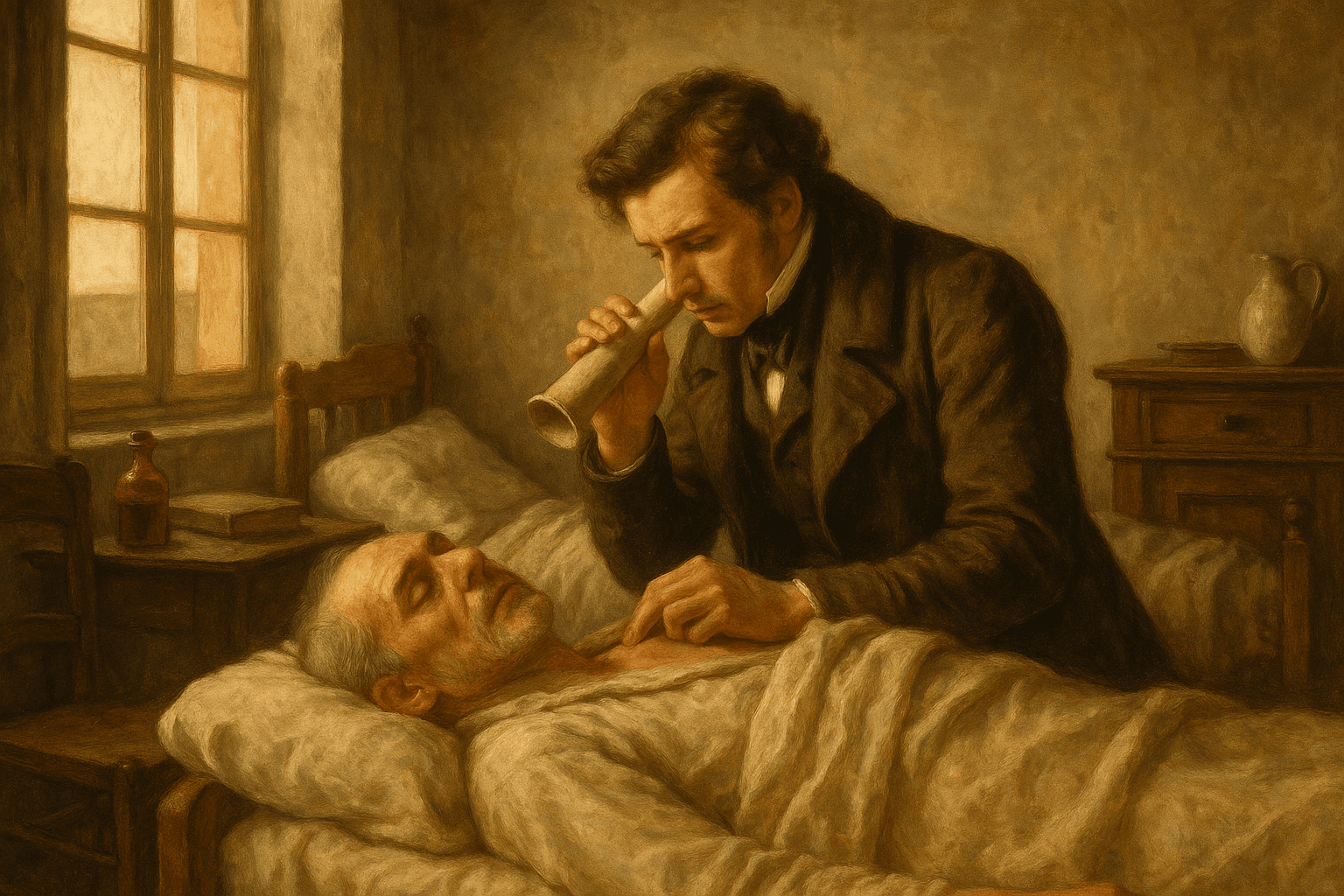
The history of the stethoscope and Laennec's modesty
In 1816 a French doctor felt too awkward to press his ear to a patient's chest, so he rolled up paper — and the stethoscope was born.
Placebo: the Latin word that means «I shall please»
«Placebo» means «I shall please» in Latin and began as a medieval funeral chant. Here is how it jumped from the church to medicine and its famous effect.