
Wolbachia: the bacterium that bends sex and kills males
Wolbachia infects half the world's insects and hijacks their reproduction: it feminizes males, kills them off, and is now used to stop dengue.
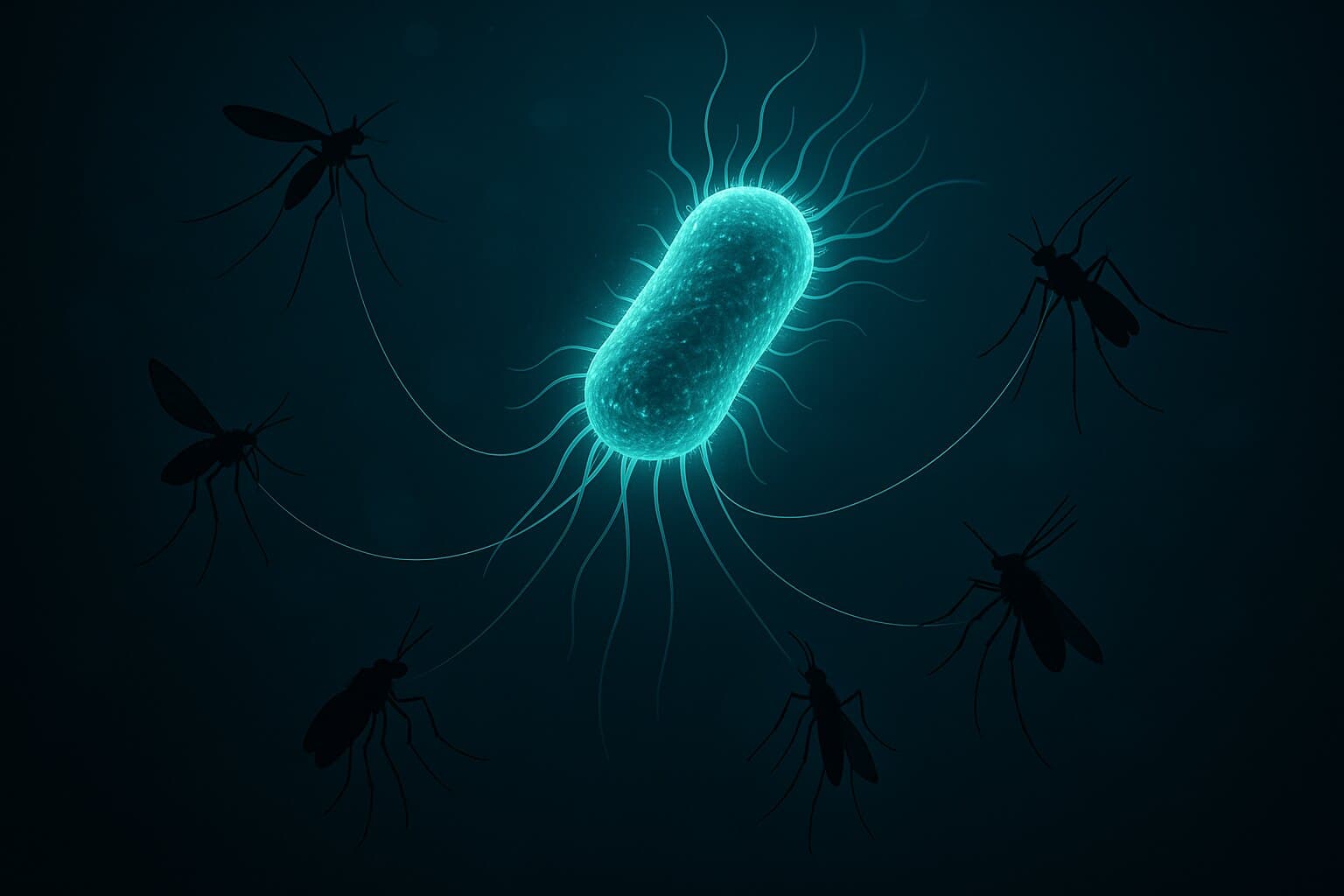
It is, quite possibly, the most successful pandemic in history, and almost no one has heard of it. It lives hidden inside its hosts' cells, spreads neither by contact nor through the air, and yet it has colonized roughly half of all insect species on the planet. It's called Wolbachia, and to guarantee itself a spot in the next generation it does something that sounds like science fiction: it rewrites the rules of sex in its hosts. It feminizes males, kills them before they hatch, or makes fathers unnecessary altogether. And, in one of the loveliest twists in recent biology, that talent for manipulating insects has turned it into our best weapon against dengue.
What Wolbachia actually is
Wolbachia is an intracellular bacterium: it doesn't live freely in the environment but inside its host's cells, especially in the reproductive organs. It was first described in 1924, when researchers Marshall Hertig and Simeon Burt Wolbach found it inside a common mosquito, Culex pipiens. In their honor it got the name we know it by: Wolbachia pipientis.
For decades it seemed a lab curiosity. Today we know it's one of the most abundant organisms on Earth: besides half of all insects, it infects spiders, mites, crustaceans and certain worms. If a ranking of the most numerous living things surprises you, we've already told the story of krill and springtails: the world is ruled by tiny creatures we almost never see, and Wolbachia is their silent passenger.
The master trick: it only rides in the eggs
To understand why Wolbachia does what it does, you only need to grasp one thing: how it passes from one generation to the next. The bacterium is inherited solely through the mother, in the cytoplasm of the egg. Sperm, by contrast, contributes barely any genetic material and no cytoplasm at all, so a male is a dead end for it: no matter how thoroughly it infects a male insect, it will never reach his offspring.
That asymmetry explains everything. From the bacterium's point of view, females are its only vehicle and males are dead weight. Evolution did the rest: over millions of years, Wolbachia developed a toolkit for skewing its hosts' reproduction in favor of females. It does this out of neither cruelty nor design; it does it because any strain that produces more infected females spreads, and the ones that don't vanish. It's pure genetic selfishness.
The four ways to twist sex
The bacterium uses not one method but at least four, depending on the host. Together they form one of the most astonishing repertoires of manipulation in nature.
1. Feminization. In some land crustaceans, like the common woodlouse Armadillidium vulgare, Wolbachia hijacks the development of genetic males and turns them into functional, egg-laying females. The animal is male in its DNA, but it grows and reproduces as a female, passing the bacterium along.
2. Male-killing. In other species, the bacterium simply kills the male embryos. It sounds absurd —what does it gain by killing?— but there's a cold logic to it: dead males free up resources and stop competing with their infected sisters, who therefore survive better. In the butterfly Hypolimnas bolina of Samoa, the slaughter was so extreme that some populations were down to roughly one male per hundred females. The species teetered on the edge of collapse… until it evolved a gene that silences the bacterium, and the males came roaring back within a few generations.
3. Parthenogenesis. In certain tiny parasitic wasps, such as those of the genus Trichogramma, Wolbachia removes the need for males entirely: infected females produce daughters from unfertilized eggs. The telling part is that simply giving them an antibiotic to kill the bacterium makes males reappear: "normal" sexuality was there all along, just hijacked.
4. Cytoplasmic incompatibility. This is the most common maneuver and the most subtle. An infected male has his sperm "marked" in such a way that, if he fertilizes an uninfected female, the eggs die. But if the female carries the same Wolbachia strain, her eggs "rescue" the fertilization and all is well. The result is a brutal advantage for infected females: they're the only ones who can breed with any male, infected or not. That's how the bacterium sweeps through an entire population in just a few generations.
From parasite to weapon against dengue
Here the story takes an unexpected turn. Scientists discovered that, on top of manipulating sex, Wolbachia has another fascinating side effect: when it lives inside a mosquito, it makes it far harder for the insect to harbor viruses like dengue, Zika or chikungunya. It's as if the bacterium, by occupying the cells, left no room or resources for the virus.
The catch is that the main dengue-carrying mosquito, Aedes aegypti, doesn't carry Wolbachia naturally. So the World Mosquito Program did something ingenious: it introduced the bacterium into lab mosquitoes and released them. Thanks to the cytoplasmic incompatibility we just saw, the bacterium spreads on its own through the wild mosquito population, generation after generation, with no need to keep releasing more. Once most mosquitoes carry it, they stop being good transmitters of the virus.
The extraordinary part is that it works. In a controlled trial in the city of Yogyakarta, Indonesia, areas with Wolbachia-carrying mosquitoes recorded a 77% drop in dengue cases and around an 86% drop in hospitalizations, compared with untreated areas. The technique is now used in cities across Colombia, Brazil, Australia and other countries: not a single mosquito is killed; they are simply "vaccinated" with a bacterium other species had been carrying all along.
The other edge: the worms that can't live without it
Wolbachia isn't always a selfish parasite. In certain worms —the filarial nematodes behind diseases like river blindness and elephantiasis— the relationship is exactly the opposite: the worm cannot live without it. The bacterium has become an indispensable partner, to the point that the parasite relies on Wolbachia to grow and reproduce.
That dependence opened a beautiful therapeutic door. Instead of attacking the worm, which is hard to kill, doctors attack its bacterium: a common antibiotic, doxycycline, wipes out Wolbachia and with it sterilizes or slowly kills the parasite. One and the same bacterium is, depending on the host, a manipulator to defeat in the mosquito and an Achilles' heel to exploit in the worm.
Who rules inside whom
The most unsettling thing about Wolbachia isn't what it does, but what it implies. We take for granted that an animal's sex is decided by its DNA, that each species controls its own reproduction. And it turns out that in millions of species there's an invisible passenger pulling the strings: deciding how many males are born, which ones die, and who gets to have offspring. An insect's "self" includes, unknowingly, a bacterium with its own agenda.
It's the same lesson that surfaces when you discover how other small creatures organize themselves —as in the democracy of bees—: in nature, control is almost never where we think it is. And sometimes, as with dengue, understanding that puppet show doesn't just rewrite the biology we knew: it hands us a tool to save lives. The most manipulative bacterium on the planet ended up working for us.
References
Categories
The books · born from this blog

Atahualpa con su abrigo de pelo de murciélago
y otras 49 historias verdaderas que parecen mentira
Available on Amazon
Tocar madera
Pequeña historia de las supersticiones que el mundo no ha podido soltar
Available on Amazon
100 futuros
Cien escenarios del mundo que viene con la inteligencia artificial
Available on AmazonYou may also like

Morse Code: How It Works and Why It Saved Lives
Morse code turns letters into dots and dashes that travel down a wire or a flash of light. Here is how it works, where it came from and why it is still used.
The Telegraph: The Victorian Internet
The telegraph shrank weeks of mail into minutes of cable. How Morse, Cooke and a wire under the Atlantic built the Victorian internet and shrank the world.
Why veins look blue when your blood is red
Human blood is never blue—it is always red. So why do veins look blue under the skin? The answer lies in how light travels through your body and how you see.