
Why Computer Files Are Called Files
The digital file inherits its name from a real office: papers strung on a thread. From the Latin filum to the file system, this is the story of the file.
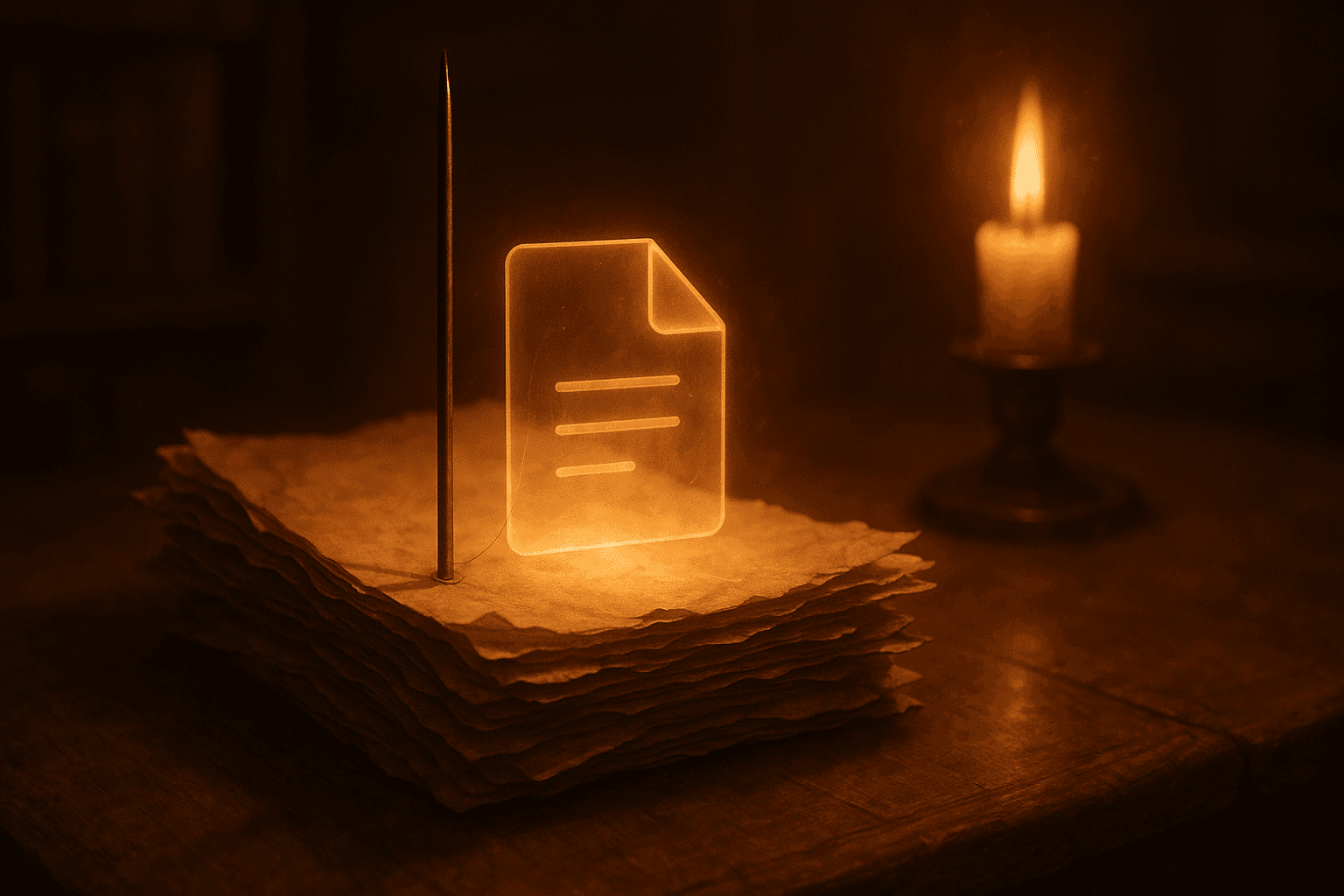
Every time you save a document on your computer you create a file. You drag it into a folder, which in turn lives on a desktop. We take these words for granted, but none of them was born in computing: they all come from a paper office that existed long before any computer. The word "file" literally hides a thread. This is the story of why we gave that name to something you cannot touch.
A thread, not a folder
The word file comes from the Latin filum, meaning "thread" or "string." The same root shows up in "filament," "fillet," and "profile." It is not an abstract metaphor: in European offices of the 16th century, the normal way to keep documents was to string them onto a thread or a wire, one after another, so they stayed in order and could be looked up. That bundle of papers hanging from a cord was a file.
An English legal definition from 1607 puts it plainly: "File (filacium) is a thread or wire, whereon writs, or other exhibits in courts, are fastened for the better keeping of them." The verb "to file" meant exactly that: to run the paper onto the thread. When you "file" an email today or "file a form," you are unknowingly repeating a gesture from five centuries ago.
From the thread to the spike and the folder
The thread had an obvious flaw: to pull out a paper from the middle you had to unhook everything above it. Over time, more convenient solutions replaced it. First came the spike or spindle: a metal point driven into a base, onto which receipts and notes were speared —the same device that for decades held food orders in restaurant kitchens. Then came pigeonholes, boxes, and, by the late 19th century, the vertical filing cabinet with its hanging folders, the piece of furniture we still associate with an office.
What is striking is that the word outlived all of those changes in technology. Even though the thread vanished, the name "file" transferred to the result of filing and then to the container that held it. By the time computers arrived, "file" no longer evoked a specific strand but an abstract idea: an ordered set of information kept so it can be consulted later. Exactly what was needed.
1950: when the file entered the machine
The leap from paper to silicon was recorded earlier than you might think. In February 1950, an RCA advertisement in Popular Science magazine introduced a new "memory" tube and promised that "the results of countless computations can be kept on file and taken out again." It is one of the earliest documented uses of the word applied to electronic data.
In those first years, "file" named not the information but the device that held it. The disks of the IBM 350 —the storage system of the first commercial computer with a hard drive, in 1956— were literally called disk files. The file was the cabinet, not the papers. The same ambiguity as in the office, where "file" could mean the thread or the documents hanging from it, now repeated itself with the machine.
The "file system" that fixed the modern meaning
The sense we give it today —many independent files coexisting on a single device— was born around 1961, with systems such as the Burroughs MCP and MIT's Compatible Time-Sharing System (CTSS). Both introduced the idea of a file system: a software layer that managed many virtual "files" on one physical medium, each with its own name, so the user did not have to think about which track of the disk held what. From then on, the file stopped being the hardware and became the unit of data we handle every day.
That lineage of ideas —giving human names to the machine's resources— is the same one that made entire operating systems possible; you can trace it in the origin of Unix, where the famous philosophy that "everything is a file" pushed the metaphor to its ultimate conclusion.
The office desk inside the screen
The finishing touch came in the 1970s and 1980s, when Xerox's labs and then personal computers adopted the desktop metaphor. The idea was brilliant precisely because it was intuitive: if people struggled to grasp a computer's memory, they would be shown something they already knew, a miniature office. There was the desktop, the folders, the trash can, and, of course, the files with their sheet-of-paper icon. All the paraphernalia of a mid-20th-century office, drawn in pixels.
That is why the "save" icon was for decades a floppy disk that many young people never used, and why "folder" and "file" feel like natural words for things that have no weight and take up no physical space. That ability to hide a complex machine behind familiar objects is the same one that turned the computer into a household appliance, as told in the story of the first personal computer and of the mouse we learned to slide across that imaginary desk.
A thread that still keeps us in order
So the next time you drag a "file" into a "folder," remember that you are repeating, in digital form, the gesture of a Renaissance clerk stringing papers onto a cord. The technology changed completely —from the linen filum to the magnetic bit— but the name never moved. Sometimes words are the sturdiest thread of all: they keep holding ideas together long after the original object has disappeared.
References
- "File," Online Etymology Dictionary. etymonline.com
- "Computer file," Wikipedia. en.wikipedia.org
- "Spindle (stationery)," Wikipedia. en.wikipedia.org
- "File," World Wide Words (Michael Quinion). worldwidewords.org
Do you enjoy these stories about the everyday words of technology? Continue with the origin of Unix or explore the whole technology section.
Categories
The books · born from this blog
Atahualpa con su abrigo de pelo de murciélago
y otras 49 historias verdaderas que parecen mentira
Available on Amazon
Tocar madera
Pequeña historia de las supersticiones que el mundo no ha podido soltar
Available on Amazon
100 futuros
Cien escenarios del mundo que viene con la inteligencia artificial
Available on AmazonYou may also like
The first computer virus was called Brain
In 1986, two brothers in Lahore wrote Brain, the first PC virus. It destroyed nothing: it guarded their software and left their name, address and phone.
The Origin of the Word “Petrichor”
The smell of rain has had a name since 1964: petrichor, “the blood of the gods flowing from stone”. This is its story — and its science.
Why veins look blue when your blood is red
Human blood is never blue—it is always red. So why do veins look blue under the skin? The answer lies in how light travels through your body and how you see.