
Why We Measure Screens in Inches
Why are screens measured in inches, and diagonally? It all started with round cathode-ray tube TVs and continued thanks to a clever marketing trick.
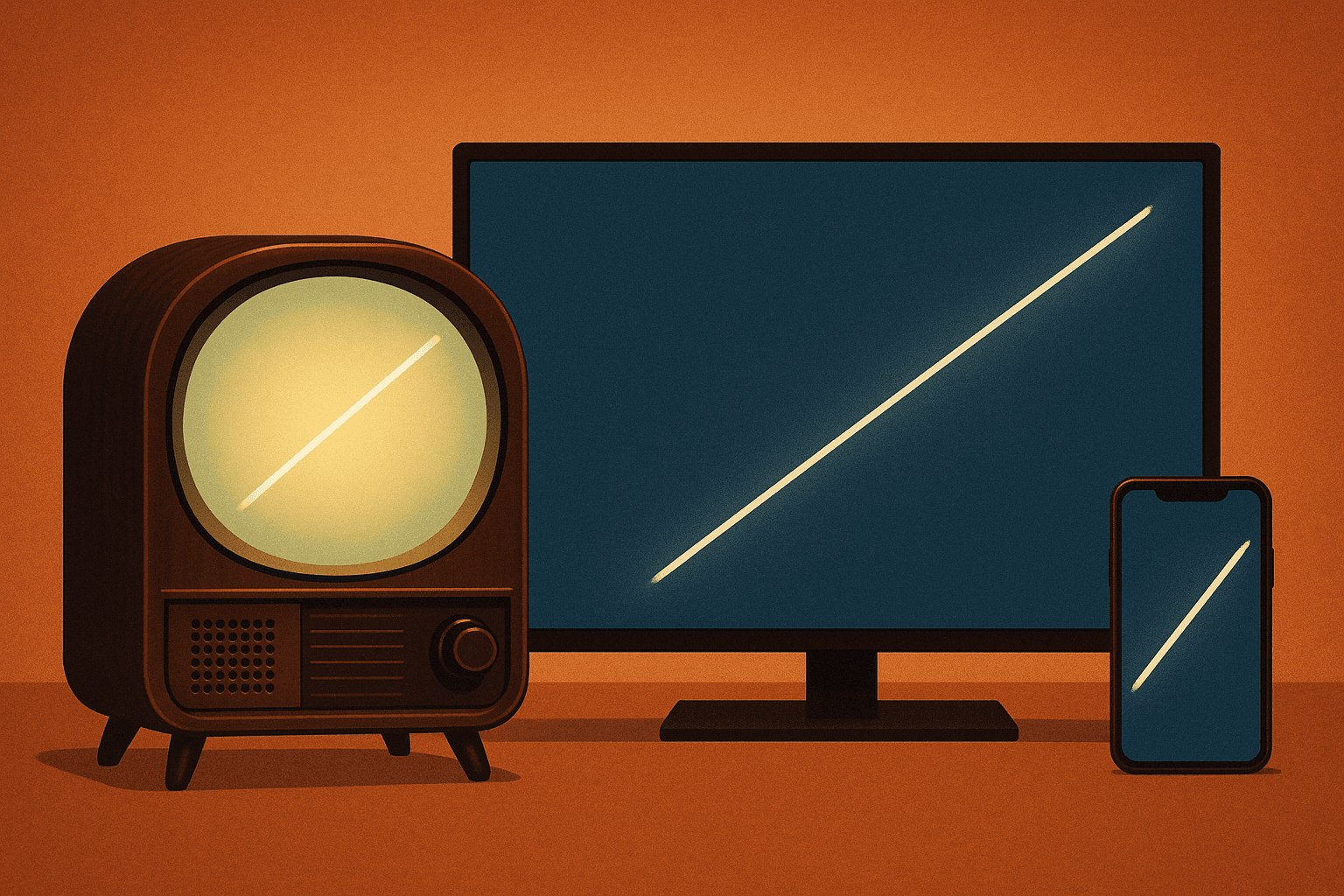
When you shop for a television, a monitor or a phone, the first number that jumps out is the screen size in inches: 55", 27", 6.1". And that number describes neither the width nor the height, but the diagonal, the line running from one corner to the opposite one. It is such a universal convention that almost nobody wonders where it came from. The answer blends physics, a change in the shape of the devices, and a healthy dose of commercial cunning that goes back nearly a hundred years, to the first tube televisions.
It all started with a round tube
The screens of the first televisions were not rectangles but circles. Inside sat a cathode-ray tube (CRT), a vacuum glass funnel that fired a beam of electrons at a phosphor coating to draw the image. Because of how it was made, the front face of that tube was round, so the picture appeared inside a circle, like looking through a porthole.
And how do you measure a circle? By its diameter. That is why a 1940s television was described by the inches it measured from one edge to the other of its circular screen. There was no diagonal to speak of: the screen was round, and the diameter was the only number that made sense.
When the screen turned rectangular
Over the years, manufacturers learned to cut and shape the front of the tube to use more of its surface, and screens became rectangular (at first almost square, in the 4:3 format). But they still came out of the same round tube: the rectangle was, in essence, the largest quadrilateral that fit inside that glass circle.
And here is the geometric key: the diagonal of that rectangle matches almost exactly the diameter of the original circle. So instead of inventing a new way to measure, the industry simply kept the number it was already using. The diagonal inherited the role the diameter once had. The shape of the screen changed, but not the figure that described it.
A single number to compare any screen
Beyond the historical inheritance, the diagonal has a real practical advantage. A screen has two dimensions —width and height— and giving both every time is clumsy. The diagonal folds them into a single number thanks to the Pythagorean theorem: being the hypotenuse of the triangle formed by width and height, it accounts for both at once.
That lets you compare, at a glance, devices with different proportions. A 4:3 monitor and a widescreen 16:9 one have very different shapes, but if both are "24 inch" you know their longest line is the same. The diagonal became a common language that survives changes in format, which is why it stuck around when tubes gave way to today's flat pixel panels.
The trick: always the biggest number
There is a less noble reason the diagonal won out, and manufacturers know it well: in a rectangle, the diagonal is always the longest measurement, greater than both the width and the height. If your job is to convince a customer that a screen is huge, you give them the biggest number you have on hand. Advertising "55 inches" is more impressive than saying the TV is 48 inches wide and 27 inches tall.
That same logic had a darker side. During the era of tube monitors, many manufacturers advertised the inches of the full tube, including the edge that the plastic casing hid. A monitor sold as "17 inches" often showed only about 15.8 visible inches. The gap ended up in class-action lawsuits in the United States in the 1990s, and ever since, ads have been required to also state the "viewable image size", the real diagonal of what you actually see when it is switched on.
And why in inches, if almost everyone uses the metric system?
That leaves the other oddity: nearly the whole planet measures in centimeters, yet screens are advertised in inches even in metric countries. The reason, again, is historical. The television industry was born and grew in the United States, which uses the imperial system, and when computer monitors, laptops, tablets and phones arrived, they all inherited the unit from their predecessors.
Over time, the inch stopped feeling like a measurement and became a size label, just as happens with shoe or clothing numbers: we say "a 65-inch TV" without mentally translating it to centimeters, as if "65 inches" were the name of a model. Curiously, almost all of these devices are made in metric countries to metric standards; the inch survives only on the label. That is why many boxes today also include the centimeter equivalent, even if the big number is still the one in inches.
From the living room to your pocket
So a "6.1-inch" phone unknowingly carries the echo of a round glass tube from the 1940s. The flat screen in your pocket has nothing circular or tube-like about it, yet it is still measured by its diagonal, in inches, out of sheer inertia from a decision made when television was a novelty. Next time you compare two screens by their inches, remember that you are using a number designed to describe a circle that vanished decades ago: one of those cases where the technology changed completely but the way we name it stayed anchored in the past.
References
- "Why TVs Are Measured Diagonally," SlashGear: the origin of the diagonal measurement in round CRT tubes and its continuity in flat panels. slashgear.com
- "Why Is Screen Size Measured Diagonally?," BGR: the diagonal as the longest measurement, its advantage for comparing formats and its marketing value. bgr.com
- "Consumer warning: HDTV sellers inflate advertised screen sizes," NBC News: the tube-size versus viewable-size problem and the misleading-advertising lawsuits. nbcnews.com
- "Television and computer screen sizes," UK Metric Association: why screens are still measured in inches even in countries that use the metric system. ukma.org.uk
Enjoy these stories about everyday technology? Continue with the origin of the word "pixel" and how the first cameras worked, or explore the whole science & tech section.
Categories
The books · born from this blog

Atahualpa con su abrigo de pelo de murciélago
y otras 49 historias verdaderas que parecen mentira
Available on Amazon
Tocar madera
Pequeña historia de las supersticiones que el mundo no ha podido soltar
Available on Amazon
100 futuros
Cien escenarios del mundo que viene con la inteligencia artificial
Available on AmazonYou may also like

Why veins look blue when your blood is red
Human blood is never blue—it is always red. So why do veins look blue under the skin? The answer lies in how light travels through your body and how you see.

The nocebo effect: when expecting harm creates it
The nocebo effect is the placebo's dark twin: believing a treatment will hurt can make it hurt. Its origin, real cases and what science says.

The History of the Match: Fire in Your Pocket
The friction match was born by accident in 1826, poisoned thousands of factory women, and only later became the safe fire we carry in our pocket.