
Entomology and aviation
Pilots' children tell good stories. This one starts with a floodlight left burning in an Amazon hangar and ends inside a museum-grade insect collection.
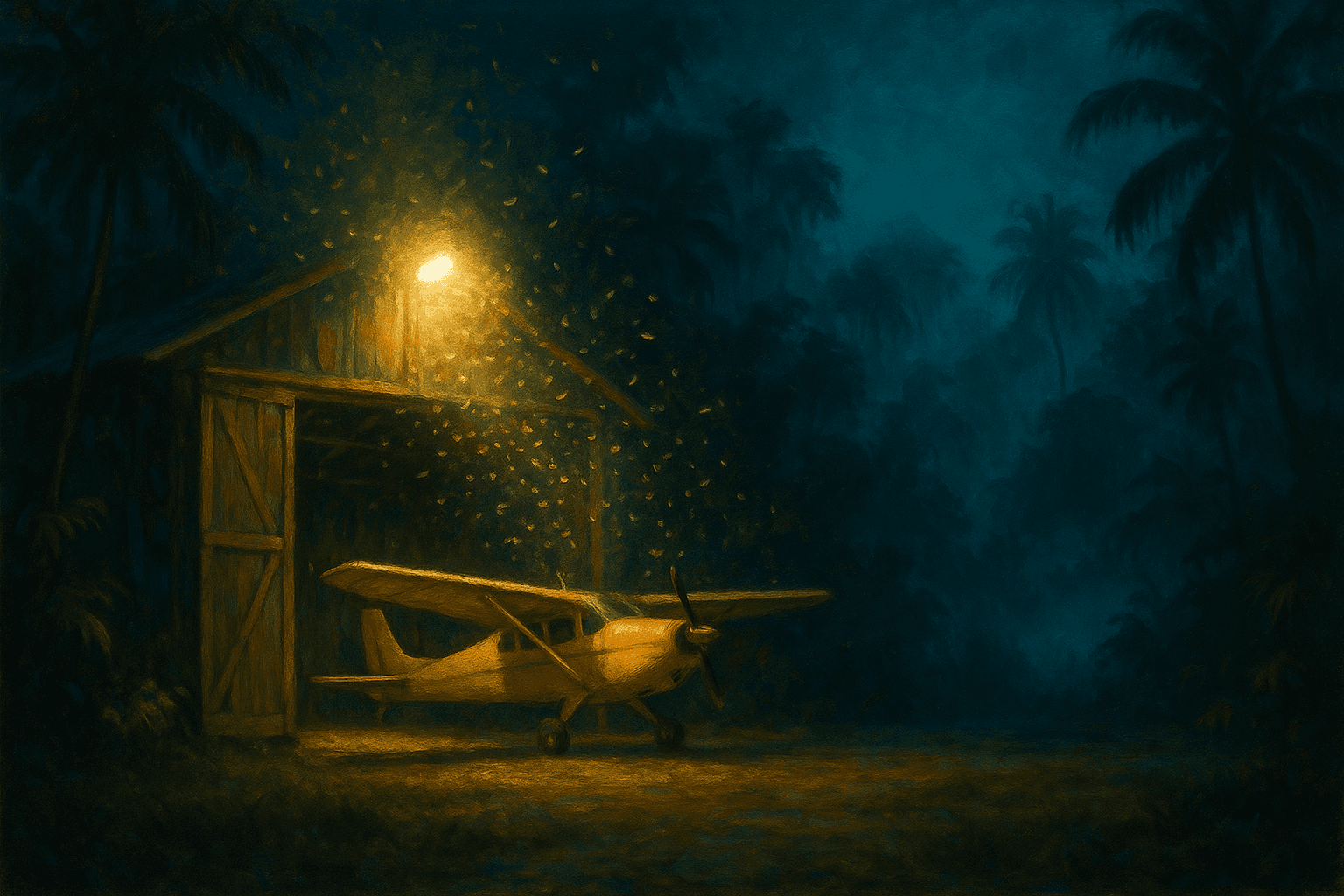
I have come to the conclusion that pilots' children tell good stories. Yesterday it dawned on me that this is at least the third time in my life that I have heard memorable anecdotes from the child of an aviator.
The first one I remember was told to me by a Uruguayan friend, some twenty years ago, over a coffee in Buenos Aires, as he related his father's exploits in the crop-dusting plane, a Cessna 188. Hours of fascinating anecdotes, flying from one town to the next in his “astronaut” suit, which he would later wash in a big tub to get out the residue of the toxic insecticides that stuck to the white fabric during the flight. It was his protection, but also his uniform, and onto it he kept sewing patches he made himself, because nobody else was going to give them to him. By the end of his life as a pilot he had decorated himself more than 20 times, for daring feats performed to save his own life and that of his precious little plane.
The second one reaches me drop by drop, in the midweek coffees with two good friends: Paul and Chento. Between one subject and another, Paul lets slip some story about his father, a pilot and a military man: the Cenepa war, the Mirage and Kfir fighter jets, the Ecuadorian legation in Paris and other adventures.
Yesterday I heard another one, which I will summarize more or less like this.
The father of a great Guayaquil historian and prolific writer was a private pilot. A pilot's life is sometimes itinerant and nomadic; you have to fly far away and make your base wherever duty calls or work demands. And so the aviator father, in order to spend more time with his young son, took the boy along to the Oriente, where there was jungle and a small hangar in which his plane slept.
So that his son Melvin, then 9 years old, would not get bored, he decided to give him a task; one that would eventually become his hobby, and the hobby, an obsession: collecting insects. Perhaps that very winter of adventures in the Oriente was the beginning of his journey through the world of collecting and of history. There are things that mark us without our noticing at the time.
I also suppose that if you want to collect insects there is no better place than the Amazon rainforest, but it is not as if the insects fly into your boxes and fall asleep there, neatly preserved. Being in the right place is only an opportunity; making the most of it is up to you. So the pilot father had a plan: he would leave the hangar's floodlight on through the night, and first thing in the morning Melvin would go out to collect the specimens that had been drawn in by the “luminous bait.”
His father taught him to drive the pin in at exactly the right spot, and to wait. To wait and wait. To submerge the insect in formaldehyde and wait again. To let it dry. To arrange the legs of the beetles without breaking them, to classify and to sort. To research. What insect was this? Male or female? Before long he had duplicates, and he began trading them with other collectors. He also learned to tell a fine specimen, and to hunt down the rare, exotic ones. He told me about a species of golden beetle, entirely gold-colored, apparently now extinct, last seen on a banana plantation somewhere around Quevedo. For some reason it used to be common in banana plantations. The famous golden beetle of Bernard Fougères was a gift from me, he told me.
When I had the chance to visit his house and get close to the cabinet where he keeps his collection, he invited me to open his entomological drawers —worthy of a museum— in which he arranges his specimens. There, beneath the protective glass, he pointed out two beetles among the thousands he had classified and explained that they were male and female and that he had collected them with his father. It surprised me greatly that, even though not one of the thousands of specimens carried a label, he knew their names and their origin by heart. Every insect had a story worth telling; some had passed through other hands and been part of the collections of illustrious figures. But among that whole army of specimens, the two from that winter in the Oriente stood out, the ones he chose to show me first, because perhaps they were the beginning of everything, back there in the lit-up hangar of the Amazon.
Categories
The books · born from this blog
Atahualpa con su abrigo de pelo de murciélago
y otras 49 historias verdaderas que parecen mentira
Available on Amazon
Tocar madera
Pequeña historia de las supersticiones que el mundo no ha podido soltar
Available on Amazon
100 futuros
Cien escenarios del mundo que viene con la inteligencia artificial
Available on AmazonYou may also like

Etymology of the Word YONI. Where Does This Term Come From?
In Ecuador, «yoni» means the United States, but where did the word come from? A linguistic trail leads to two rival, surprising explanations.

Asimov: The Man Who Wrote About Everything (Literally)
Isaac Asimov published some 500 books: science fiction, yes, but also history, chemistry, Shakespeare, the Bible and even humor. This is his story.

Cigarrón and His Intellectual Carriage
A childhood memory of Guayaquil's PPG flea market and Cigarrón, the cigar-smoking bookseller who hauled an entire library in a wooden cart.