
The Airship: The Elegant Future That Burned
The airship promised to cross oceans in silent luxury. From Giffard to the Hindenburg, the story of an elegant future that ended in flames.
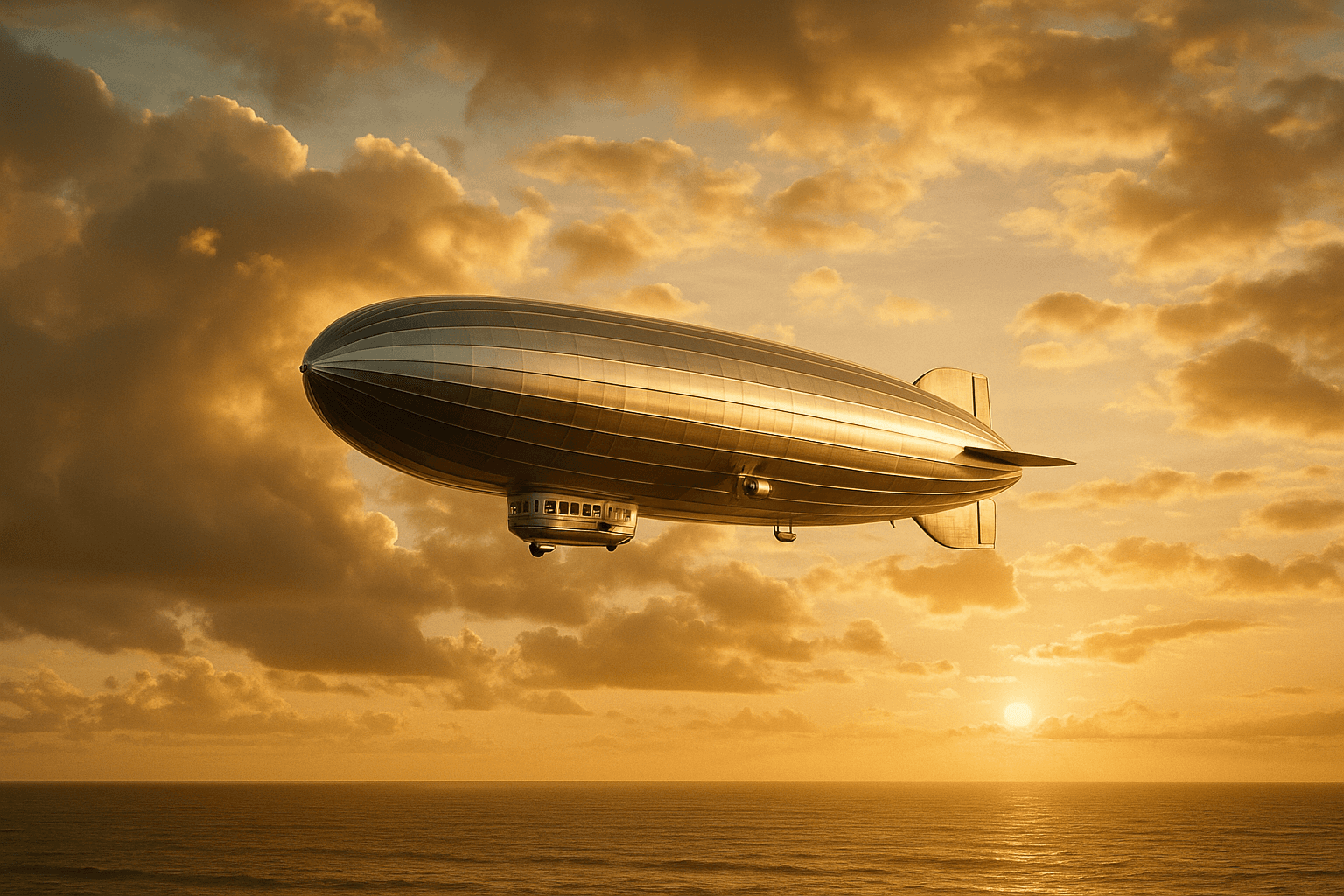
For almost a century, the airship was the very image of the future: silver giants gliding silently across the Atlantic, with dining rooms, cabins and panoramic windows, while airplanes were still noisy contraptions that barely hopped from one field to the next. In 1936 you could dine over the ocean at 200 meters and sleep in a real bed. A year later, that promise burned in 32 seconds in front of the whole world's cameras. This is the story of how the most elegant flight that ever existed ended in fire.
Giffard, 1852: the first craft you could steer
The word "dirigible" literally means "steerable," and that was exactly the difference from a balloon. A hot-air balloon goes up and down, but it drifts wherever the wind takes it. The first to break that curse was the French engineer Henri Giffard. On September 24, 1852, he hung a barely three-horsepower steam engine driving a propeller beneath an elongated hydrogen balloon and flew some 27 kilometers from the Paris Hippodrome to Trappes.
The wind was too strong for him to return to the start, but Giffard achieved something unheard of: he could turn, trace curves, choose a heading. It was the first powered, steerable flight in history. As with so many inventions, the problem was not the idea but the engine: steam was too heavy to drive a real craft against the wind. It would take half a century, and the gasoline engine, for the dream to become practical.
Santos-Dumont: rounding the Eiffel Tower (1901)
That leap was made by a wealthy, eccentric, slightly-built Brazilian who cruised around Paris in his own airships. Alberto Santos-Dumont took up the challenge of a prize, the Deutsch de la Meurthe, which paid 100,000 francs to anyone who could take off from the Saint-Cloud park, round the Eiffel Tower and return in under half an hour. On October 19, 1901, aboard his No. 6, he did it in 29 minutes and 30 seconds, engine trouble on the way back included.
Santos-Dumont proved that a lighter-than-air craft could maneuver over a city with precision. Years later he would abandon airships for airplanes and become, for much of the world, a pioneer of aviation—a story we tell in the airplane before the Wrights. But while the airplane was making its first clumsy hops, the airship was already crossing entire capitals.
The golden age of the zeppelin
The name that would be forever tied to the airship belonged to a retired German count. On July 2, 1900, at the age of 62, Ferdinand von Zeppelin flew the LZ-1 over Lake Constance, the first practical rigid airship: instead of a simple gas bag, an aluminum frame with hydrogen cells inside. That allowed them to be built huge and stable. That first flight lasted about 18 minutes with five people aboard.
Three decades later, the technology reached its peak. The Graf Zeppelin (LZ-127) flew around the world in 1929: more than 34,000 kilometers in a little over twelve days, with stops in Germany, Japan and the United States, and half the trip paid for by press magnate William Randolph Hearst in exchange for the exclusive. On board, passengers traveled in a luxury unthinkable on any airplane of the era. Just as the first submarine in history seemed lifted from a Jules Verne novel, the transatlantic zeppelin was science fiction made real.
The gas problem: hydrogen versus helium
All those giants shared one Achilles' heel: to float, they used hydrogen, the lightest gas that exists… and also one of the most flammable. A safe alternative existed, helium, which does not burn. The trouble was that in the 1930s almost all the world's helium was produced by the United States, and in 1927 a law banned its export.
Germany's new pride, the Hindenburg, had been designed to fly on helium. Unable to buy it, its builders had no choice but to fill it with hydrogen. The bomb was assembled; all it needed was a spark.
Hindenburg, 1937: 32 seconds that ended an era
The LZ-129 Hindenburg was the largest flying machine ever built: 245 meters long, nearly three soccer fields. On May 6, 1937, while maneuvering to moor at the Lakehurst station in New Jersey after crossing the Atlantic, the giant caught fire at the tail. In barely 32 seconds it was reduced to a burning skeleton.
Of the 97 people aboard, 35 died, plus one member of the ground crew: 36 victims in all, and 62 survivors. The toll was not the worst in airship history, but it was the most widely seen. Cameras and microphones were waiting for the landing, and the footage of the disaster—along with announcer Herbert Morrison's anguished "Oh, the humanity!"—circled the planet in movie theaters. The cause was never determined with certainty, but it no longer mattered: no passenger would ever again willingly climb aboard a bag of hydrogen.
It wasn't just the Hindenburg
The Hindenburg is remembered as the end of the airship, but the tragedies had been piling up for years. Britain's R101 crashed in France on its first overseas voyage on October 5, 1930. And the deadliest disaster by death toll did not even use hydrogen: the USS Akron, a helium-filled American military airship able to launch and recover airplanes in mid-flight, fell into the sea off New Jersey on April 4, 1933. 73 of its 76 crew died. Its twin, the USS Macon, was lost in a storm in 1935.
The pattern was clear: those colossi were magnificent in good weather, but enormously vulnerable to the storms and winds that airplanes—smaller and faster—were beginning to dodge with ease.
Why did the airship lose?
It wasn't any one thing. The Hindenburg fire destroyed public confidence, but the airship was already losing the technical race. It was slow—crossing the Atlantic took two or three days—hugely expensive to operate, dependent on gigantic hangars and dozens of ground crew to moor it, and fragile in bad weather. Meanwhile, the airplane grew faster, safer and cheaper every year. World War II accelerated that advantage, and the pressurized passenger jet finished the story.
What remains is the nostalgia for a way of flying that no longer exists: no turbulence, no noise, with windows that opened to the air and a dining room overlooking the ocean. The airship was one of those futures humanity imagined, touched with its fingertips, and then left behind. Like so many technologies ahead of their time, it shone just long enough that we still dream of what might have been.
References
- Encyclopædia Britannica, "Hindenburg" and "Ferdinand, Graf von Zeppelin."
- Wikipedia, "Hindenburg disaster," "Zeppelin LZ 1" and "Giffard dirigible."
- Airships.net, "Hydrogen and Helium in Airship Operations" and "Worst Airship Disaster in History: USS Akron."
- World History Encyclopedia, "Graf Zeppelin's Round the World Trip of 1929."
- Fédération Aéronautique Internationale (FAI), "170 years of Giffard's dirigible."
Do you enjoy stories of inventions that brushed glory? Continue with the airplane before the Wrights or explore the whole science of the past series.
Categories
The books · born from this blog

Atahualpa con su abrigo de pelo de murciélago
y otras 49 historias verdaderas que parecen mentira
Available on Amazon
Tocar madera
Pequeña historia de las supersticiones que el mundo no ha podido soltar
Available on Amazon
100 futuros
Cien escenarios del mundo que viene con la inteligencia artificial
Available on AmazonYou may also like

The LaserDisc: The Future That Came Too Early
In 1978 the LaserDisc already offered sharp images, instant access and digital sound — everything DVD would bring twenty years later. It came too early.

The Bicycle: The Machine That Freed the City
In 1817 Karl Drais built a running machine with no pedals. A century later the bicycle had reshaped cities and helped set women free.
The Airplane Before the Wrights: Who Almost Won
Before the Wright brothers flew in 1903, pioneers nearly got there first: Cayley, Lilienthal, Ader and Santos-Dumont. This is their untold story.