
Why veins look blue when your blood is red
Human blood is never blue—it is always red. So why do veins look blue under the skin? The answer lies in how light travels through your body and how you see.
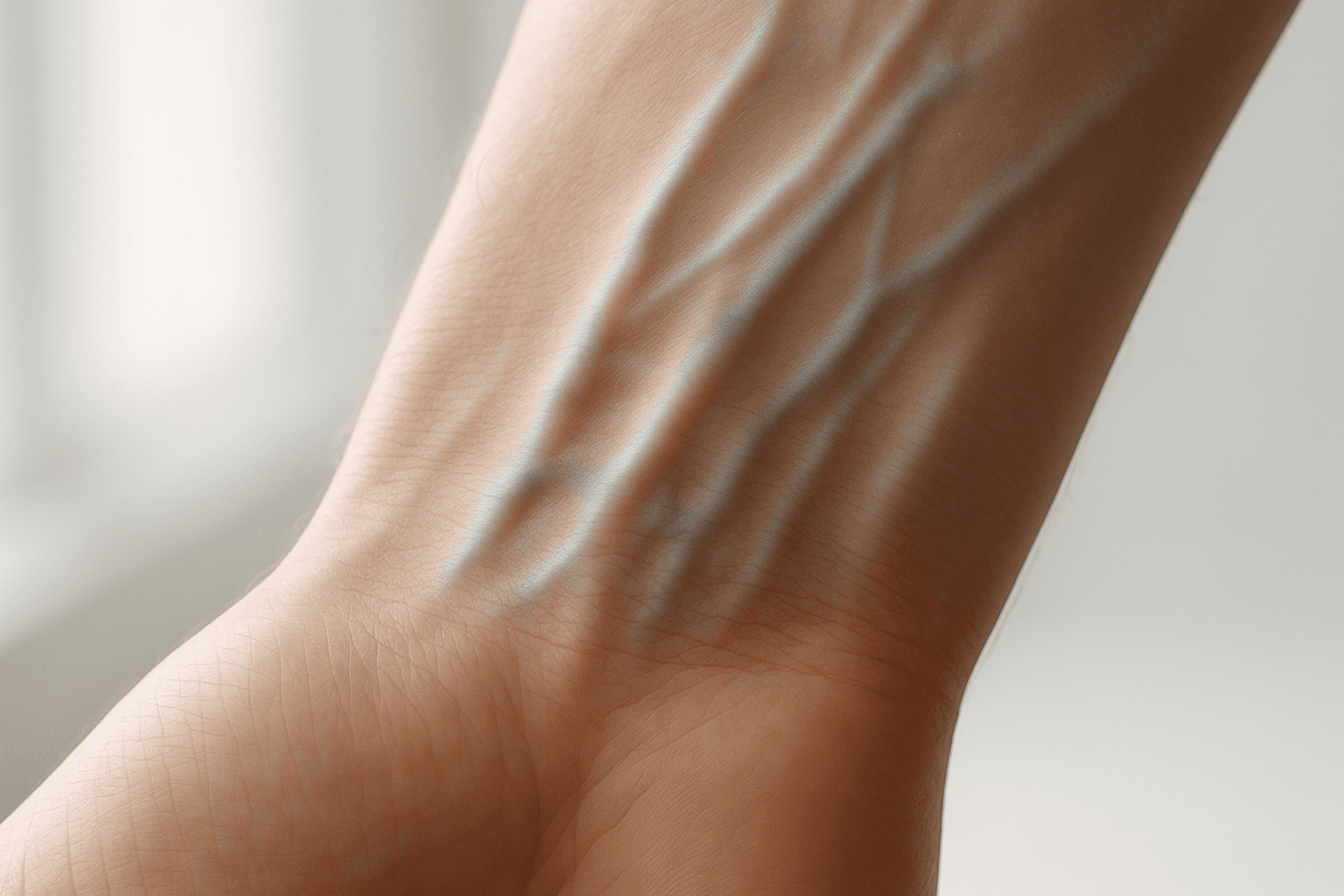
Look at the back of your wrist or the crook of your elbow and you will see bluish lines running under the skin. The conclusion seems obvious: the blood in your veins must be blue, and only turns red when it leaves the body and meets the air. It is one of those ideas most of us learned as children and many keep repeating as adults. The trouble is that it is false. Human blood is never blue, neither inside nor outside the body. What we see as blue is not the blood but the result of a trick of light and of our own perception.
Blood is always red
The color of blood is decided by hemoglobin, the iron-rich protein that fills red blood cells and carries oxygen. When hemoglobin is loaded with oxygen —the blood leaving the heart for the body— it takes on a bright, almost scarlet red. When it has handed that oxygen over to the tissues and returns through the veins, the molecule changes shape and reflects light differently: it becomes a dark red, a maroon much like red wine. Dark, yes; blue, never.
Anyone can check this. When a nurse draws blood from a vein —deoxygenated blood, the supposed «blue blood»— what fills the tube is dark red, not sky blue. If venous blood were really blue, donations and lab tests would give it away every single day. The idea that it «turns red on contact with the air» is another piece of the myth: the shift between bright and dark red depends on how much oxygen it carries, not on whether the vial is capped or open.
Why veins look blue
If blood is red, the blue has to come from somewhere else, and it comes from light. The white light shining on your skin is a mix of every color, each with a different wavelength. And here is the key: they do not all penetrate the body equally. Red light, with its long wavelength, passes through skin easily and reaches several millimeters deep, right where many veins sit. Blue light, with its short wavelength (about 475 nanometers), is scattered and reflected much sooner, barely sinking into the tissue.
When red light reaches a vein, the hemoglobin in the blood absorbs it. So from the patch of skin directly over the vein, less red returns to your eyes than from the skin around it. Meanwhile the blue —which never went that deep— keeps bouncing back from the surface layers evenly across the whole area. The result is that, over the vein, the balance of colors tips toward blue, and that is what you perceive. The vein is not blue: it has «stolen» the red out of the light that lit it. It is the same kind of physics that explains how light forms an image inside a camera: everything depends on which wavelengths arrive, get absorbed, or bounce back.
It is not only the light: your brain, too
The story has one more twist, and a team of physicists signed off on it in 1996. In a famous study titled «Why do veins appear blue?», Alwin Kienle and his colleagues measured, with cameras and simulations, how light reflects off a real vein. They confirmed the absorption mechanism but added a factor that is often forgotten: perception.
Our brain does not judge the color of a spot in isolation, but by contrast with its surroundings. The skin around the vein returns plenty of red; the strip over the vein returns a little less. That relative contrast is enough for the visual system to label the vein «blue», even though the light coming off it is not a pure blue at all. Put another way: the vein looks blue partly because the neighboring skin looks redder. It is a mirage of the eye and the brain, not a property of the liquid running inside —a reminder that what we see does not always match what is there, just as the equator is not where we think it is.
Where the «blue blood» myth comes from
If the idea is so wrong, why is it so deeply rooted? Part of the blame lies with school diagrams: in almost every biology textbook arteries are painted red and veins blue, a handy color code to tell them apart that many took literally. Add to that an old expression: in English, Spanish (sangre azul) and other languages the aristocracy was called «blue-blooded». The origin is medieval Spain, where very pale-skinned nobles boasted of the bluish veins showing through their skin as proof they had not mixed with other peoples. The metaphor was about lineage, not biology, but it helped fix the image.
Curiously, blue blood does exist in nature—just not in us. Some animals —the horseshoe crab, octopuses, squid, many spiders and crustaceans— do not use iron-based hemoglobin but hemocyanin, a copper-based protein. And hemocyanin, when it loads up with oxygen, turns a genuine blue. Their blood is truly blue, not through a trick of light. Ours, by contrast, is as red as ever; the blue is added by physics, and a little by our own brain. Next time you look at your veins, remember you are seeing an optical trick as reliable as the feeling that a symptom appears just because you expected it: convincing, everyday, and yet an illusion.
References
- Kienle A et al., «Why do veins appear blue? A new look at an old question», Applied Optics, vol. 35 (1996). opg.optica.org
- «I've always wondered: why do our veins look blue when our blood is red?», The Conversation. theconversation.com
- «If blood is red, why do veins look bluish?», Live Science. livescience.com
- «The Chemistry of the Colours of Blood», Compound Interest. compoundchem.com
Enjoy explanations of why we see what we see? Continue with the origin of the word «pixel» or explore the whole science section.
Categories
The books · born from this blog

Atahualpa con su abrigo de pelo de murciélago
y otras 49 historias verdaderas que parecen mentira
Available on Amazon
Tocar madera
Pequeña historia de las supersticiones que el mundo no ha podido soltar
Available on Amazon
100 futuros
Cien escenarios del mundo que viene con la inteligencia artificial
Available on AmazonYou may also like

The History of the Match: Fire in Your Pocket
The friction match was born by accident in 1826, poisoned thousands of factory women, and only later became the safe fire we carry in our pocket.
Teflon: The Lab Accident That Ended Up in Your Kitchen
Teflon was born from a failed DuPont experiment in 1938, served in the atomic bomb, and ended up on your nonstick pan. This is its story.

The nocebo effect: when expecting harm creates it
The nocebo effect is the placebo's dark twin: believing a treatment will hurt can make it hurt. Its origin, real cases and what science says.