
Morse Code: How It Works and Why It Saved Lives
Morse code turns letters into dots and dashes that travel down a wire or a flash of light. Here is how it works, where it came from and why it is still used.
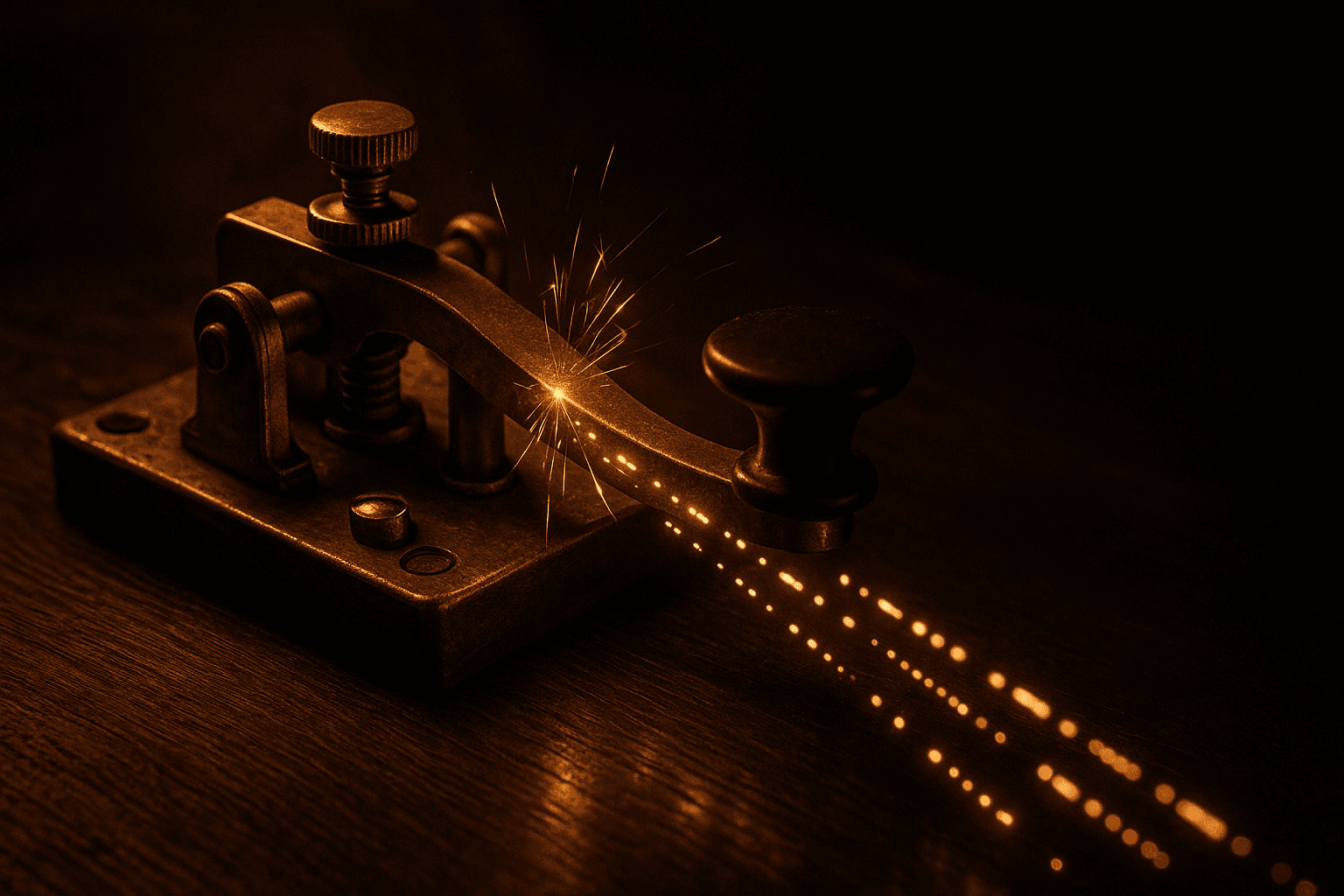
Three dots, three dashes, three dots. Almost anyone recognizes that pattern —· · · — — — · · ·— even without knowing a single other letter: it is SOS, the most famous cry for help in the world. Behind those nine pulses lies a 19th-century invention that turned the alphabet into a stream of flashes and clicks, and that for more than a hundred years was the fastest way to send a message across a distance. This is the story of Morse code: how letters become pulses, who really invented it, and why —decades after it was declared dead— it still saves lives.
What Morse code is
Morse code is a way of representing letters, numbers and symbols using only two signals: a short one and a long one. The short one is called a dot (or dit) and the long one a dash (or dah). By combining those two pieces you can spell anything: E, the most common letter in English, is a single dot; T is a dash; A is dot-dash (·—) and S is three dots (· · ·).
The key is that it does not matter how the signal travels. It can be an electrical click on a wire, a radio beep, a flash of a flashlight, a knock on a pipe, or even a blink of the eyes. As long as there is a way to produce "short" and "long," Morse code works. That independence from the medium is exactly what made it so powerful and so hard to kill off completely.
How letters become pulses
The elegance of the system lies in timing. Everything is measured in one basic unit of duration —the length of a single dot. From there, the rules are simple:
- A dot lasts 1 unit; a dash lasts 3 units.
- Between the dots and dashes of one letter there is a 1-unit silence.
- Between two letters, the silence is 3 units.
- Between two words, the silence is 7 units.
That 1 : 3 : 7 ratio is what lets a trained ear tell where one letter ends and the next begins, even though it all sounds like a continuous burst of beeps. Speed is measured in words per minute, and to standardize it a reference word is used: PARIS, chosen because its combination of dots and dashes works out to exactly 50 units. An average amateur radio operator handles 15 to 20 words per minute comfortably; champions exceed 40.
Another brilliant, often forgotten detail is how the letters were assigned. It was not random: the most frequent letters got the shortest codes. To pull that off, Alfred Vail visited the office of a local newspaper and counted how many pieces of each letter sat in the movable-type cases; the more pieces, the more that letter was used, and the shorter its symbol should be. It is, at heart, a data-compression idea a century before computing existed.
Who invented Morse code
The name says it all —and yet tells only half the story. Samuel Morse, an American painter and professor, is the public figure: he championed the electric telegraph in the United States and gave the code its name. But the system of dots and dashes as we use it —with letters, numbers and that clever frequency-based assignment— owes a great deal to his partner and assistant, the machinist Alfred Vail, whose contribution spent decades in the shadow of the famous surname.
The founding moment came on May 24, 1844. From a room in the Capitol in Washington, Morse sent Vail —waiting in Baltimore— the first official message over the telegraph line funded by Congress: "What hath God wrought," a biblical quote suggested by Annie Ellsworth, daughter of the patent commissioner. In a matter of seconds, a message had crossed tens of kilometers. The world had suddenly shrunk. We tell that revolution in more detail in the story of the telegraph, the Victorian internet.
SOS: three dots, three dashes, three dots
Morse code's most memorable use was born at sea. In the early 20th century, each company had its own distress signal; Britain's Marconi used "CQD." To end the chaos, an international conference adopted a German signal in 1906 that officially came into force on July 1, 1908: SOS. It is not the initials of "Save Our Souls" or any other phrase; it was chosen simply because · · · — — — · · · is an unmistakable, easy-to-remember pattern, impossible to confuse with anything else even when the signal arrives weak or broken up.
The event that burned SOS into collective memory was the sinking of the Titanic, in April 1912. Its operators, Jack Phillips and Harold Bride, began by transmitting the old CQD; as the story goes, Bride joked about sending the new SOS "because it may be your last chance to use it." They ended up alternating both signals. The tragedy accelerated the universal adoption of SOS and of stricter rules on keeping a permanent radio watch aboard ships.
From its heyday to retirement… and survival
For more than a century, Morse was the backbone of long-distance communication: telegraphs, ships, aviation, armies. But technology moved on. On February 1, 1999, the new Global Maritime Distress and Safety System (GMDSS), based on satellites and digital calls, officially replaced Morse at sea. That date marked the end of an era: ships were no longer required to keep a radio operator listening for dots and dashes.
And yet Morse code did not die. Today it lives on in several surprising corners:
- Amateur radio. Millions of hams worldwide still transmit in Morse —they call it CW— because a signal of dots and dashes cuts through noise and distance better than voice, with minimal equipment.
- Aviation. Navigation radio beacons broadcast their identifier in Morse, and pilots still learn to recognize it to confirm they are tuned to the right station.
- Accessibility. People with severe paralysis or spinal-cord injuries control computers with a single switch —or even by sipping and puffing on a straw— translating those gestures into dots and dashes.
- Emergencies. When modern networks fail, a simple flash or a rhythmic knock can still spell SOS.
The most harrowing example of that resilience came in 1966. U.S. Navy commander Jeremiah Denton, a prisoner of war in North Vietnam, was forced to give a propaganda interview for television. While saying aloud what his captors wanted to hear, Denton deliberately blinked at the camera, spelling out a single word in Morse: T-O-R-T-U-R-E. It was the first clear confirmation to the world that American POWs were being tortured. With two signals, short and long, and nothing but his eyelids, he transmitted what no spoken word could.
Why it still matters
Morse code is a lesson in design that never ages: with just two symbols and a good sense of rhythm, you can transmit any idea over almost any medium. It is the same pursuit of efficiency we see again and again in technology, from Edison's phonograph that first captured the human voice to the QR code, another black-and-white alphabet designed so a machine can read the physical world. Officially dead for more than two decades now, Morse is still here, beating in dots and dashes, because sometimes the simplest solution is also the hardest to beat.
References
- "Morse code," Wikipedia. en.wikipedia.org
- "Morse Code & Telegraph: Invention & Samuel Morse," HISTORY. history.com
- "A Forgotten History: Alfred Vail and Samuel Morse," Smithsonian Institution Archives. siarchives.si.edu
- "Jeremiah Denton, ex-senator and Vietnam POW who blinked 'torture' in Morse code, dies at 89," CBS News. cbsnews.com
Enjoy the technologies that changed how we communicate? Continue with the story of the Victorian telegraph or with the oldest recorded human voice.
Categories
The books · born from this blog
Atahualpa con su abrigo de pelo de murciélago
y otras 49 historias verdaderas que parecen mentira
Available on Amazon
Tocar madera
Pequeña historia de las supersticiones que el mundo no ha podido soltar
Available on Amazon
100 futuros
Cien escenarios del mundo que viene con la inteligencia artificial
Available on AmazonYou may also like
The Origin of Unix: Why It Lives in Your Phone
Unix was born in 1969 on a forgotten Bell Labs computer. Today its descendants run your phone, your Mac and nearly every server on Earth.
The QR code story: from Toyota to the restaurant menu
The QR code was born in 1994 to track car parts at Toyota. Thirty years later it took over restaurant menus. This is its unlikely history.
The Telegraph: The Victorian Internet
The telegraph shrank weeks of mail into minutes of cable. How Morse, Cooke and a wire under the Atlantic built the Victorian internet and shrank the world.