
The Telegraph: The Victorian Internet
The telegraph shrank weeks of mail into minutes of cable. How Morse, Cooke and a wire under the Atlantic built the Victorian internet and shrank the world.
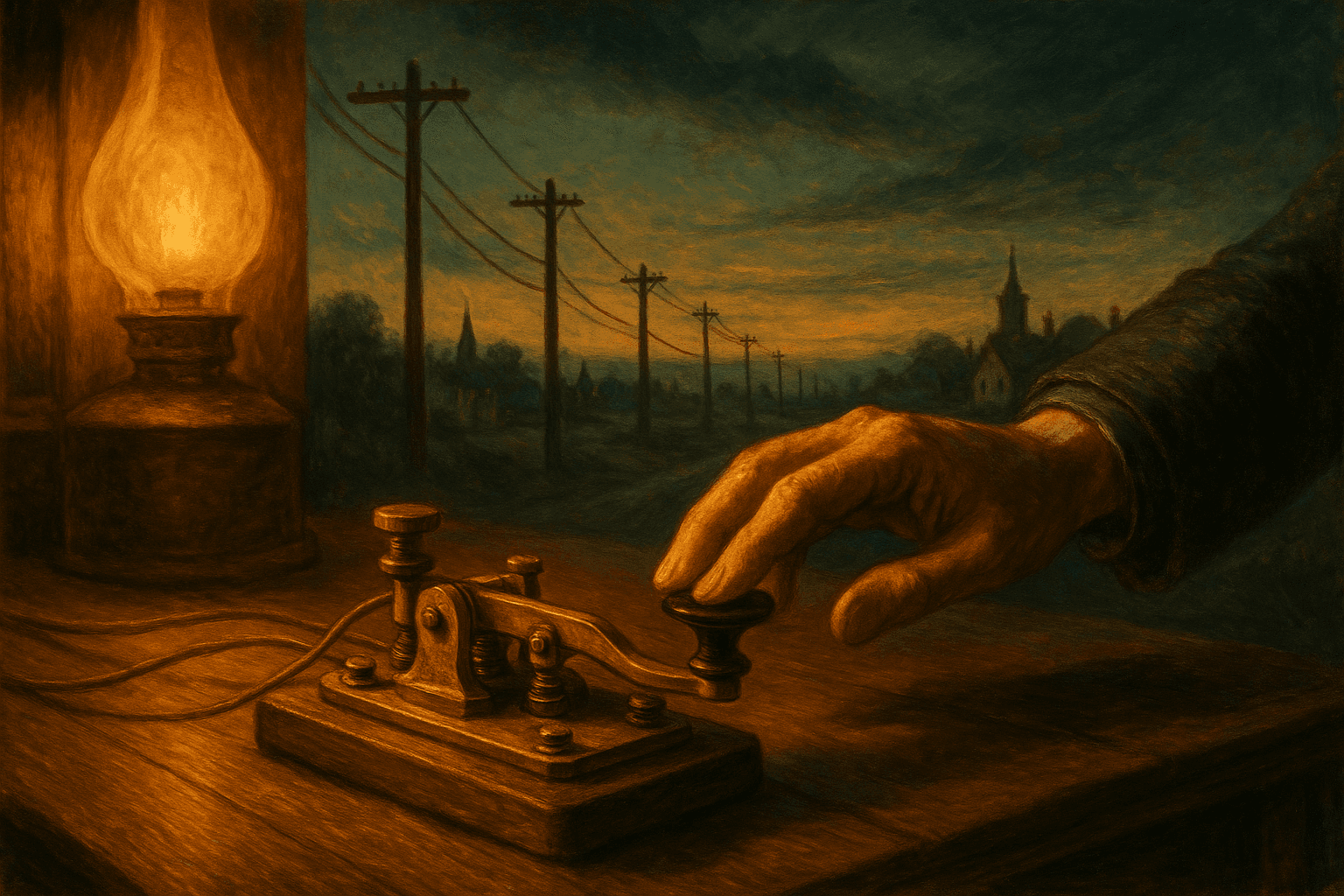
Before the telegraph, news could travel no faster than a horse, a ship or a train. A message from London to New York took weeks — the time a sailing vessel needed to cross the Atlantic. Then, in just a few decades of the 19th century, everything changed. For the first time in human history, information broke free from transport: a piece of news could reach the far side of the world before the person carrying it. That leap — as abrupt and profound as the arrival of the internet a century and a half later — was driven by the electric telegraph. This is its story.
What the telegraph was, and why it changed everything
The word telegraph comes from the Greek tele ("far") and graphein ("to write"): to write at a distance. Optical telegraphs already existed before electricity — towers with moving arms relaying signals from hill to hill; they worked only by day and in good weather, and they were painfully slow. The electric telegraph rewrote the rules: it sent pulses of current down a copper wire, and those pulses could travel for kilometers almost instantly, at night, in the rain, no matter the terrain.
The underlying idea is the same one that holds up all modern communication: turn a message into signals a wire knows how to carry. In the telegraph, those signals were simply current switched on and off. Decades later, that same logic would return when the modem turned data into sound to travel down the phone line. The telegraph was the first link in that chain.
1837: two inventions at once, on both sides of the sea
As often happens with great ideas, the electric telegraph had no single father. In 1837, almost in parallel, two rival systems emerged on either side of the Atlantic.
In England, William Fothergill Cooke and the scientist Charles Wheatstone patented a telegraph with five magnetic needles that tilted to point at letters and numbers on a panel. It was intuitive — anyone could read it without training — and that same year they sent their first message down a line between the London stations of Euston and Camden Town. Their system found a perfect customer: the railways, which used it to coordinate trains and prevent collisions. In 1839 the first permanent line was installed, alongside the Great Western Railway.
Across the ocean, the painter and professor Samuel Morse was developing a different and, in the long run, more influential idea. Instead of needles pointing at letters, Morse proposed a code: dots and dashes — short and long pulses — to represent each letter. With the help of the mechanic Alfred Vail, his system needed a single wire instead of five, which made it far cheaper to string.
1844: "What hath God wrought"
Morse spent years searching for money to demonstrate his invention. Finally, in 1843 the U.S. Congress approved $30,000 to build an experimental line of about 60 kilometers between Washington and Baltimore. On May 24, 1844, from the Capitol, Morse sent Vail the line's first official message: "What hath God wrought", a Bible verse suggested to him by Annie Ellsworth, the daughter of a friend.
The message reached Baltimore and Vail sent it back word for word. It was a short sentence with enormous consequences: a technology had been born that, within a few years, would weave a web of cables across the United States and Europe. That first "did you get this?" followed by a confirmation is, in spirit, the very same gesture as the first message sent over the internet more than a century later.
Morse code: an alphabet of pulses
The great advantage of Morse's system was its code. Instead of a complicated panel, the operator needed only to tap a key: a brief touch was a dot, a longer one a dash. Each letter had its combination, and — with an engineer's cunning — the most frequent letters got the shortest codes: E, the most common in English, is a single dot.
That efficiency turned Morse code into a universal language of long-distance communication that outlived the machines that created it. It was used on the telegraph, then on the radio, and its distress signal — three dots, three dashes, three dots: SOS — kept saving lives at sea throughout the 20th century. A fine example of how a simple standard can win out through sheer practicality, just as happened with Ethernet in computer networks.
1858–1866: the cable under the Atlantic
Stringing cables overland was one thing; crossing an ocean was another entirely. The American entrepreneur Cyrus Field became obsessed with joining Europe and America by a submarine cable over 3,000 kilometers long. After several failed attempts, in August 1858 he managed it for the first time: Queen Victoria and President Buchanan exchanged greetings, and American cities erupted in celebration.
The triumph was fleeting. That first cable, poorly designed, degraded within weeks and stopped working. Field did not give up: the American Civil War delayed the project, but in 1866 a better cable, laid by the gigantic ship Great Eastern, finally established a permanent, reliable connection between Valentia, in Ireland, and Heart's Content, in Newfoundland. What had once taken ten days by ship now took minutes.
The Victorian internet
The nickname is no exaggeration by modern chroniclers. The 19th-century telegraph network resembled the internet astonishingly well: it had cables crossing continents and oceans, operators who became friends — and even couples — tapping away at a distance, codes to make messages cheaper, frauds, its own jargon, and a very familiar anxiety about information overload. Governments learned to spy on the cables; speculators, to move money in real time; newspapers, to publish foreign news the next day instead of the next month.
When the telegraph shrank the world, many naively believed that a planet able to communicate instantly would be a planet at peace. It was not. But it did remain, forever, connected. The submarine cables Field laid through a string of failures are the great-great-grandparents of the fiber optics that carry these very lines to your screen: at heart, we are still sending each other dots and dashes beneath the sea.
References
- "Telegraph | Invention, History & Facts", Encyclopædia Britannica. britannica.com
- "Cooke and Wheatstone telegraph", Wikipedia. en.wikipedia.org
- "First Telegraph Message, May 24, 1844", U.S. Senate. senate.gov
- "First transatlantic telegraph cable completed", History.com. history.com
Enjoy tracing the origins of everyday technology? Continue with the history of the modem or explore the whole science & tech section.
Categories
The books · born from this blog
Atahualpa con su abrigo de pelo de murciélago
y otras 49 historias verdaderas que parecen mentira
Available on Amazon
Tocar madera
Pequeña historia de las supersticiones que el mundo no ha podido soltar
Available on Amazon
100 futuros
Cien escenarios del mundo que viene con la inteligencia artificial
Available on AmazonYou may also like
The First Message Ever Sent Over the Internet Was 'LO'
On October 29, 1969, the first message in internet history was meant to be 'login', but the network crashed after just two letters: 'LO'.
Morse Code: How It Works and Why It Saved Lives
Morse code turns letters into dots and dashes that travel down a wire or a flash of light. Here is how it works, where it came from and why it is still used.

The nocebo effect: when expecting harm creates it
The nocebo effect is the placebo's dark twin: believing a treatment will hurt can make it hurt. Its origin, real cases and what science says.