
The QR code story: from Toyota to the restaurant menu
The QR code was born in 1994 to track car parts at Toyota. Thirty years later it took over restaurant menus. This is its unlikely history.
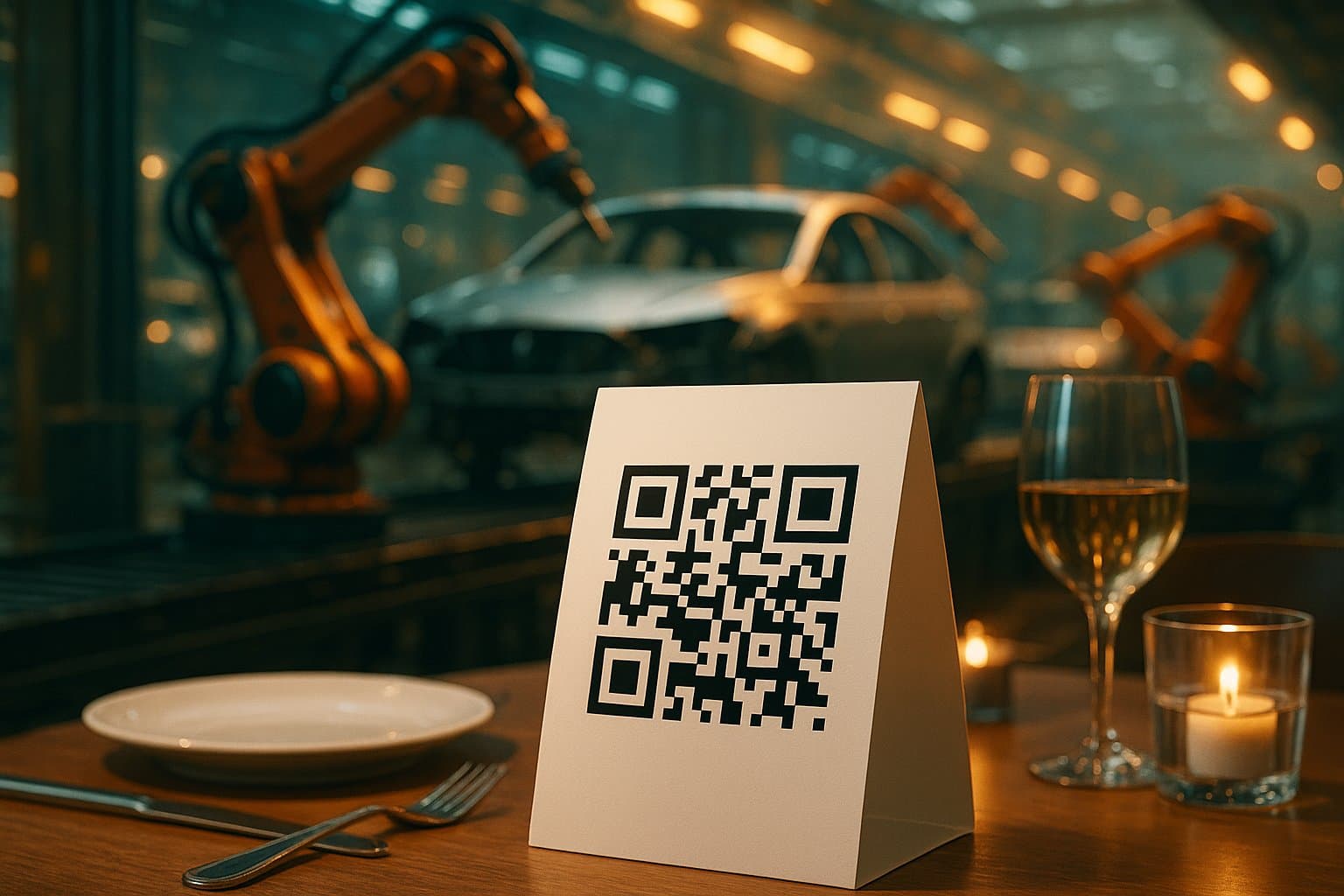
You do it without thinking: you point your phone's camera at a small square full of black speckles and, a second later, the restaurant's menu appears. That everyday gesture hides an unlikely journey. The QR code wasn't born for your dinner, but on the floor of a car factory in Japan, more than thirty years ago, to solve a problem that had nothing to do with you.
A code born in a car factory
The year was 1994. At Denso Wave, a company in the Toyota group devoted to automotive components, an engineer named Masahiro Hara had a very specific headache. Toyota's «just-in-time» production required tracking thousands of parts along the assembly line, and the tool for that was the good old barcode. The catch: a traditional barcode holds barely a couple dozen characters, and workers had to scan up to ten different codes on each box. It was slow and error-prone.
Hara wanted a code that stored far more information and could be read at a glance, no matter the angle. The idea of tracking physical objects with a machine-readable pattern is still very much alive today, from industrial inventories to the AirTag Apple hangs from your keys. But in 1994, Hara's answer was to draw in two dimensions.
The game of Go and the three squares
Inspiration came, according to Hara himself, while playing Go during his lunch break: that board of black and white stones suggested that information could be encoded in a grid, not in simple stripes. Thus the QR was born, from Quick Response, because his great obsession was reading speed.
The most ingenious detail is those three squares in the corners. They let the scanner find and orient the code instantly, from any direction. To design them, the team analyzed the black-and-white ratio of countless printed materials —magazines, boxes, leaflets— looking for the pattern least likely to appear in the real world, so that nothing would be mistaken for those marks. The result was a 1:1:3:1:1 ratio that almost never shows up by accident.
The reward for all that cleverness: while a barcode stores a few dozen characters, a QR holds up to 7,000 digits, reads in 360°, and, thanks to its error correction, works even when it's up to 30 % damaged or dirty. Packing so much information into a printed pattern is, deep down, the same dream chased by those who today imagine storing data in unlikely places, like a hard drive made of DNA.
The decision that changed everything: giving it away
Here is the quiet twist of this story. Denso Wave patented the QR code, but made an unusual decision: it announced that it would not exercise its patent rights. Anyone could create and read QR codes without paying a cent. Without that calculated generosity, the QR would have been just another proprietary curiosity. Thanks to it, it became an open standard —formalized as an ISO norm in 2000— and took root all over the planet.
From Japan to China: the code that became money
Japan adopted it first, driven by the camera phones of the early 2000s. But it was China that took the QR to another level: starting in 2011, apps like WeChat and Alipay turned it into the backbone of mobile payments. From street markets to buskers, the whole country began charging by showing a square on a screen. The humble code from the car factory had literally turned into money.
Why the West took so long
In the Western world, by contrast, the QR spent years with a reputation as a useless gadget. The reason was simple: you had to download a separate app just to scan it, a friction almost no one wanted. The turning point came in 2017, when phones built the QR reader straight into the camera: suddenly, scanning was just pointing.
And then came 2020. The pandemic, with its obsession with «contactless», was the final push: menus, capacity logs, certificates. The restaurant replaced its laminated menu with a little square on the table, and the QR finally entered the daily life of half the world. Curiously, it was the same era in which another everyday test, the CAPTCHA, was also becoming ubiquitous on our screens.
From the assembly-line board to your table
Today the QR code is on plane tickets, on the Wi-Fi networks we share, in advertising, in art and, yes, on almost every menu. Not all of it is innocent: its success drew in scammers, who now paste fake codes to steal data —a technique dubbed quishing. But the next time you scan one to order your food, it's worth remembering where it comes from: a Japanese engineer who, playing Go on his break, just wanted to count parts faster in a Toyota factory. Few inventions have traveled so far from their original purpose.
References
- Denso Wave. «History of QR Code» (official document from the company that invented the code).
- ISO/IEC 18004 standard: international specification of the QR code (2000).
- Interviews with Masahiro Hara on the invention of the QR at Denso Wave (1994) and his inspiration from the game of Go.
- Reed, I. S. and Solomon, G. «Polynomial Codes over Certain Finite Fields» (1960): basis of the QR's error correction.
Enjoy the hidden histories behind everyday technology? Continue with the CAPTCHA, the test that lost to AI and how Apple's AirTag really works, or explore more in Technology.
Categories
The books · born from this blog
Atahualpa con su abrigo de pelo de murciélago
y otras 49 historias verdaderas que parecen mentira
Available on Amazon
Tocar madera
Pequeña historia de las supersticiones que el mundo no ha podido soltar
Available on Amazon
100 futuros
Cien escenarios del mundo que viene con la inteligencia artificial
Available on AmazonYou may also like

The nocebo effect: when expecting harm creates it
The nocebo effect is the placebo's dark twin: believing a treatment will hurt can make it hurt. Its origin, real cases and what science says.

The History of the Match: Fire in Your Pocket
The friction match was born by accident in 1826, poisoned thousands of factory women, and only later became the safe fire we carry in our pocket.
The History of the Floppy Disk and the Save Icon
The floppy disk held 80 KB in 1971 and survives today as the «save» icon many young people never touched. This is the full history of the floppy disk.