
The Daguerreotype: The Photo That Demanded Stillness
The daguerreotype was the first photograph you could buy: silver plates, mercury vapor and long minutes holding perfectly still before the camera.
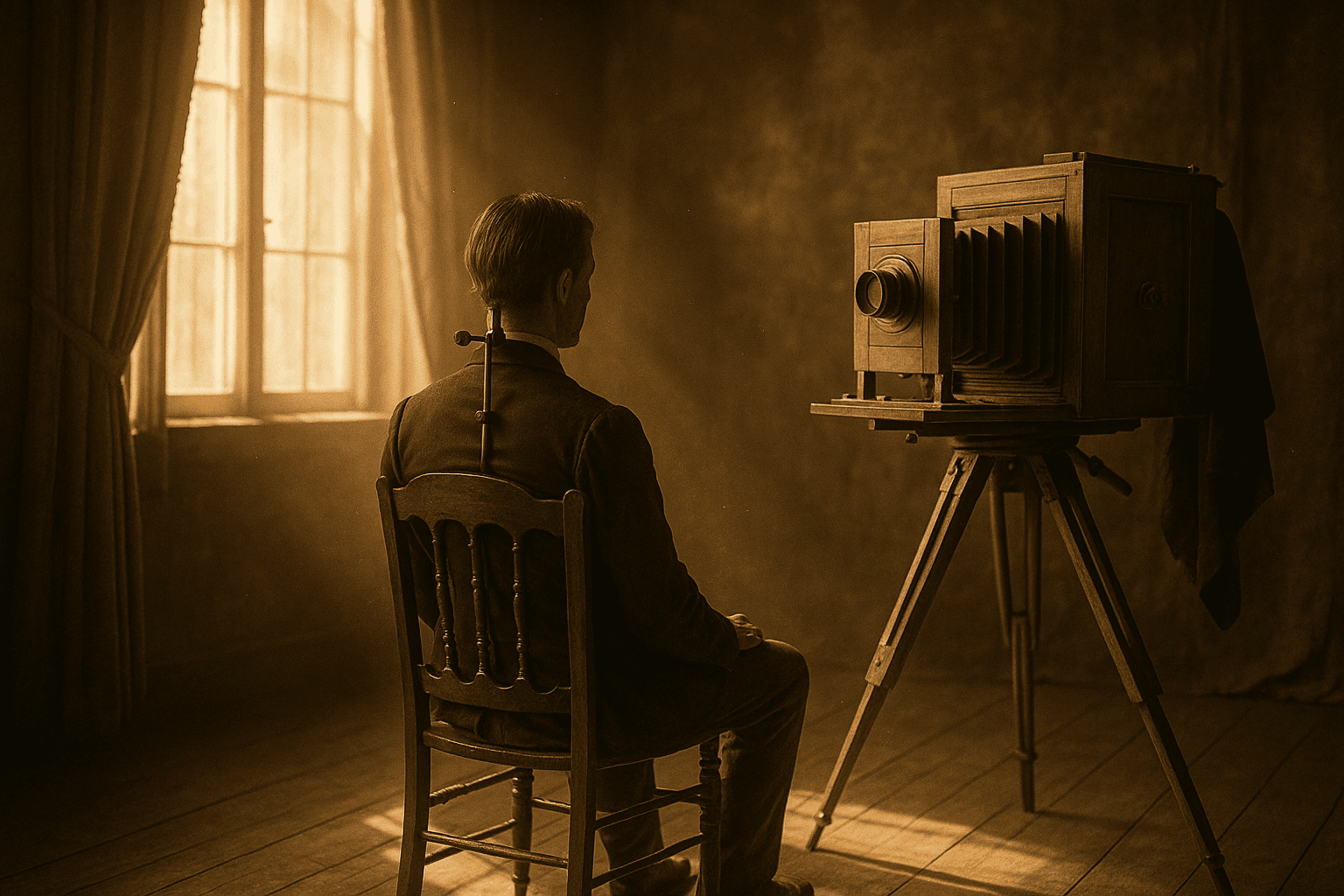
Imagine that having your picture taken meant sitting before a wooden box, resting the back of your head against a metal clamp, and holding perfectly still for several minutes—no blinking, no swallowing—while the photographer quietly counted the seconds. That is how a portrait was made in 1840. The daguerreotype was the first form of photography sold to the public, and also the most demanding: it produced images of astonishing sharpness in exchange for an almost impossible stillness. This is the story of that invention and of what it literally cost to sit still in front of it.
1839: the year photography was born
The invention bears the name of Louis-Jacques-Mandé Daguerre, a French painter and set designer who had spent years searching for a way to fix the image formed inside a camera obscura. In January 1839 he announced his process to the Academy of Sciences in Paris, and on August 19 of that year the French government published the full method and declared it a gift, "free to the world." That is why August 19 is celebrated today as World Photography Day.
There was one striking exception: England. Days before France released the invention, an agent of Daguerre had filed a British patent, so in the United Kingdom and its colonies you still had to pay for a license. The rest of the planet could copy the process from day one, which explains how fast it spread. For the full picture of how we got here, see how the first cameras worked.
How a daguerreotype was made, step by step
The daguerreotype used neither paper nor film: the image formed directly on a silver-coated copper plate, polished to a mirror finish. The process had four stages, and each was a small ritual of chemistry.
First, in darkness, the plate was exposed to iodine vapor, which reacted with the silver to form light-sensitive silver iodide. Then it went into the camera and was exposed, aimed at the sitter or the landscape. Next came the strangest step: development with mercury. The plate was placed face down over a dish of mercury heated to about 60–65 °C (120–150 °F), and the vapor clung to the areas that had received the most light, forming a whitish amalgam that made the image appear as if by magic. Finally, the plate was fixed with a salt solution (later with sodium thiosulfate) so it would stop being sensitive and wouldn't darken when viewed.
The result was a unique image, impossible to reproduce, with a level of detail that still surprises today. But it had a quirk: because it sat on polished silver, you had to tilt it at just the right angle for the picture to appear; head-on it looked like a plain mirror. And it was laterally reversed, like your reflection.
The ordeal of posing
The daguerreotype's great enemy was time. In 1839, an exposure could last between three and fifteen minutes. That made it nearly impossible to portray a person: nobody can hold still for a quarter of an hour. At first the daguerreotype was used mainly for buildings and landscapes—subjects that had the courtesy not to breathe.
Portraits required an entire apparatus of immobilization. Studios used headrests and metal clamps hidden behind the client, gripping the neck and back to prevent the slightest tremor. The photographer asked sitters not to blink and to breathe slowly. Any movement translated into a blurred, ghostly face. That statue-like tension is one of the reasons nobody smiled in old photos: holding a smile for several minutes is exhausting, so the sensible thing was a neutral face and no movement.
Things improved quickly. With brighter lenses—like the Petzval lens of 1840—and the use of bromine as an accelerator, by 1842 the exposure for a portrait had dropped to around one minute. It was still an eternity by today's standards, but at last it was possible to photograph people without quite torturing them.
Daguerreotypomania
Enthusiasm was immediate and global. The press of the day named the phenomenon "daguerreotypomania": within months, workshops opened all across Europe and America. The United States in particular fell in love with the invention. By 1850, New York City alone had more than seventy portrait studios, and major cities competed to build the most lavish premises, set up on upper floors to make the most of the sunlight.
For the first time, owning a portrait was no longer a privilege of the wealthy who could pay a painter. A middle-class family could take home the exact likeness of a loved one—something unthinkable a generation earlier. Those plates, kept in velvet-lined cases, are today irreplaceable windows into a lost world, like the ones in photographs from a century ago.
The hidden price: mercury in the air
Behind the magic was a poison. Development with heated mercury vapor exposed daguerreotypists, day after day, to an extremely toxic substance. Mercury poisoning—tremors, neurological problems, the same affliction that drove nineteenth-century hatters "mad"—was a real hazard of the trade. The New York photographer Jeremiah Gurney, one of the most famous of his time, suffered an acute case in 1852 that kept him from work for months. The beauty of those images carried a cost that never showed up on the plate.
Why it vanished
Its reign was intense but brief. The daguerreotype carried two flaws it could never solve: each plate was a unique image that couldn't be copied, and the process was expensive and delicate. In the late 1850s, cheaper and more practical alternatives arrived—the ambrotype on glass and the tintype on metal—and above all the negative principle took over, letting you make as many copies as you wanted from a single shot. By 1860 the daguerreotype was already a curiosity of the past.
It lasted barely twenty years, but it changed humanity's relationship with its own image forever. Before 1839, most people died without leaving a single portrait of their face; afterward, anyone could look themselves in the eye decades later. The next time you snap a selfie in a tenth of a second, spare a thought for that gentleman in 1840 with an iron clamp gripping his neck, holding his breath while the mercury did its work.
References
- "The Daguerreotype Medium," Library of Congress. loc.gov
- "The Daguerreian Era and Early American Photography on Paper, 1839–1860," The Metropolitan Museum of Art. metmuseum.org
- "August 19, 1839 – Louis Daguerre presents the daguerreotype," Rincón educativo. rinconeducativo.org
- "The Invention of the Daguerreotype Process," Copper Development Association. copper.org
Fascinated by the technology we take for granted? Continue with how the first cameras worked or explore the whole Science & Technology section.
Categories
The books · born from this blog
Atahualpa con su abrigo de pelo de murciélago
y otras 49 historias verdaderas que parecen mentira
Available on Amazon
Tocar madera
Pequeña historia de las supersticiones que el mundo no ha podido soltar
Available on Amazon
100 futuros
Cien escenarios del mundo que viene con la inteligencia artificial
Available on AmazonYou may also like
Morse Code: How It Works and Why It Saved Lives
Morse code turns letters into dots and dashes that travel down a wire or a flash of light. Here is how it works, where it came from and why it is still used.
The Telegraph: The Victorian Internet
The telegraph shrank weeks of mail into minutes of cable. How Morse, Cooke and a wire under the Atlantic built the Victorian internet and shrank the world.

The nocebo effect: when expecting harm creates it
The nocebo effect is the placebo's dark twin: believing a treatment will hurt can make it hurt. Its origin, real cases and what science says.