
The History of the Modem: When the Internet Screeched
The modem turned data into sound to travel down the phone line. This is its story, from the 1958 Bell 101 to the screech of dial-up internet.
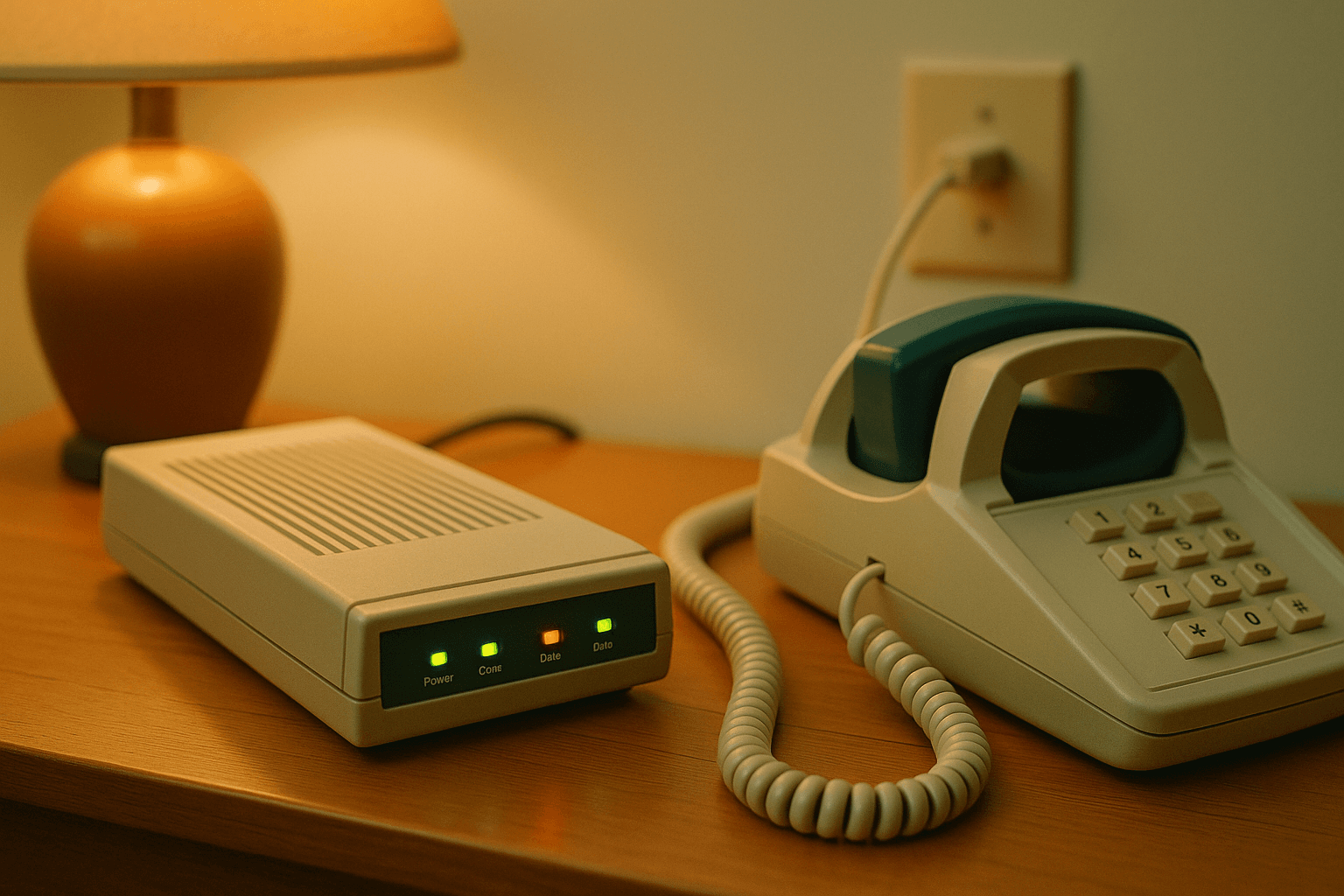
For almost two decades, getting online began with an unmistakable sonic ritual: a dial tone, a few beeps, and then that harsh, half-metallic screech that faded into a hiss of static. Anyone who lived through the 1990s recognizes the sound instantly. But few people knew they were listening, live, to two machines agreeing on how to talk to each other. The device responsible for that noise —and for almost all communication between computers for half a century— is the modem. This is its story.
What a modem is, and why it turns data into sound
The word modem is a contraction of modulator-demodulator, and that contains everything it does. A computer speaks in bits, ones and zeros. The telephone network, by contrast, was designed to carry just one thing: the human voice, that is, analog sound. A modem acts as a translator between those two worlds. At the sending end it modulates: it turns the bits into audible tones the phone line knows how to carry. At the receiving end it demodulates: it listens to those tones and turns them back into ones and zeros.
That is why the modem made noise. The screech was not a defect or a decoration: it was literally the voice of your data converted into audio, traveling down the same wire you used to call your grandmother. The oldest technique for this is called frequency-shift keying (FSK): one tone represents a «1», a different tone the «0». The line cannot tell whether there is a person or a machine on the other side; it just carries sound.
1958: the first modem was born of the Cold War
The first modem was not invented for browsing or chatting, but for watching the skies. In 1958, AT&T introduced the Bell 101, designed for the U.S. military system SAGE (Semi-Automatic Ground Environment), the giant air-defense network meant to detect Soviet bombers at the height of the Cold War. The Bell 101 could send digital data between computers over ordinary telephone lines, at the very modest speed of 110 bits per second. In 1959 it was offered to the public, becoming the first commercial modem in history.
Four years later came the model that would set the standard for a whole generation. In 1962, AT&T released the Bell 103, capable of 300 bits per second and —crucially— full-duplex: it could send and receive at the same time, with a set of tones for each direction. The originating station used tones of 1,070 and 1,270 Hz; the answering station, 2,025 and 2,225 Hz. For years, «Bell 103» was simply how machines connected.
The lawsuit that freed the phone line
There was a huge legal problem: AT&T was a monopoly and forbade connecting to its lines any device it had not built itself. That changed with the famous Carterfone decision of 1968, when the FCC ruled that third-party devices could be attached to the telephone network as long as they did not harm it. The door was open, and through it poured a wave of independent modems.
Since directly plugging into the line was not always allowed yet, many used an acoustic coupler: a rubber cradle where you wedged the telephone handset. The modem literally «spoke» into the mouthpiece and «listened» through the earpiece, just as a person would. Models like the Novation CAT filled the 1970s. It was clumsy and noisy, but it worked, and it laid the groundwork for what would come when the first personal computer reached people's homes.
1981: Hayes and the modem that dialed by itself
The decisive leap toward the home modem came in 1981, when Dennis Hayes and Dale Heatherington introduced the Hayes Smartmodem. Earlier modems were dumb: someone had to dial the number by hand and then connect the device. The Smartmodem, by contrast, was controlled by software through a set of instructions sent from the computer, the legendary AT command set (from Attention). With a simple ATDT followed by a number, the modem dialed on its own, waited for a tone, connected, and reported the result.
It was so influential that nearly every modem built afterward adopted the AT commands or a variant, and many are still in use today inside the modems of mobile phones. The de facto standard was set by a small Georgia company, not a giant —a story that echoes other everyday inventions that won by being practical, like the QWERTY keyboard that outlived all its rivals.
The screech explained: two machines negotiating
And so we reach the most nostalgic sound of the internet. When your modem called your provider's, the two could not simply start sending data: first they had to agree on things. That rising screech was the handshake: an answer tone, probing signals that sounded out the quality of the line, and training sequences with which they measured the noise and distortion of that particular wire to decide at what speed and with what compression they would talk.
It was audible for a very practical reason: if you had mistakenly dialed a house instead of the provider, hearing the noise gave you time to pick up and apologize. Sending the command ATM0 before dialing was enough to silence it, but by default modems left that process out in the open. Every connection sounded similar because it always followed the same script, even though the machines improvised depending on how bad the line was that day.
From the screech to invisible fiber
The speed climbed in jumps: 300, 1,200, 2,400, 9,600, 14,400, 28,800 bits per second, up to the ceiling of dial-up, the famous 56k of the V.90 standard in the late 1990s. Even then, a photo took minutes and a music album took hours. Then came ADSL, cable and fiber, which left the phone line free to talk while you browsed, and the screech vanished from our lives.
But the modem did not die: it is still there, inside your home router and your phone's chip, modulating and demodulating without your hearing it, as invisible as the USB-C connector or the Bluetooth radio. The difference is that the noisy grandfather of the 1990s did not hide: it sang to you, live and in a voice of static, the everyday miracle of two machines learning to understand each other.
References
- «Bell 101 modem», Wikipedia. en.wikipedia.org
- «Bell 103 modem», Wikipedia. en.wikipedia.org
- «Hayes Command Set History», Tedium. tedium.co
- «The sound of the dialup, pictured and explained», absorptions (windytan). windytan.com
Do you enjoy these everyday technologies almost nobody understands? Continue with how Bluetooth works or explore the whole technology section.
Categories
The books · born from this blog

Atahualpa con su abrigo de pelo de murciélago
y otras 49 historias verdaderas que parecen mentira
Available on Amazon
Tocar madera
Pequeña historia de las supersticiones que el mundo no ha podido soltar
Available on Amazon
100 futuros
Cien escenarios del mundo que viene con la inteligencia artificial
Available on AmazonYou may also like

The History of the Match: Fire in Your Pocket
The friction match was born by accident in 1826, poisoned thousands of factory women, and only later became the safe fire we carry in our pocket.
The History of the Floppy Disk and the Save Icon
The floppy disk held 80 KB in 1971 and survives today as the «save» icon many young people never touched. This is the full history of the floppy disk.
Spam: The First Junk Email in History
On May 3rd, 1978, a salesman sent the first unsolicited mass email to 400 people. That we call it “spam” is the fault of a can of ham.