
RISC-V: the free chip that could be hardware's Linux
RISC-V is the open, royalty-free chip architecture challenging ARM and x86. What it is, why it's growing so fast, and where you already use it without knowing.
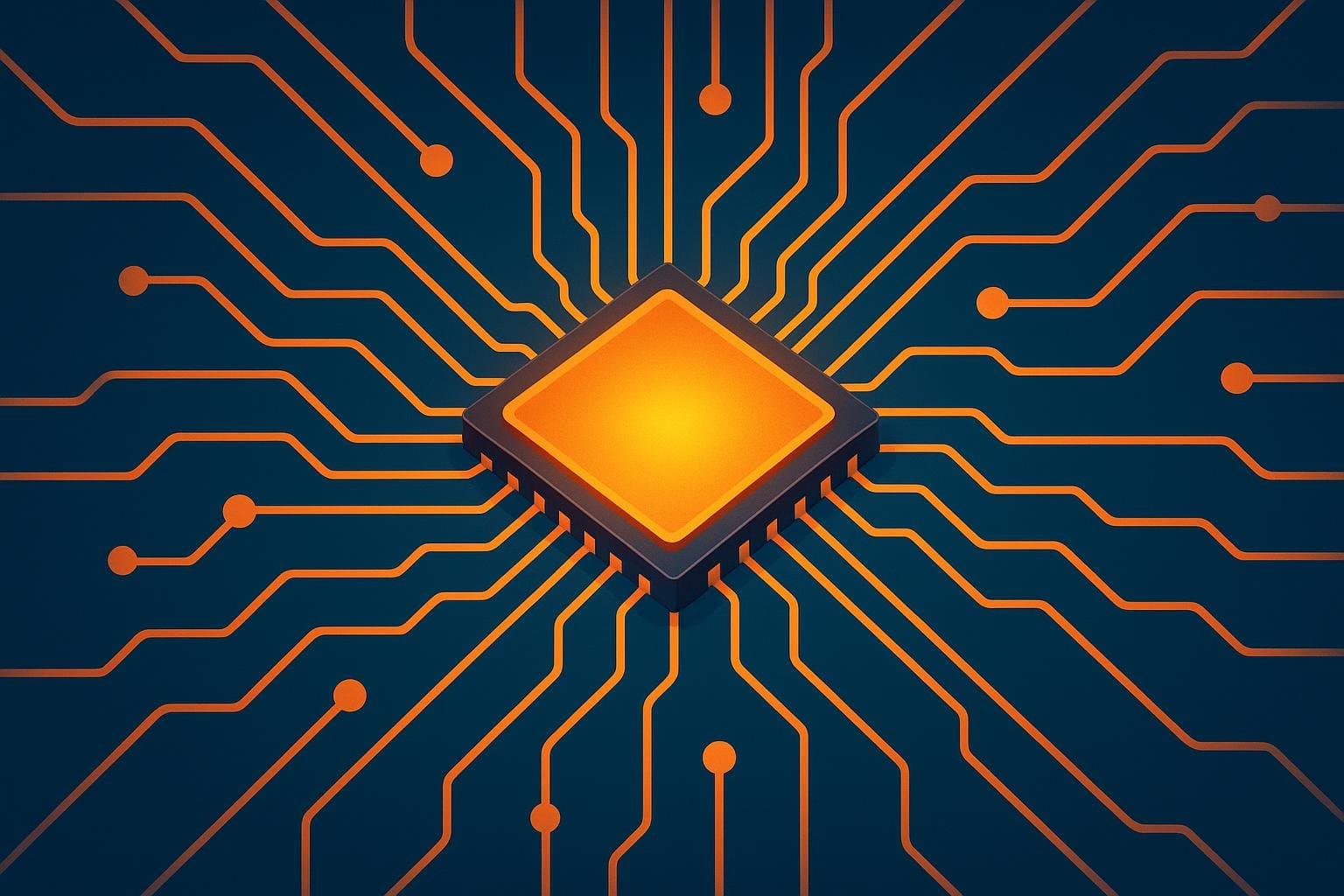
Almost every chip that runs the world —the processor in your phone, your laptop, your router— speaks a language that someone owns. ARM charges licensing fees for its own; Intel and AMD control x86. RISC-V (pronounced "risk five") proposes the opposite: an open, royalty-free instruction set that anyone can use, modify and manufacture without asking permission or paying a cent. The comparison is unavoidable: RISC-V aims to be for hardware what Linux was for software.
What RISC-V actually is
To get it, you have to separate two things we tend to confuse. One is the physical chip; the other is the instruction set architecture (ISA): the catalog of basic orders —add, compare, read memory— that the processor understands. RISC-V is not a chip: it's that ISA, a public specification describing how a processor should behave. It's like the difference between a language and the person who speaks it: the language is free; building someone to speak it costs money, but nobody charges you for using the words.
That's where the revolution lies. To design an ARM chip you have to sign a contract and pay royalties on every unit sold. With RISC-V, a startup, a university or an entire country can design its own processor from an open base, with no licenses and no clauses. It's the same philosophy that separates open source from free software, carried over to silicon.
From a summer project at Berkeley
RISC-V was born in 2010 at the University of California, Berkeley. Professor Krste Asanović needed an open architecture for his research and, together with students Yunsup Lee and Andrew Waterman, decided to build one from scratch in what was meant to be "a short, three-month project over the summer." The name says it all: it's the fifth generation of RISC designs to come out of Berkeley since 1981, which is why the "V" is the Roman numeral five.
The idea behind it —RISC, Reduced Instruction Set Computer— is old and powerful: a processor with few, simple but very fast instructions, instead of many complex ones. What was new wasn't the technique but the license. In 2011 the first version was published, the RV32I base set, under a license as permissive as any free software project. In 2015, so the specification wouldn't depend on a single university or country, the foundation now called RISC-V International was created, headquartered in Switzerland to stay neutral amid the geopolitical tensions between world powers.
Modular like Lego
RISC-V's technical charm is that it's modular. There's a mandatory minimal core —barely a few dozen instructions to add, subtract and move data— and then a series of optional extensions: multiplication, decimal numbers, vectors for artificial intelligence, cryptography. Whoever designs the chip picks only what they need.
That lets the same architecture serve a tiny one-dollar microcontroller and a server processor running Linux. A temperature sensor doesn't need vector instructions; a data-center chip does. Instead of carrying the full weight of an x86 inherited from the 1970s, each designer assembles a processor "to measure," like someone choosing Lego pieces.
Where you already use it without knowing
RISC-V stopped being an academic experiment a while ago. By 2025, according to RISC-V International, more than 10 billion RISC-V cores had been manufactured worldwide. Many are hidden inside devices you already own: disk controllers, earbuds, sensors and maker boards.
The closest example for anyone who tinkers with electronics is Espressif: its newest chips in the ESP32-C family dropped the previous proprietary core and adopted RISC-V. If you want to understand that ecosystem, we break it down in our guide to getting started with the ESP32 from scratch. And the Raspberry Pi Pico 2, with its RP2350 chip, does something astonishing: it includes two architectures at once and lets you choose to run your code on ARM cores or on RISC-V cores, a detail we mention when comparing boards in ESP32, Arduino and Raspberry Pi Pico.
When the giants climb aboard
What was a summer project in 2010 now worries the industry. The year 2025 marked a turning point: the foundation ratified the RVA23 profile, a standard that defines what a RISC-V processor must include to run full operating systems like Linux with no compatibility surprises —the equivalent of agreeing on a common grammar so software written once works on chips from any manufacturer. Ubuntu, in fact, adopted it as a requirement starting in October 2025.
And the heavyweights moved. NVIDIA announced full support for its CUDA platform on RISC-V, and Qualcomm bought Ventana Micro Systems, a company specialized in high-performance RISC-V cores. These are signs that the largest chip companies want to diversify and depend less on ARM. It doesn't mean RISC-V will dethrone the incumbents tomorrow; it means that, for the first time, there's an open alternative being taken seriously.
Really the "Linux of hardware"?
The analogy is good but not perfect. Linux proved that an open, collaborative project could beat closed, expensive alternatives, and today it runs on almost every server on the planet. RISC-V is betting on the same path in silicon: a common, neutral, ownerless base that anyone can build on. The difference is that manufacturing a chip is still far more expensive and slow than compiling software, so the "revolution" advances at the pace of a foundry, not a download.
Even so, the direction is clear. In a world where control of chips has become a matter of national security, having an architecture that nobody can ban or make more expensive by decree is a huge asset. RISC-V may not replace ARM or x86, but it has already changed the conversation: the heart of our gadgets can be free too.
References
Categories
The books · born from this blog
Atahualpa con su abrigo de pelo de murciélago
y otras 49 historias verdaderas que parecen mentira
Available on Amazon
Tocar madera
Pequeña historia de las supersticiones que el mundo no ha podido soltar
Available on Amazon
100 futuros
Cien escenarios del mundo que viene con la inteligencia artificial
Available on AmazonYou may also like

Could a Quantum Computer Crack All Our Passwords?
Could a quantum computer crack all our passwords? The short answer is yes, and even the NSA warns it could break today's encryption.
Open source vs free software. Their differences and which one is better?
Open source vs free software: a founder who built Elastix and met Stallman explains the real difference and why it still matters today.
Remembering Yubox: Ecuador's First Linux Distribution
Yubox was Ecuador's first Linux distribution, built from 2004 and abandoned by 2006, yet its story quietly helped give birth to Elastix.