
What Does Wi-Fi Stand For? Nothing, Actually
Wi-Fi doesn't stand for 'Wireless Fidelity' — or anything at all. It's a made-up brand name. Here's the real story and how the signal actually works.
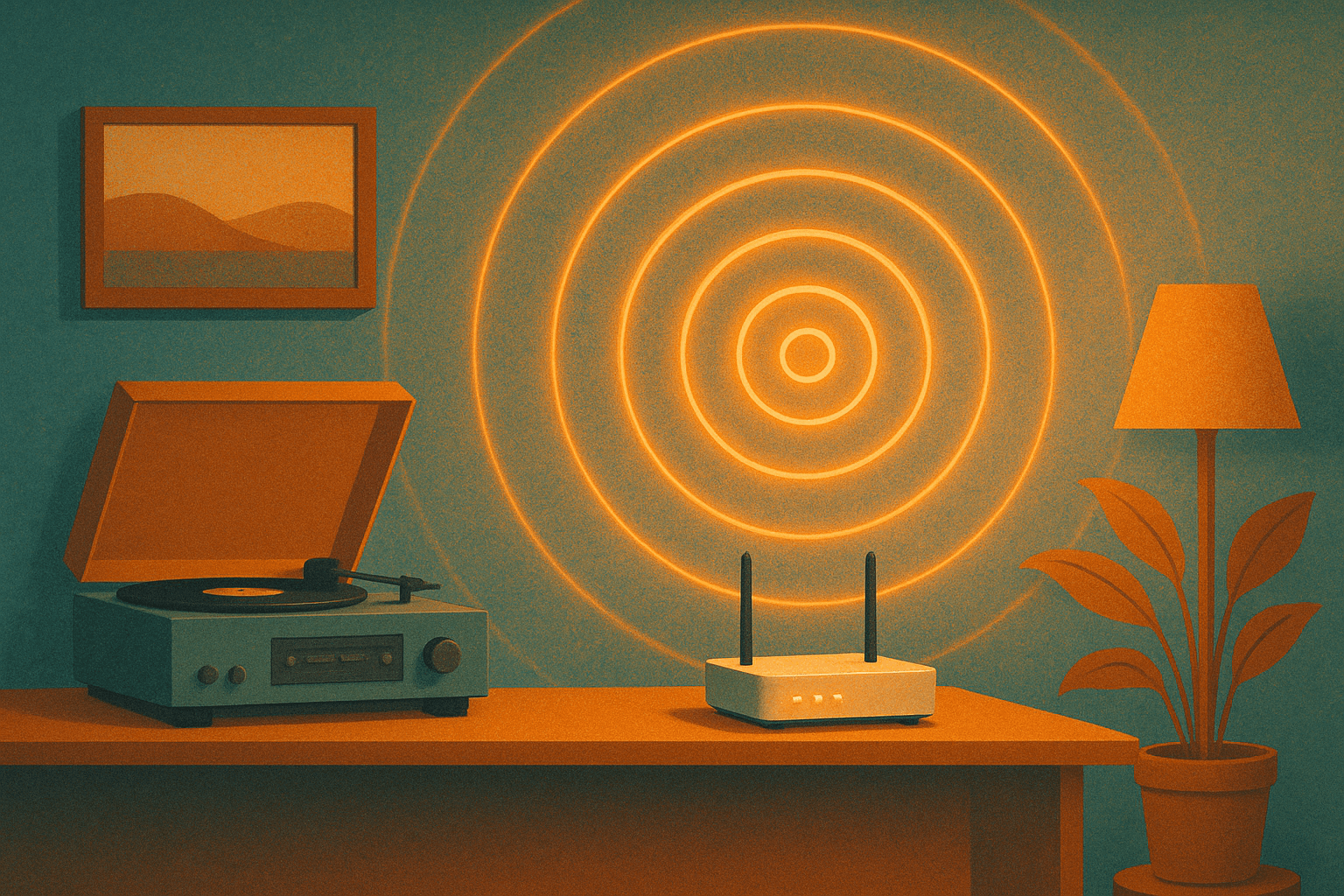
It sounds like an easy dinner-table question: what does Wi-Fi stand for? Almost everyone answers the same thing, with the confidence of reciting an obvious fact: «Wireless Fidelity». It sounds logical, it sounds technical, it sounds like someone thought it through. The problem is that it's false. Wi-Fi doesn't stand for that. In fact, Wi-Fi doesn't stand for anything: it's a word a branding agency pulled out of thin air because «IEEE 802.11b» would never fit on an advertisement. This is the story of how the most repeated name in modern technology ended up being a meaningless rhyme.
First came the technology, not the name
Before the catchy name there were years of decidedly unglamorous engineering. In 1997, a technical committee called the IEEE published the 802.11 standard — the rules that let two devices swap data over radio instead of over a cable. That first version reached a modest 2 Mbit/s and worked in the unlicensed 2.4 GHz band, the same slice of spectrum used by microwaves and Bluetooth. It was neither fast nor cheap, but it worked: you could connect a computer to a network without dragging a cord across the floor.
Much of the trick that let that signal survive the noise came from an unlikely place: radio astronomy. In the 1980s, Australian engineer John O'Sullivan and his team at the science agency CSIRO were trying to detect the faint radio echoes of tiny exploding black holes. The astronomical experiment failed, but the signal-processing technique they invented to pull a weak signal out of interference turned out to be perfect for beaming data through the air across a cluttered room. CSIRO patented it in 1992, and that math ended up embedded in the heart of 802.11. The person who brought order to all of it, wrangling manufacturers who couldn't agree, was engineer Vic Hayes, who chaired the standards group — which is why he's often called «the father of Wi-Fi».
The problem: no one was going to ask for «802.11b» in a store
By 1999 the technology was ready, but it had a fatal commercial flaw: its name. Imagine walking into a shop and asking for an «IEEE 802.11b Direct Sequence router». Manufacturers knew that with a name like that the invention would never escape the world of engineers. Worse still: each brand sold its own version, and nothing guaranteed that one company's gear would work with another's — exactly the compatibility problem that had strangled other technologies.
To fix it, a group of companies founded an alliance in 1999 with another unpronounceable name — the Wireless Ethernet Compatibility Alliance (WECA) — with two missions: to certify that devices from different brands could understand each other, and to find a name an ordinary human could remember. For the second task they did what any serious company does: they hired a branding agency, the firm Interbrand.
The name that means nothing
Interbrand delivered a shortlist of about ten possible names. The winner was Wi-Fi, and the reason was purely about sound: it rhymed with Hi-Fi, the old «high fidelity» label that had graced good sound systems since the 1950s. The idea was for the ear to associate Wi-Fi with quality, just as Hi-Fi evoked a fine turntable. But that was all it was: a play on words, a phonetic echo. Wi-Fi was not short for anything.
The person who has said this most plainly is Phil Belanger, a founding member of the alliance who presided over the selection of the name: «Wi-Fi doesn't stand for anything. It is not an acronym. There is no meaning». Full stop. The word was born empty, on purpose, like any other brand.
Where the «Wireless Fidelity» myth came from
So why does half of humanity swear it stands for «Wireless Fidelity»? Because of a mistake by the alliance itself. As Belanger tells it, several colleagues got nervous: they couldn't imagine launching a name without a literal explanation behind it, something people could «understand». So, as a compromise, they agreed to pair the logo with a tagline: «The Standard for Wireless Fidelity».
It was, in Belanger's own words, a mistake. That filler phrase made everyone believe Wi-Fi was short for «Wireless Fidelity», when the tagline had been invented after the name was chosen — precisely to justify a name that needed no justification. The alliance eventually dropped the tagline, but it was too late: the misunderstanding had become more popular than the truth. It's a textbook case of how a word reaches us by an absurd route and then the public invents an origin that sounds better. Even the logo — that black-and-white yin-and-yang symbol — came from the same agency, and hides no secret message.
How the signal we now call Wi-Fi actually works
Beyond the name, what happens when your phone «connects to the Wi-Fi» is rather elegant. The router translates internet data into radio waves and broadcasts them in the 2.4 GHz or 5 GHz band. The receiving device — phone, laptop, TV — catches those waves with its antenna and turns them back into ones and zeros. It's a two-way radio conversation, invisible and at the speed of light, similar in principle to other wireless signals we rely on every day.
The newer 5 GHz band offers more speed but shorter range: its shorter waves pass less easily through walls. That's why the signal weakens as you move away from the router or cross partitions, and why a repeater sometimes helps. And because that same 2.4 GHz band is crowded with gadgets — from the microwave to the Bluetooth in your earbuds — modern versions of the standard juggle to dodge interference and share the air among dozens of devices at once.
A hollow word that filled the world
Each generation brings its commercial label — Wi-Fi 5, Wi-Fi 6, Wi-Fi 7 — which is just a friendly way of naming versions of the 802.11 standard whose codes still wouldn't fit on an advertisement. The brand did exactly what Interbrand promised: today «Wi-Fi» is one of the most-spoken words on the planet, and almost no one knows it means absolutely nothing. Like so many everyday technologies, we use it without thinking; except this one also carries a name that was invented to mean nothing… and a myth that insists on giving it a meaning it never had.
References
- «Wi-Fi», Wikipedia (the name was coined by the firm Interbrand as a pun on «hi-fi»; it is not an acronym for «Wireless Fidelity»). en.wikipedia.org
- Cory Doctorow, «WiFi isn't short for "Wireless Fidelity"», Boing Boing, 2005 (quotes Phil Belanger, a founding member of the Wi-Fi Alliance, explaining that the name means nothing and that the «Wireless Fidelity» tagline was a later add-on). boingboing.net
- «What Does 'Wi-Fi' Stand For?», Snopes, 2024. snopes.com
- «Bringing fast wireless connectivity to the world», CSIRO (the 1992 patent by John O'Sullivan's team, born from radio astronomy, was incorporated into the 802.11 standard). csiro.au
Enjoy everyday technologies almost no one understands? Keep going with how Bluetooth works and the Viking king behind its name or with how NFC works.
Categories
The books · born from this blog

Atahualpa con su abrigo de pelo de murciélago
y otras 49 historias verdaderas que parecen mentira
Available on Amazon
Tocar madera
Pequeña historia de las supersticiones que el mundo no ha podido soltar
Available on Amazon
100 futuros
Cien escenarios del mundo que viene con la inteligencia artificial
Available on AmazonYou may also like

Why veins look blue when your blood is red
Human blood is never blue—it is always red. So why do veins look blue under the skin? The answer lies in how light travels through your body and how you see.

The nocebo effect: when expecting harm creates it
The nocebo effect is the placebo's dark twin: believing a treatment will hurt can make it hurt. Its origin, real cases and what science says.

The History of the Match: Fire in Your Pocket
The friction match was born by accident in 1826, poisoned thousands of factory women, and only later became the safe fire we carry in our pocket.