
The oldest recorded voice: sound before Edison
In 1860, 17 years before Edison, a French typesetter recorded the oldest human voice we can hear today. This is how we finally heard the past.
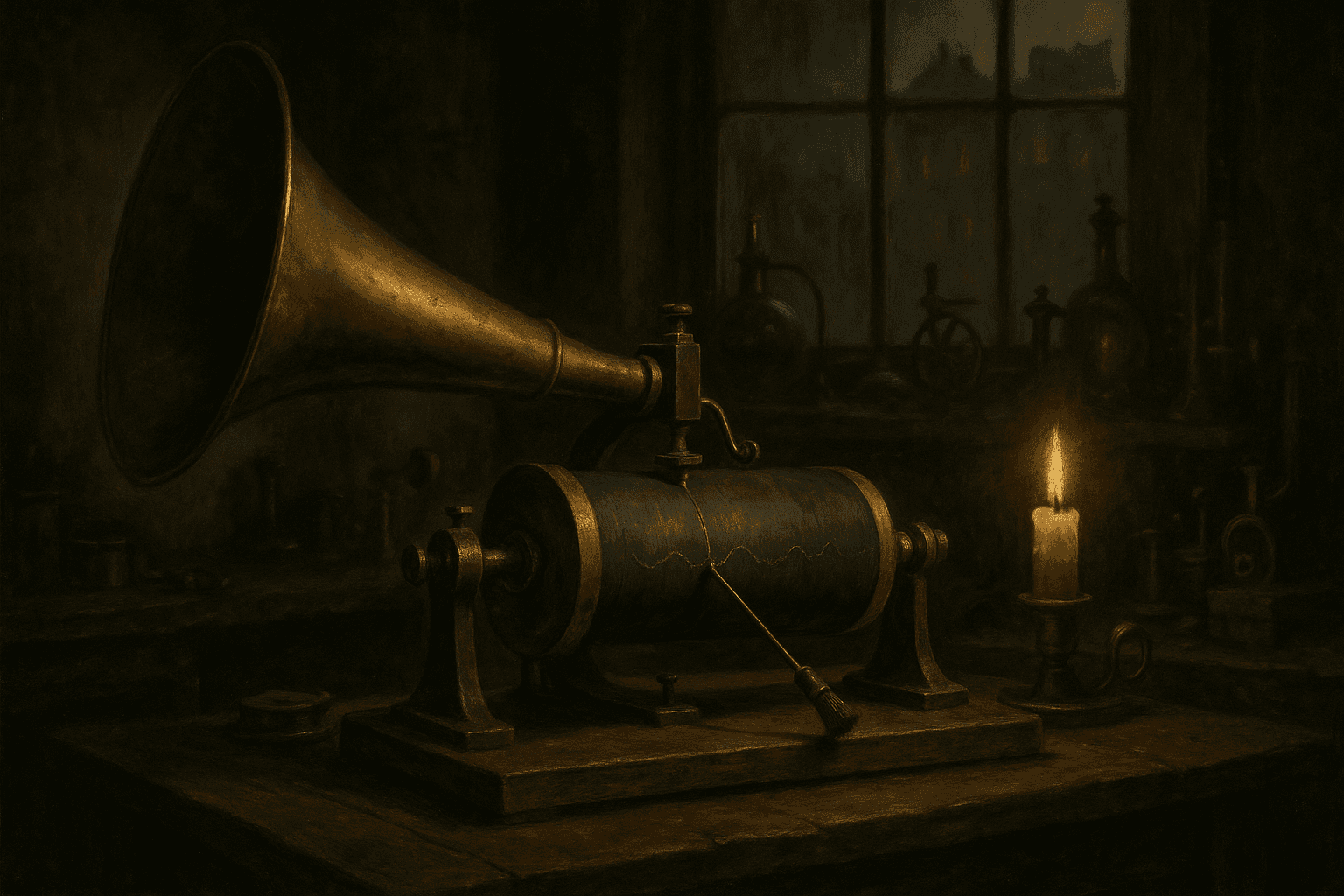
For centuries, the human voice was the most fleeting thing that existed: a vibration in the air that died in the very instant it was born. No one could keep it. Until a Parisian typesetter, obsessed with "writing down" sound, unknowingly left behind the oldest recording of a human voice we can hear today.
When we think of the first sound recording, almost all of us picture Thomas Edison and his 1877 phonograph reciting "Mary had a little lamb." It's a lovely story, but an incomplete one. The oldest surviving human voice was not recorded by Edison, nor by an American, nor even by a machine designed to play sound back. It was recorded by a Frenchman 17 years earlier, in 1860, and his device was never able to return a single note. This is the story of how the past, at long last, began to sound.
The man who wanted to draw the voice
His name was Édouard-Léon Scott de Martinville (1817–1879), a typesetter and proofreader in Paris. Working among lead type and page proofs, one idea lodged itself in his mind: if we could capture images with photography, why not capture sound the same way, letting it draw its own trace onto some surface?
Scott's ambition was not to record music so it could be heard again—that idea never even crossed his mind. What he wanted was a kind of "natural shorthand": a method for words to write themselves down, so a trained eye could later read those squiggles the way one reads a musical score. It's the very same obsession with fixing the fleeting that drove the pioneers of the image; you can see it in the story of the daguerreotype and the art of sitting still.
On March 25, 1857, he patented his invention with a name worthy of his ambition: the phonautograph (from the Greek, "the sound that writes itself").
How the phonautograph worked
The device was ingeniously simple. A large horn or funnel gathered the sound and focused it onto a thin membrane, mimicking the workings of the human eardrum. Attached to that membrane was a stiff bristle—a wild boar's bristle—that vibrated in time with the voice.
Beneath it, a rotating cylinder covered in paper blackened with lamp soot turned by a hand crank. The bristle scratched into that soot and left a wavering line, a trembling trace that was, literally, the shape of the voice drawn onto the black. That visual record was called a phonautogram.
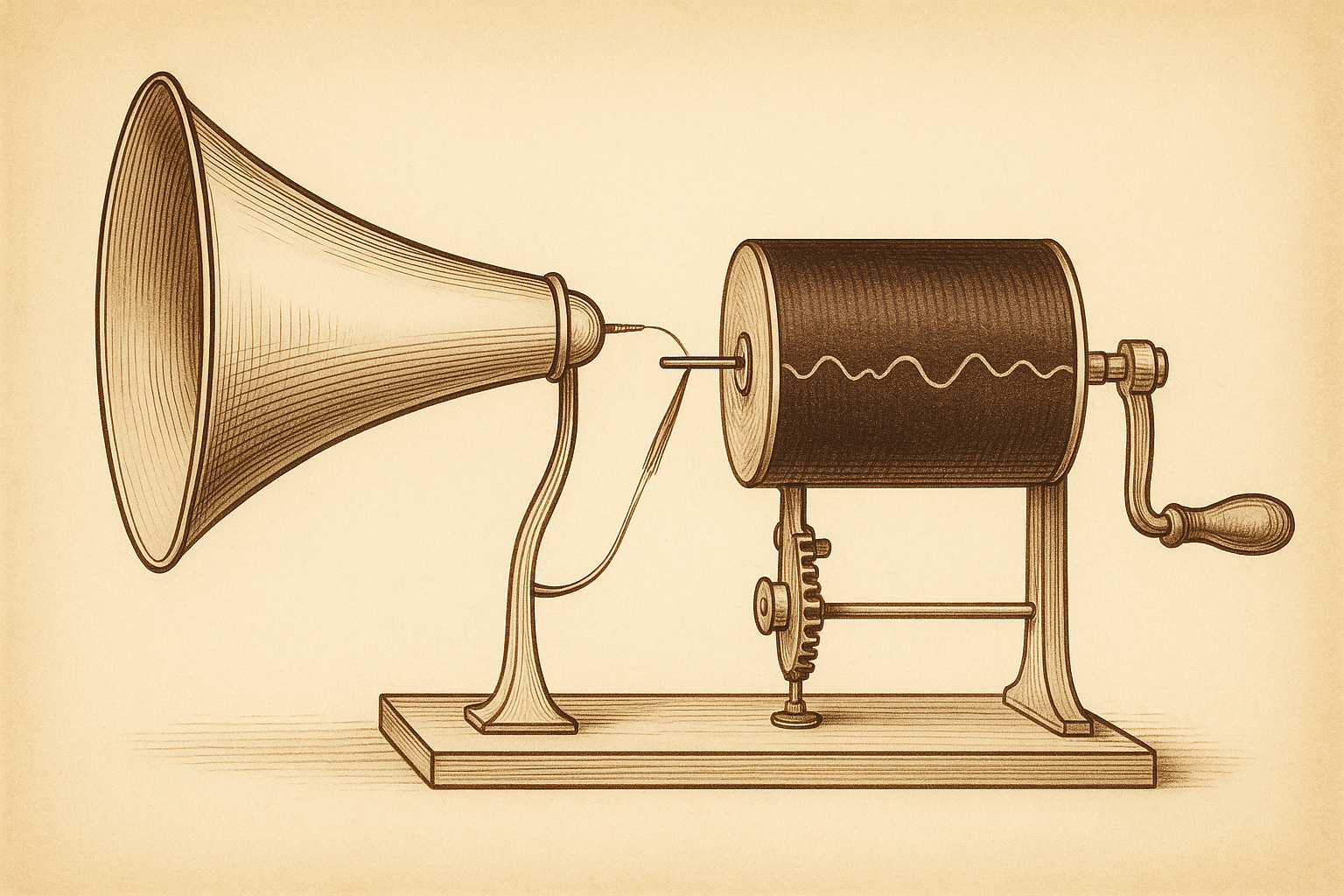
And here lies the great paradox of the invention: the phonautograph could record, but not play back. There was no way to turn that line in the soot back into sound. It was like writing letters in a language no one—not even their author—knew how to read aloud. Scott accumulated dozens of these traces between 1853 and 1860, deposited them with the French Academy of Sciences, and there they slept for nearly a century and a half.
"Au clair de la lune": twenty seconds from 1860
The most famous phonautogram is dated April 9, 1860. On it, a voice slowly hums a fragment of "Au clair de la lune," an old French folk song. It lasts only a few seconds, but it is the oldest surviving recording of a human voice singing: nearly two decades older than Edison's phonograph.
Scott never heard it. He died in 1879, embittered at watching Edison receive all the credit for "recording sound," convinced that he had gotten there first. And in a sense he was right: the difference is that his machine filed the voice away without being able to release it. Those blackened papers were messages hurled into the future, waiting for a technology that did not yet exist in order to be read.
The rescue: when the soot spoke again
The technology arrived in 2008. A group of audio historians gathered under the First Sounds project, led by David Giovannoni, located Scott's fragile papers in the Parisian archives. In collaboration with the Lawrence Berkeley National Laboratory in California, they never touched the originals: they scanned them optically at extremely high resolution.
Software then followed every oscillation of that trembling line drawn in 1860 and translated it back into sound waves. For the first time in history, the voice of a 19th-century person that could never have "truly" been recorded emerged from a drawing made in soot. It's the same conceptual leap—turning a physical trace into experience—that made it possible for the first cameras to capture light, except here what was captured was a vibration of air from 150 years ago.
The final twist: it wasn't a woman's voice
The first version released in 2008 sounded like a high voice, almost that of a girl or a young woman, floating ghostlike through time. It was a worldwide sensation. But there was a mistake.
Scott had taken the precaution of recording, alongside the voice, the vibration of a reference tuning fork so the speed could be calibrated. The researchers misread that frequency and played the phonautogram back at twice the correct speed. When the calculation was corrected in 2009—the tuning fork was 250 Hz, not 500—the "woman" vanished: it was in fact a man, probably Scott himself, singing slowly and deeply. The past had not only begun to sound again; we had to learn all over again how to listen to it properly.
Why this recording matters
Scott de Martinville's story rewrote the family tree of recorded sound. Edison remains the father of playback—the first to close the loop between recording and hearing again—but the first human being to fix a voice onto a physical surface was a forgotten typesetter who died believing himself a failure.
There is something deeply moving in those twenty seconds. They are proof that we sometimes create things whose true value is revealed only when we are no longer here: messages written for a future that did not yet know how to read them. Like the only known recording of the last castrato, this voice singing in the gloom of 1860 reminds us that history is not only something to be read: for one instant, against all odds, it can also be heard.
References
Categories
The books · born from this blog

Atahualpa con su abrigo de pelo de murciélago
y otras 49 historias verdaderas que parecen mentira
Available on Amazon
Tocar madera
Pequeña historia de las supersticiones que el mundo no ha podido soltar
Available on Amazon
100 futuros
Cien escenarios del mundo que viene con la inteligencia artificial
Available on AmazonYou may also like
The History of Zero: The Number We Took Ages to Accept
The history of zero: from a dot in an Indian manuscript to Brahmagupta's rules and the Florence ban. How we finally learned to write nothing down.
The Antikythera Mechanism: A 2,000-Year-Old Computer
The Antikythera mechanism is the oldest known analog computer: a bronze Greek machine, found in a shipwreck, that could predict eclipses 2,000 years ago.
Archimedes' Death Ray: Myth or Real Weapon?
Did Archimedes really set the Roman fleet ablaze with mirrors at Syracuse? What the ancient sources and the MIT and MythBusters experiments reveal.