
How a Lithium Battery Works and the 1% Myth
The lithium battery powers your phone and your electric car. Here is how it works inside and why the percentage you see is never quite exact.
The lithium battery is probably the piece of technology that rescues you most often each day without your giving it a thought: it powers the phone, the laptop, the wireless earbuds and the electric car. It is also the one that scares us most. Why does it sometimes jump from 20% to 5% all at once? Why does the phone hang on at 1% one day and shut off with no warning the next? The answer lies in two things almost nobody separates: how the battery works inside, and how the device guesses how much charge is left. Let's take both.
What is inside a lithium battery
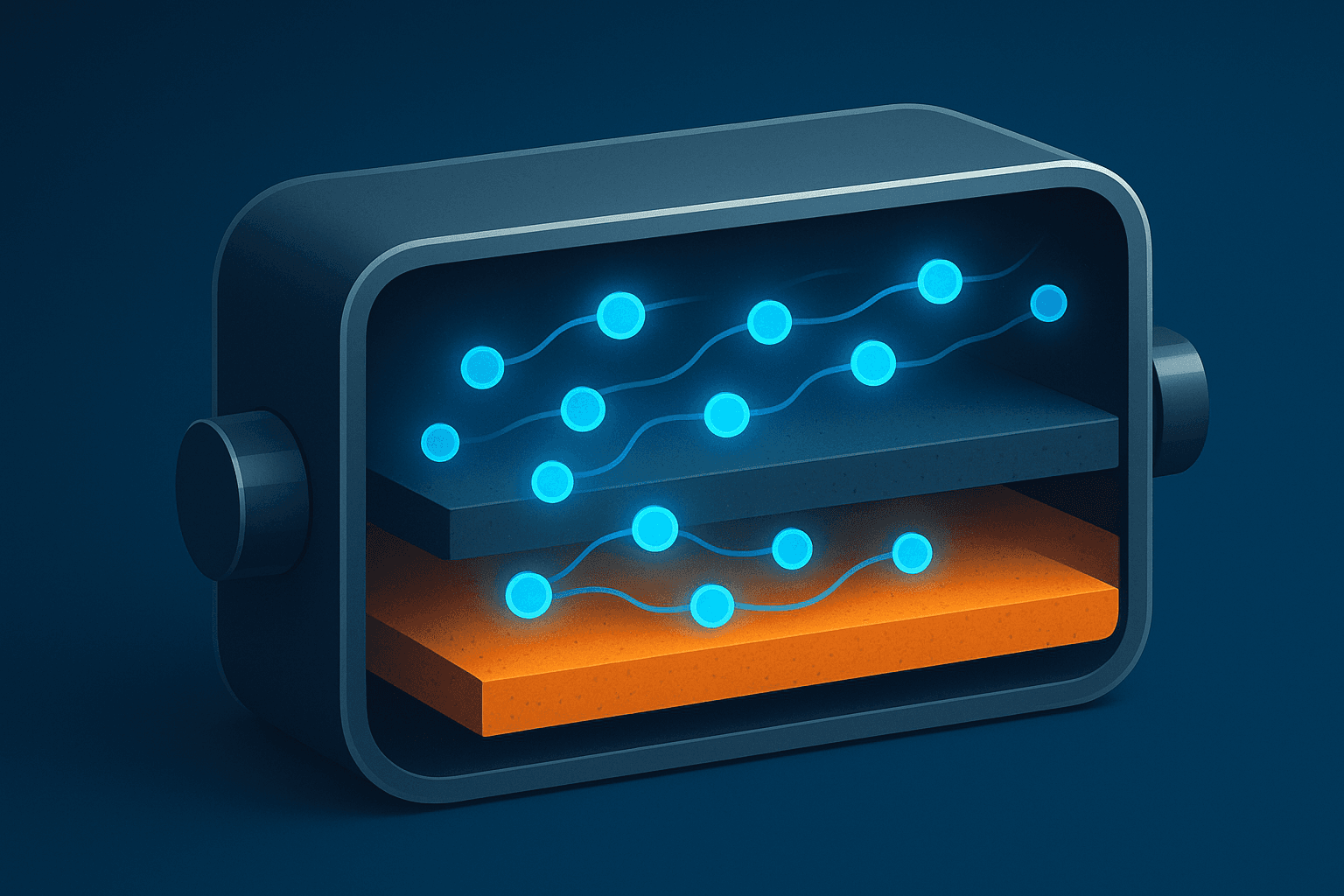
A lithium-ion (Li-ion) battery has four essential parts. Two electrodes: the anode, almost always made of graphite (a form of carbon), and the cathode, made of a lithium metal oxide. Between them sits an electrolyte —a lithium salt dissolved in an organic solvent— that lets ions through but not electrons. And a separator, a very thin sheet that keeps the two electrodes from touching and causing a short circuit.
The key word is lithium, the lightest metal on the periodic table, so light it floats on water. That lightness is exactly what made it ideal for storing a lot of energy in very little weight. If you're curious how this metal went from spa water and even a 7Up ingredient to powering the digital world, we tell that story in the history of lithium.
Ions coming and going: how energy is stored and released
A battery does not «hold electricity» the way a bucket holds water. What it does is shuttle lithium ions from one electrode to the other, and use that trip to push electrons through your device's circuit. Physicists call this back-and-forth intercalation: the ions slot in and out of the crystal structure of the electrodes, like books sliding on and off a shelf.
When the battery discharges (while you use the device), the lithium ions leave the graphite anode and travel through the electrolyte toward the cathode. At the same time the electrons —which cannot cross the electrolyte— take the long way around through the external circuit, and that current is what lights up the screen or spins the motor. When you charge it, the exact opposite happens: the external power source pushes the ions back from the cathode to the anode, ready for the next use.
That shuttling is reversible hundreds or thousands of times, which is why the battery is rechargeable. It is a very different kind of energy from ordinary disposable batteries, and also from the current that arrives at the wall socket, whose own story we tell in the war of the currents between Edison and Tesla.
Why the percentage you see is never exact
Here comes the big misunderstanding. The number in the corner of the screen is not a direct measurement, like the needle on a fuel gauge. It is an estimate, and the device works it out by one of two methods (or a mix of both).
The crudest is to measure voltage: as the battery discharges, its voltage drops, so you can link the voltage to the remaining charge. The trouble is that this relationship is not a straight line —the voltage stays nearly flat through much of the discharge and then plunges at the very end— and on top of that it shifts with cold and with the battery's age. That is why the most accurate phones use coulomb counting: a chip measures how much charge flows in and out and keeps a running tally, like a water meter.
That method is better, but not foolproof either. The small measurement errors keep piling up over time, so the tally drifts out of sync with the real charge. And there is a deeper problem: the percentage is calculated against the battery's total capacity, but that capacity shrinks over the years. An old battery reading «100%» may be holding far less energy than it did when new. That is why 1% on a three-year-old phone doesn't last as long as 1% did the day you bought it: the percentage is honest about the proportion, but it lies about the minutes.
Why your phone shuts off «before» 0%
When the phone reads 0% and shuts down, the battery is not empty. Manufacturers deliberately reserve a cushion of charge —on the order of 5 to 10%— below the zero they show you. That margin does two jobs: it leaves the device enough power to shut down in an orderly way and save its data, and above all it protects the battery.
The reason is chemical. Fully draining a lithium cell damages it permanently and speeds up its aging, so a small guardian circuit —the battery management system, or BMS— cuts the current when the voltage falls to a safe minimum, well before it reaches true empty. That cutoff, combined with how imprecise the estimate is at the tail end of the discharge, is what explains the erratic behavior of the last stretch: the phone that dies at 15% in the cold, or the one that hangs at 1% for ten minutes. It is not a fault; it is the system playing it safe.
How to actually take care of it: goodbye to the 1% myth
All of this leads to the practical advice, and it runs against an old habit. Lithium batteries have no «memory effect»: there is no need —and no benefit— to run them down to 0% before charging, as there was with the old nickel-cadmium ones. On the contrary: deep discharges below 20% stress them and raise their internal resistance.
The sweet spot is the so-called 20-80 rule: keep the charge between 20% and 80% whenever you can. In that band the cell works under less electrochemical stress, avoiding the two extremes that wear it out most: near 100%, side reactions and the dreaded plating of metallic lithium accelerate; near 0%, mechanical strain on the cathode. No need to obsess —charging to 100% now and then for a long trip ruins nothing— but as a habit, that middle range is what most extends the battery's life. It is the same logic of quiet efficiency behind how one USB-C cable charges fast and another doesn't: understanding what happens inside changes how you use it outside.
References
- «BU-204: How do Lithium Batteries Work?», Battery University. batteryuniversity.com
- «BU-903: How to Measure State-of-charge», Battery University. batteryuniversity.com
- «Why Lithium-Ion Batteries Last Longer at 20–80% SoC», EE Power. eepower.com
- «Lithium-ion battery», Wikipedia. en.wikipedia.org
Do you enjoy these everyday technologies almost nobody understands? Keep going with the history of lithium or explore the whole electronics section.
Categories
The books · born from this blog

Atahualpa con su abrigo de pelo de murciélago
y otras 49 historias verdaderas que parecen mentira
Available on Amazon
Tocar madera
Pequeña historia de las supersticiones que el mundo no ha podido soltar
Available on Amazon
100 futuros
Cien escenarios del mundo que viene con la inteligencia artificial
Available on AmazonYou may also like
How USB-C works and why one cable charges fast
All USB-C cables look the same, but they aren't: we explain the e-marker chip and why one charges at 240W while another barely reaches 15W.
How Apple's AirTag ACTUALLY Works
Apple's AirTag doesn't transmit over long distances like many believe; here's how it really finds lost items using BLE and a vast Find My network.
How to make a USB car charger (car) and how a DC voltage reducer works
When my car charger died, I took it apart to show how to build a USB car charger and how a DC voltage reducer works using the MC34063 chip.