
How Bluetooth Works and the Viking King Behind It
Bluetooth links your earbuds, car and keyboard with no cables. Here is how that invisible radio works and why it is named after a Viking king.
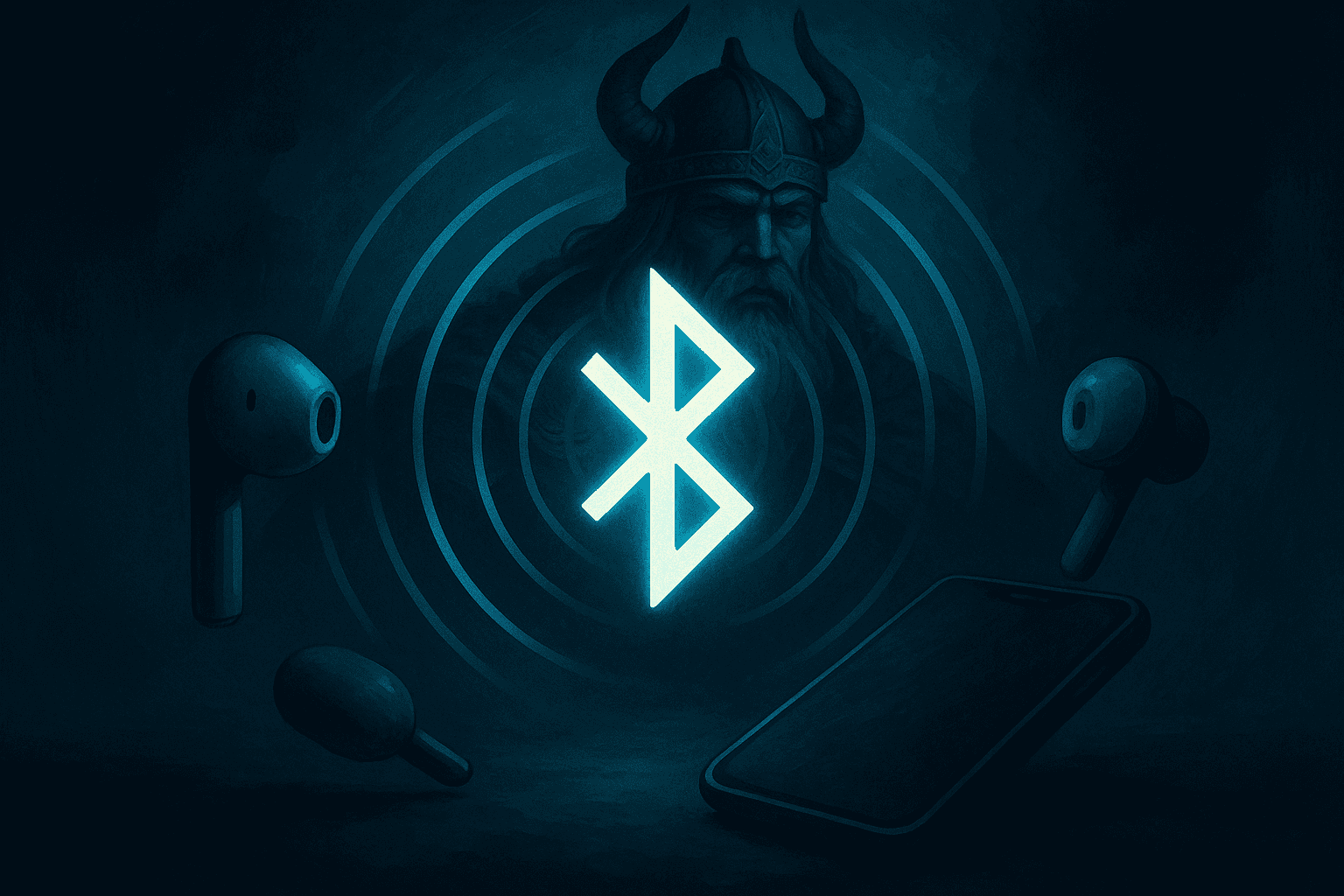
You take your earbuds out of the case and they just start playing. You get in the car and your phone links to the stereo without your touching a thing. You type on a keyboard that has no cable at all. Behind all those everyday gestures lies one discreet, almost magical technology: Bluetooth, a short-range radio so common that almost nobody stops to ask how it works… or why it has such a strange name. This is the story of both.
What Bluetooth actually is
Bluetooth is a form of short-range wireless communication designed to replace the cables between nearby devices: about 10 meters in the classic version, though in practice it works best within a few meters. It operates on the 2.4 GHz radio band, the same license-free strip used by WiFi, microwave ovens and cordless phones, and available almost everywhere without a permit.
The original goal was not to connect earbuds but something more modest: getting rid of the tangle of cables that hung off every phone and computer in the 1990s. An Ericsson engineer, Sven Mattisson, and his colleague Jaap Haartsen had been working since 1994 on a tiny, cheap radio that could link a phone to its accessories with no wire. Out of that project came what we now use a hundred times a day.
How it works: hopping frequencies a thousand times a second
Here is the clever part. The 2.4 GHz band is crowded: your home WiFi runs through it, so does the neighbor's, plus the microwave and any other nearby Bluetooth device. How does Bluetooth avoid drowning in that noise? With a trick called frequency hopping (frequency-hopping spread spectrum).
Instead of staying on a single channel, Bluetooth splits the band into 79 channels of 1 MHz each and keeps jumping between them up to 1,600 times per second, following a sequence that only the transmitter and receiver know in advance. If a channel is busy or full of interference, it doesn't matter: within a fraction of a second they have already hopped to another. Modern versions even learn which channels are congested and dodge them on purpose, which is called adaptive frequency hopping.
That constant dance does two things at once. It makes the connection robust against interference —that is why your earbuds don't cut out even with the WiFi maxed out— and it adds a layer of privacy, because anyone who doesn't know the hopping sequence hears only disconnected scraps of the signal. It is the same family of radio tricks that lets other nearby technologies, such as the NFC in cards and phones, work without stepping on each other.
From a Viking king to your pocket
And now the name. «Bluetooth» literally means «blue tooth», and it is not a marketing metaphor: it is the nickname of a real king. Harald Blåtand Gormsson ruled Denmark and Norway in the 10th century and went down in history for having united the Danish tribes under a single crown around the year 958. The nickname «blue tooth» came, by tradition, from a dead tooth of a dark, bluish-gray color that he carried in his mouth.
The link to the technology was born in a bar conversation. In 1996, while Intel, Ericsson and Nokia were trying to agree on a common standard, Intel engineer Jim Kardach went out for drinks with Ericsson's Sven Mattisson. Kardach, a history buff, had just been reading about the Vikings, and his colleague told him about The Longships, a novel set in Harald's Denmark. Kardach saw the perfect analogy: just as the king had united warring peoples, this radio would unite phones, computers and accessories from different makers. He proposed «Bluetooth» as a provisional code name for the project.
It was supposed to be temporary, an internal nickname until a commercial one was found. But the real chosen name never arrived in time, the code name stuck, and so a 21st-century technology ended up christened with the moniker of a monarch from the year 958. Even the logo is a tribute: that blue symbol you see on so many devices is really the merging of two runes from the Viking alphabet, ᚼ (Hagall) and ᛒ (Bjarkan), which are Harald Blåtand's initials.
From the first headset to AirPods
In May 1998, five companies —Ericsson, Intel, Nokia, Toshiba and IBM— founded the Bluetooth SIG, the non-profit group that has since defined how all Bluetooth devices should understand one another. The first product arrived in 1999: a hands-free headset that won an award at the COMDEX trade show. The first commercial phones with Bluetooth followed soon after, led by the Ericsson T39 in 2001.
From then on the technology kept improving. The Bluetooth Low Energy (BLE) version, introduced with the 4.0 specification in 2010, cut power use so dramatically that a sensor or a wristband could run for months on a watch battery: it is what today powers smartwatches, scales, toys and trackers like Apple's AirTag. The rise of wireless earbuds —the AirPods in 2016 and the whole wave that followed— finished turning Bluetooth invisible: it stopped being a feature you switched on by hand and became something that is simply there.
Why it sometimes fails (and why it is safe)
If Bluetooth is so robust, why does it sometimes cut out? Almost always for the same reason: the 2.4 GHz band is very crowded, and while frequency hopping helps, a running microwave or a dozen devices fighting for the air can degrade the signal. Range is deceptive too, because a wall or your own body is enough to weaken it. That is why the age-old advice —bring the devices closer, remove obstacles— really does work.
As for security, modern Bluetooth encrypts the communication and requires an explicit pairing before connecting two devices, which keeps just anyone from sneaking in. It is not infallible —vulnerabilities and attacks have existed— which is why it is wise to turn it off when not in use and never accept a pairing you did not start. But, like the USB-C connector, Bluetooth is one of those technologies we use without thinking precisely because they work so well they become invisible… except this one also carries the nickname of a Viking from the year 958.
References
- «Bluetooth», Wikipedia. en.wikipedia.org
- «Origin of the name», Bluetooth Technology Website. bluetooth.com
- «Harald Bluetooth», Wikipedia. en.wikipedia.org
- «A little history of Bluetooth: Everything you need to know», Android Authority. androidauthority.com
Do you enjoy these everyday technologies almost nobody understands? Continue with how NFC works or explore the whole technology section.
Categories
The books · born from this blog

Atahualpa con su abrigo de pelo de murciélago
y otras 49 historias verdaderas que parecen mentira
Available on Amazon
Tocar madera
Pequeña historia de las supersticiones que el mundo no ha podido soltar
Available on Amazon
100 futuros
Cien escenarios del mundo que viene con la inteligencia artificial
Available on AmazonYou may also like

How a Microwave Works, and Why Not from Inside Out
How does a microwave work? It doesn't cook from the inside out; it heats the water in your food. The story began with a melted chocolate bar.
How a Touchscreen Works
How does a touchscreen work? Your finger alters an invisible electric field in the glass. The story runs from the first 1965 prototype to the iPhone.
How GPS Works and Why It Knows Where You Are
Your phone's GPS pinpoints you thanks to satellites 20,000 km up and atomic clocks. Here is how that everyday magic actually works, step by step.